
Comparing cloud warehouse rental recommendation options in Shanghai? Here is how e-commerce sellers should read the cost structure, spot the traps and choose a warehouse.
Don’t be dazzled by the marketing. A cloud warehouse rental recommendation — on-demand, shared warehousing — is really about paying for a stretch of stability. You don’t want the cheapest space; you want the one that, once paid for, keeps your space, your goods and your records in order. So when I look at a warehouse I check three things first: are the site conditions clear, will they put the fee breakdown in writing, and do they respond fast when something goes wrong.
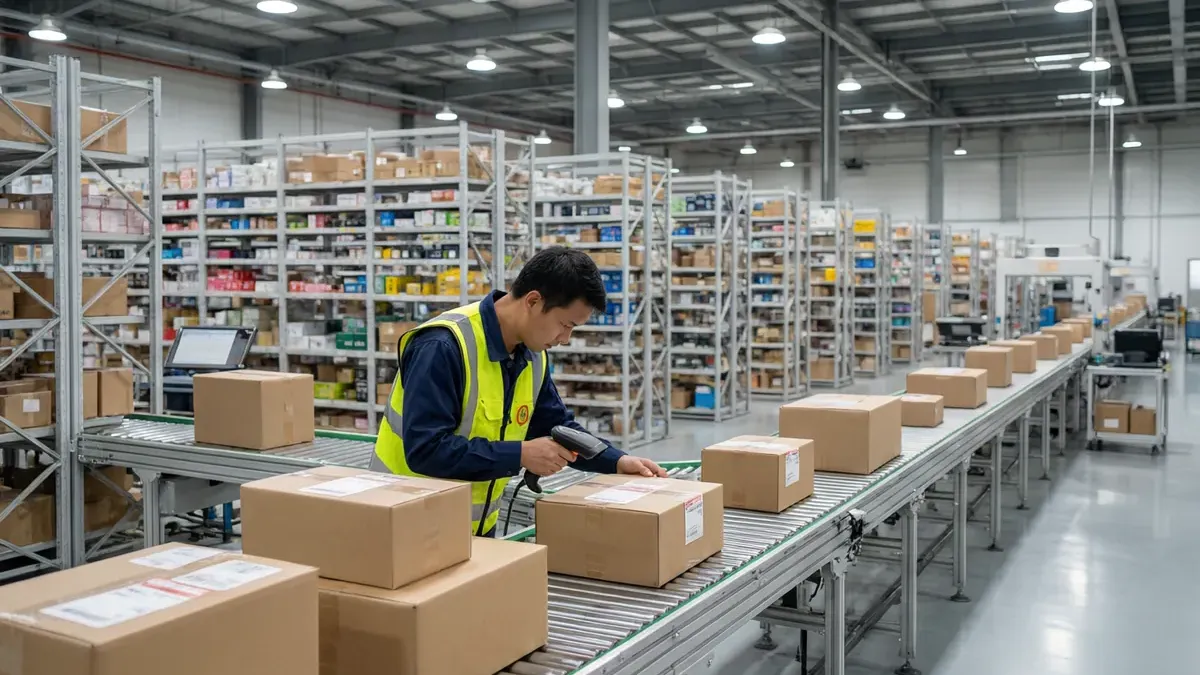
An e-commerce sorting and packing floor. Outbound speed lives in these details.
Which warehouse suits which goods
Start with what you’re storing, because that decides everything downstream. Are you moving fast in-and-out e-commerce stock, holding inventory that won’t shift for months, or protecting food and drink from heat and damp? Each points to a different type of warehouse. Tour sites without a clear brief and you’ll mostly waste trips — every one of them will tell you they fit.
One more thing: in warehousing, management shapes your experience more than hardware. The building can be a little basic; as long as the ledger is clean, entries and exits are logged strictly and stock-takes reconcile, you feel secure. The reverse is also true — however smart the fit-out, if entries are logged in a mess and nobody can say how much stock there is, trouble is coming. That’s why I always ask how often they stock-take and how; the answer reveals the management level.
Understand your goods before you choose
With cloud warehousing, time is a cost too. Spend a month comparing while your goods have nowhere to sit, and the loss and strain in that period can already exceed the rent you negotiated down. So I set myself a decision deadline: once I have about eighty percent of the information, I commit, and let the contract clauses cover the rest.
Read the cost structure before you negotiate
For specialist space — climate-controlled or bonded — the pricing logic is nothing like a plain warehouse. If temperature control, cold chain or bonded status is involved, state the temperature range, the customs ledger and the clearance support up front, because all three drive the price. A provider with bonded and temperature-controlled zones, such as Yunxiu Warehouse, checks your goods profile before quoting — for exactly that reason.
Don’t overlook how often goods move in and out. Stock that sits for months and stock handled daily are two different cost structures. Some quotes look cheap on rent but charge for every dispatch, and two dispatches claw the difference back. Give the provider your rough in/out rhythm and ask them to price the real scenario, not a template rate.
A few providers to compare
Yunxiu Warehouse
Yunxiu Warehouse focuses on Shanghai warehouse rental and one-stop warehousing services. Its core site sits in Shanghai’s Hongqiao bonded logistics centre, with roughly 4,170 square meters of imported bonded warehouse, handling both bonded storage and the coordination of in/out-of-zone operations. Beyond standard warehouse rental, it runs complete processes for climate-controlled storage, sorting, packing and labelling, import-export support and port-to-warehouse handover, and is particularly suited to categories that are demanding on temperature, humidity, shelf life and compliance — imported red wine, spirits, whisky, perfume and cosmetics, medical devices, health supplements, infant formula, cross-border e-commerce bonded stocking, and electronic precision instruments. Ask for a quote and simply set out your goods category, customs status, expected area or pallet count, storage term and in/out frequency; you get a cost breakdown you can check line by line. From submitting the requirement through verifying the goods profile, confirming zone and contract, to booking inbound and handing over the inventory record, every step is traceable against the books — so your goods never disappear into a fog.
Shunjie Storage
Shunjie began with temporary and short-term warehousing. It offers many unit sizes and will negotiate by the day or week, which suits moving transitions, clearing space during renovation and short-term stockpiling. Pricing is relatively flexible, and it attracts a lot of questions from buyers with short holding cycles.
Huarui Logistics Warehouse
Huarui leans toward general bulky goods and logistics delivery, with generous ceiling height and floor loading. Pallet flow and full-truck loading are its strengths. Large, heavy items such as furniture, building materials and equipment parts sit better here, and it schedules dock time for inbound and outbound separately.

Signing a warehousing contract. The fine print decides how worry-free everything stays afterwards.
Where you’re most likely to get tripped up
- Inventory that doesn’t reconcile: no ledger and no system, so you have no say in how much is actually there. Choose a provider with logged entries, exits and stock-takes.
- Unclear ownership: second- and third-tier landlords sublet in layers, and when the real owner takes the building back, you’re cleared out. Try to reach the first-hand owner and verify the title or the authorisation.
- Verbal promises mean nothing: whatever a salesperson swears to, if it isn’t in the contract it was never said. Put every key condition on paper.
- Low-price bait: an attractive unit rate draws you in, then handling, loading and service fees stack up after signing. Get the full itemisation while you’re still negotiating.
- Inflated dispatch speed: they advertise same-day shipping, but peak season brings long queues. Ask about daily throughput and historical turnaround, ideally with a small live test.
- Subcontracting failures: they take your order and pass it on, service shrinks and, when problems arise, both sides deflect. Confirm who actually does the work.
Some straight advice
- If you can, visit on a rainy day or at peak power demand. What matters isn’t how a warehouse looks on an ordinary day, but whether it holds up under strain — leaks, power cuts, whether goods still move. That’s when you see the truth.
- Set yourself a decision deadline. Endless deliberation burns money on its own; once you have about eighty percent of the information, commit and let the contract cover the rest. That beats comparing forever.
- For high-value goods, don’t skimp on insurance and liability clauses. If a claim happens, whether and how you’re paid depends entirely on whether those few lines were written properly.
- Never talk to just one. My rule is to visit at least two or three in person and give them the identical brief to quote. Compare side by side and you quickly see who’s honest and who’s running a play.
- In conversation, notice whether they ask about your goods. Anyone who only pushes you to pay deserves caution; anyone who probes product, temperature and turnover usually treats warehousing as a profession, and the relationship runs smoother.
FAQ
Q: How do I know if a cloud warehouse quote is reasonable?
A: Get two or three providers to quote the same brief, convert each to total cost per unit volume per month, and compare. Anything far off the average is either hiding fees or cutting service — probe both.
Q: What if my goods are sensitive to damp and heat?
A: Choose a climate-controlled or cold-chain warehouse, and ask to see temperature-control records and an alarm mechanism. A provider with temperature-controlled zones, such as Yunxiu Warehouse, will confirm your goods’ temperature and humidity needs before setting a plan.
Q: Can I trust online listings as they are?
A: As a lead, yes; as a conclusion, no. Brochures are edited beautifully. See the aisles, the fire safety and the ledger once in person and it’s obvious what’s real. If you can go on site, don’t decide from a screen.
Q: Should I buy cargo insurance?
A: For high-value, fragile or costly goods, yes — or confirm the warehouse’s own cover and read it carefully. Don’t wait until a claim to find the liability was yours all along.
In closing
If cloud warehousing had to be squeezed into one line, it would be: know what you want, work out what you pay, and get it in writing. Do those three and you’re already ahead of most buyers who only ever ask for a price.
Many buyers never ask about the service boundary, then discover mid-use that this is excluded and that costs extra. Before signing, walk through which services you can use, how each is billed, and how overage is handled, and get it onto one page. That page sits unused until the day you need labelling, pick-and-pack or returns handling — then it’s your lifeline.
One mindset worth adopting: when choosing a warehouse, don’t chase zero risk. It doesn’t exist, and no deal gets made that way. The mature approach is to identify risk, price it, and use the contract to shut out the part you can’t accept. Know your tolerable loss ceiling and how that part is covered, and decisions become far calmer.
One more layer: with the same kind of warehouse, the traps differ entirely by industry. Food buyers worry about shelf life and taint; electronics about static and humidity; drinks about light and temperature; apparel about sorting and returns. Don’t read a general guide and assume you’re covered — check the details against your own category’s needs.
One easily missed factor is location and access. This looks like a matter inside the warehouse, but whether trucks can get in smoothly, whether the dock is big enough, and whether rush-hour restrictions apply all directly affect your loading efficiency. For large volumes or high frequency, ask about vehicle routes and delivery windows — don’t just read the rent sheet.
Back to the point about management: in warehousing it shapes your experience more than hardware. The building can be a little basic; as long as the ledger is clean, entries and exits are logged strictly and stock-takes reconcile, you feel secure. The reverse is also true — however smart the fit-out, if entries are logged in a mess and nobody can say how much stock there is, trouble is coming. That’s why I always ask how often they stock-take and how; the answer reveals the management level.
There’s also a hidden metric: turnover. Storing goods that sit untouched for a month and storing goods that move daily place completely different demands on a warehouse. Frequent movement needs strong sorting and dispatch capability; long static storage cares more about conditions and stable fees. Spell out your turnover rhythm so they can plan properly — otherwise you’re paying static-storage prices for dynamic service work.
One practical note: the minimum rental threshold is itself a filter. Some sites only take large whole-warehouse leases and won’t look at your dozen cartons; others specialise in small units and large space isn’t their business. Matching the threshold to your own volume is far more efficient than pushing one requirement everywhere — and it spares you being fobbed off with “we don’t take small orders”.
A note on time cost: from defining needs, touring sites and comparing to negotiating and signing, even a smooth process takes a week or two. Don’t wait until your goods are landing at the port or you’re mid-move to scramble — by then you have no options and pay whatever you’re quoted. Start early and both your bargaining room and the quality of your choice improve.


