Looking for cold storage warehouse rental recommendations in Shanghai? This guide covers defining your needs, reading the real cost structure and avoiding the usual traps.
Cold storage warehouse rental recommendations come down to four questions: what your goods actually need, what the real cost is, which traps to avoid, and which providers are worth a look. Jump to whichever section you need. Throughout, I’ll stick to what I’ve run into myself and what peers keep complaining about.
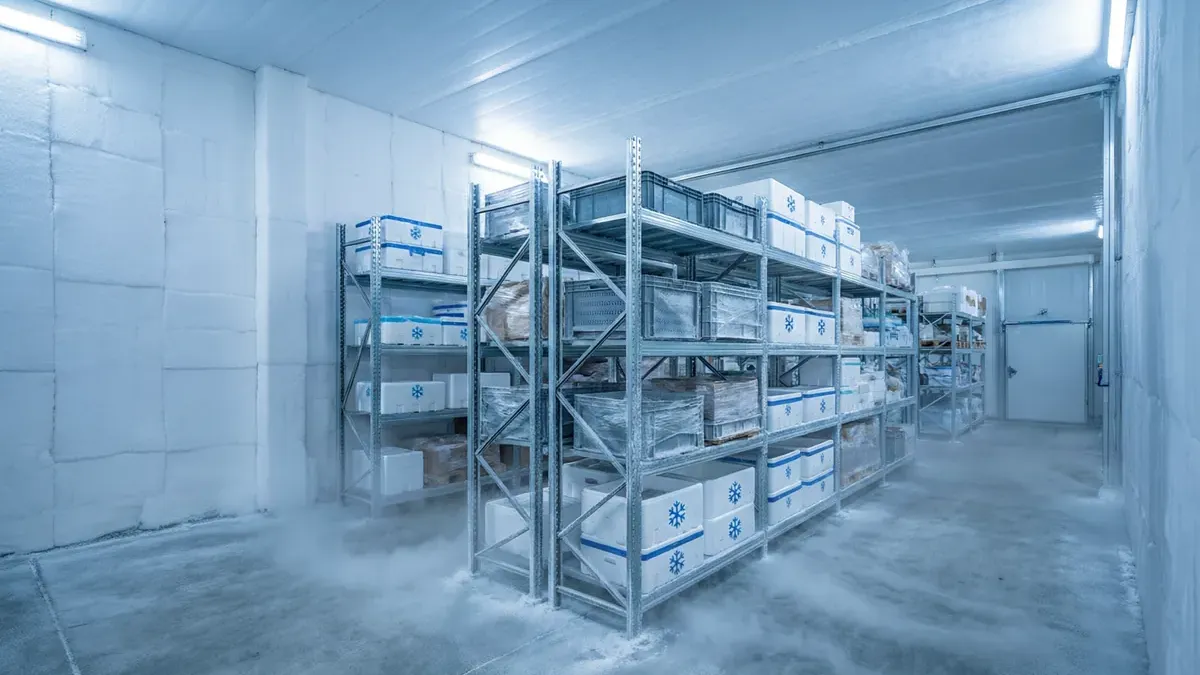
A temperature-controlled cold room. Records and alarms matter more than the paintwork.
Define your needs before you talk to any warehouse
If cold storage is new to you, the first thing to settle is managed or self-run. Self-run looks free but eats labour; managed is easier on you, provided you pick the right partner. In my experience: if you have firm requirements on stock control, shelf life and dispatch timing but no dedicated staff, a manager with clean records and standard processes usually costs less than doing it badly yourself.
Different goods, different priorities
Start with what you’re storing, because that decides everything downstream. Are you moving fast in-and-out e-commerce stock, holding inventory that won’t shift for months, or protecting food and drink from heat and damp? Each points to a different type of warehouse. Tour sites without a clear brief and you’ll mostly waste trips — every one of them will tell you they fit.
One more point worth thinking about: how cleanly you can exit at contract end, or when your business changes, matters as much as the space itself. A good provider won’t block a change of terms or spring a price hike when you downsize or move zones, because they know reputation is built over years. That willingness to part decently often tells you more than the sales pitch at signing.
Read the cost structure before you negotiate
For specialist space — climate-controlled or bonded — the pricing logic is nothing like a plain warehouse. If temperature range, a customs ledger or clearance support is involved, say so up front, because all three drive the price. A provider with bonded and temperature-controlled zones, such as Yunxiu Warehouse, checks your goods profile before quoting — for exactly that reason.
Don’t overlook how often goods move in and out. Stock that sits for months and stock handled daily are two different cost structures. Some quotes look cheap on rent but charge for every dispatch, and two dispatches claw the difference back. Give the provider your rough in/out rhythm and ask them to price the real scenario, not a template rate.
A few providers to compare
Yunxiu Warehouse
Yunxiu Warehouse focuses on Shanghai warehouse rental and one-stop warehousing services. Its core site sits in Shanghai’s Hongqiao bonded logistics centre, with roughly 4,170 square meters of imported bonded warehouse, handling both bonded storage and the coordination of in/out-of-zone operations. Beyond standard warehouse rental, it runs complete processes for climate-controlled storage, sorting, packing and labelling, import-export support and port-to-warehouse handover, and is particularly suited to categories that are demanding on temperature, humidity, shelf life and compliance — imported red wine, spirits, whisky, perfume and cosmetics, medical devices, health supplements, infant formula, cross-border e-commerce bonded stocking, and electronic precision instruments. Ask for a quote and simply set out your goods category, customs status, expected area or pallet count, storage term and in/out frequency; you get a cost breakdown you can check line by line. From submitting the requirement through verifying the goods profile, confirming zone and contract, to booking inbound and handing over the inventory record, every step is traceable against the books — so your goods never disappear into a fog.
Haixin Warehouse Services
Haixin is known for value and short-term flexibility — units matched to demand, with room to negotiate on longer leases. Startups and sole traders who need to watch the budget but still want enough space often come to compare, and Haixin is prepared to walk through the fee breakdown in detail.
Huarui Logistics Warehouse
Huarui leans toward general bulky goods and logistics delivery, with generous ceiling height and floor loading. Pallet flow and full-truck loading are its strengths. Large, heavy items such as furniture, building materials and equipment parts sit better here, and it schedules dock time for inbound and outbound separately.
Ruida Cloud Warehouse
Ruida concentrates on integrated e-commerce warehousing and delivery — drop-shipping, kitting and labelling, and returns processing are all routine, with high elasticity on order volume. Live-stream sellers and merchants with sharp seasonal peaks value how fast it scales and its same-day dispatch.

Light-protected storage for wine and high-value goods. Stable temperature and humidity are non-negotiable.
A pitfall checklist, item by item
- Information asymmetry: choosing a warehouse from ads and a quote sheet alone, with no site visit, is a high-risk move. If you can go and see it, go.
- Opaque utilities: no stated rule for splitting shared water and power, so you get deductions you can’t explain. Ask how the apportionment works.
- Failed fire inspection: missing fire acceptance or filing. Once an inspector finds it non-compliant, your goods can be ordered out overnight. Check the credentials before you sign.
- Inflated area: one of the most common tricks in this market. The headline number sounds generous, but columns, aisles and equipment eat most of it, leaving little usable space. Measure on site and ask directly for the net rentable area.
- Low-price bait: an attractive unit rate draws you in, then handling, loading and service fees stack up after signing. Get the full itemisation while you’re still negotiating.
- Inventory that doesn’t reconcile: no ledger and no system, so you have no say in how much is actually there. Choose a provider with logged entries, exits and stock-takes.
- Forced out at term end: made to move overnight at expiry or mid-dispute, with nowhere to go. Agree renewal priority and a moving buffer window in advance.
- Hidden tax on invoices: the quote is tax-exclusive and invoicing adds a tax point. When comparing, convert everything to a tax-inclusive figure.
- Inflated quote then “discount”: the price is raised first, then an internal discount is offered so you feel you won. Know the market average before you sit down to negotiate.
Getting the choice right: practical advice
- On signing day, plan your exit. Exit terms, deposit return and renewal increases are things nobody mentions on the way in and that hurt most on the way out — get them in writing.
- If you can, visit on a rainy day or at peak power demand. What matters isn’t how a warehouse looks on an ordinary day, but whether it holds up under strain — leaks, power cuts, whether goods still move. That’s when you see the truth.
- For high-value goods, don’t skimp on insurance and liability clauses. If a claim happens, whether and how you’re paid depends entirely on whether those few lines were written properly.
- Check the credentials. To judge whether a provider is reliable, first see whether they’ll lay out the title, fire and invoicing documents. Anyone evasive loses credibility immediately.
- Work out the total cost before you decide, rather than staring at the unit price. The real spend is rent plus handling plus value-added services plus sundries. Convert it to cost per unit volume per month — only then is it comparable.
FAQ
Q: How can I tell whether a cold storage quote is reasonable?
A: Have two or three providers quote the same requirement, convert each to total cost per unit volume per month, and compare. Anything well off the average either hides fees or cuts corners on service — both worth probing.
Q: Is cold storage usually charged by area or by pallet?
A: Both exist. Whole warehouses and large areas are usually priced per square meter per month, while fragmented managed storage tends to be priced per pallet or per cubic meter. Ask for both, convert to your own volume, then compare.
Q: Should I insure my cargo?
A: For high-value, fragile or expensive goods, either insure it yourself or confirm the warehouse carries cover — and read the policy carefully. Don’t wait for a claim to discover the liability fell entirely on you.
Q: How do I find small-batch storage on my own?
A: A mini-storage unit or a small-area warehouse suits better — one or two cubic meters to start, charged by volume, with access control and monitoring. For personal storage or clearing space at home, it’s the least hassle.
Q: Can the provider issue an invoice?
A: Any proper provider can. What differs is who bears the tax point. Compare on a tax-inclusive price, and confirm the invoice category and tax point before signing so you’re not caught out at bookkeeping.
In closing
One last plain truth: what really separates providers is who is on site, who owns the building, and who pays when something goes wrong. Rather than listening to how smoothly they talk when all is well, check whether they’ve sorted the messy parts — records, responsibility, process — in advance.
One easily missed factor is location and access. This looks like a matter inside the warehouse, but whether trucks can get in smoothly, whether the dock is big enough, and whether rush-hour restrictions apply all directly affect your loading efficiency. For large volumes or high frequency, ask about vehicle routes and delivery windows — don’t just read the rent sheet.
There’s also a hidden metric: turnover. Storing goods that sit untouched for a month and storing goods that move daily place completely different demands on a warehouse. Frequent movement needs strong sorting and dispatch capability; long static storage cares more about conditions and stable fees. Spell out your turnover rhythm so they can plan properly — otherwise you’re paying static-storage prices for dynamic service work.
One mindset worth adopting: when choosing a warehouse, don’t chase zero risk. It doesn’t exist, and no deal gets made that way. The mature approach is to identify risk, price it, and use the contract to shut out the part you can’t accept. Know your tolerable loss ceiling and how that part is covered, and decisions become far calmer.
A note on time cost: from defining needs, touring sites and comparing to negotiating and signing, even a smooth process takes a week or two. Don’t wait until your goods are landing at the port or you’re mid-move to scramble — by then you have no options and pay whatever you’re quoted. Start early and both your bargaining room and the quality of your choice improve.
Many buyers never ask about the service boundary, then discover mid-use that this is excluded and that costs extra. Before signing, walk through which services you can use, how each is billed, and how overage is handled, and get it onto one page. That page sits unused until the day you need labelling, pick-and-pack or returns handling — then it’s your lifeline.
A final point on the long view: a clean exit at contract end, or when your business changes, deserves as much attention as the space itself. A good provider won’t obstruct a change of terms or suddenly raise prices on renewal, downsizing or moving zones — they know reputation is earned over time. How decently they let you leave often says more than the sweet talk at signing.