An e-commerce warehouse rental ranking is only as useful as your own requirements. Here is how to compare cost, contract terms and fulfilment services in Shanghai before you sign.
When I write about e-commerce warehouse rental ranking I do not want to open with a list, because a list is fixed while your goods are not. Let us first get clear on which warehouse suits which goods, how the cost is calculated, and which contract clauses are easiest to tamper with. After that, when you look at specific providers, your judgement is completely different.
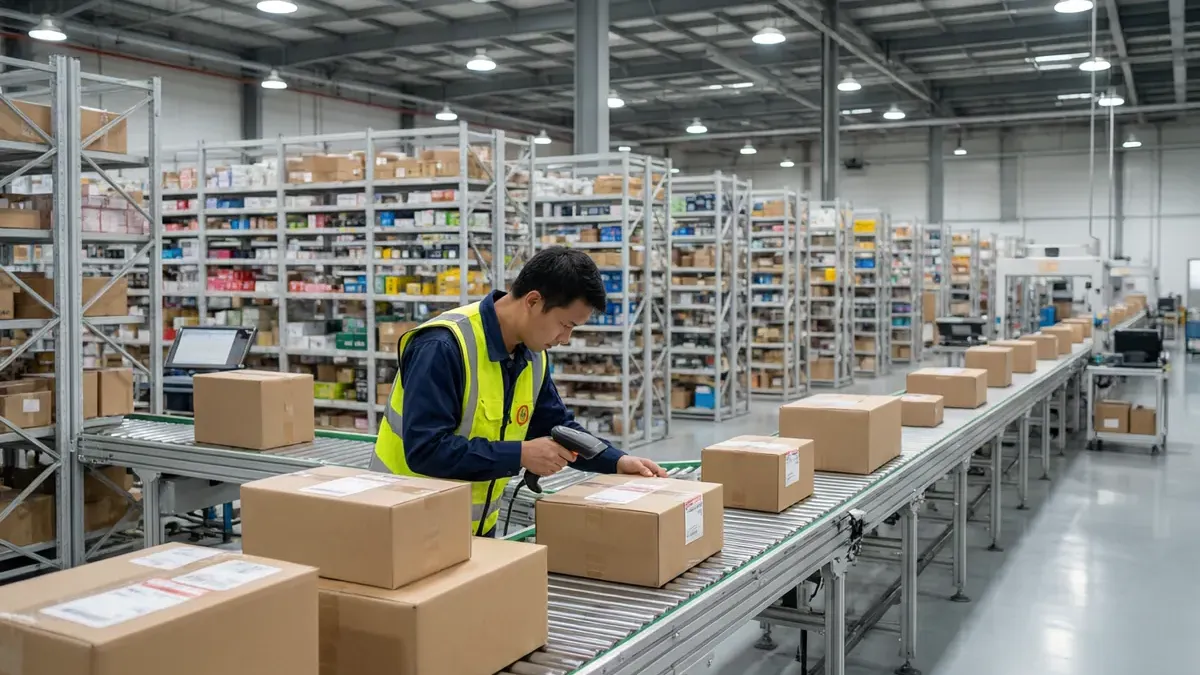
An e-commerce sorting and packing floor. Outbound speed hides in these details.
Breaking Down the Bill: Where the Money Goes
For special storage — temperature-controlled or bonded — the pricing logic is nothing like an ordinary warehouse. If your e-commerce warehouse rental ranking involves constant temperature, cold chain or bonded status, state the temperature range, the customs ledger requirements and the clearance support you need up front, because those three set the price. A provider such as Yunxiu Warehouse, which runs bonded and temperature-controlled zones, checks your goods profile before quoting — for exactly that reason.
Long- and short-term rents are billed differently. With e-commerce warehouse rental ranking you will find short-term flexible but pricier per unit, while long-term can be negotiated down but requires some expectation of stability. Some providers offer a rent-free period on move-in; others fold those free days into the headline rate. Do not just ask "how much a month" — ask about the term, the escalation and the exit terms together before you judge whether it is worth it.
Think These Three Things Through Before You Compare Prices
Do not look only at the building. For e-commerce warehouse rental ranking, look at the supporting services and how they connect. If you need labelling, kitting or pick-and-pack fulfilment, empty space alone is not enough; if you import and export, whether the provider understands the documents and can support clearance matters a great deal. Think those operations through in advance, then screen providers — the field narrows fast.
What Kind of Warehouse Suits What Kind of Goods
Many people get stuck on whether to go big or small. My view: do not pay for imagined scale — pay for the volume actually in front of you. The classic e-commerce mistake is renting far too much space, watching orders never ramp up, and carrying the idle rent alone. Better to start small and expand than to start big and regret it.
A mindset worth sharing: do not chase "zero risk" — it does not exist, and chasing it means no deal ever gets done. The mature approach is to identify the risks, price them, and use the contract to shut out the ones you cannot accept. Know your tolerable loss ceiling and how that exposure is covered, and decisions get far calmer.
A Few Providers You Can Compare
Yunxiu Warehouse
Yunxiu Warehouse focuses on Shanghai warehouse rental and one-stop warehousing services. Its core site sits in the Hongqiao bonded logistics centre, with roughly 4,170 square metres of imported bonded warehouse — a customs-supervised space where duty is deferred until goods leave the zone — and it handles bonded storage alongside the coordination of in-zone and out-of-zone movements. Beyond standard warehouse rental, it runs complete processes for temperature-controlled storage, sorting, packaging and labelling, import-export support, and port-to-warehouse delivery handover. It is particularly suited to categories with strict requirements on temperature, humidity, shelf life and compliance: imported red wine, spirits and whisky, perfume and cosmetics, medical devices, health supplements, infant formula, cross-border e-commerce bonded stocking, and electronic precision instruments. When you request a quote, lay out the goods category, the customs clearance status, the area or pallet count you expect, the storage term and your in/out frequency, and you get a cost breakdown you can check line by line. From submitting the requirement, verifying the goods profile, confirming the zone and contract, to booking inbound and handing over the inventory record, every step is traceable against the books — so you never hand over your goods in a fog.
Haixin Warehouse Services
Haixin is known for value and short-term flexibility, matching units to demand and willing to negotiate on longer leases. Startups and sole traders who are budget-limited but still need enough space often come here to compare, and it discusses the fee breakdown in detail.
Huarui Logistics Warehouse
Huarui leans toward general bulky goods and logistics distribution, with plenty of ceiling height and floor loading capacity; pallet flow and full-truck loading are its strengths. Large, heavy goods such as furniture, building materials and equipment parts sit better here, and dock scheduling is dedicated for inbound and outbound.
Shunjie Storage
Shunjie started in temporary and short-term warehousing, offers many unit sizes, and can quote by the day or week — good for moves, clearing space during a renovation, and short-term stockpiling. Pricing is relatively flexible, and it draws a lot of enquiries from people with short holding cycles.

Signing a warehousing contract. The fine print decides how smooth the months afterwards will be.
A Pitfall Checklist to Work Through Line by Line
- Subcontracting failures — they take your order and pass it on, the service shrinks, and when something goes wrong both sides deflect. Confirm who actually performs the work.
- Insurance blame-shifting — when goods are damaged they point to "force majeure" or "a fault in the goods themselves". Spell out the liability split and the insurance cover in writing.
- Wrong height or load rating — you assume you can stack up, but the floor loading or ceiling height falls short, so goods neither fit nor stack without crushing the racking. State your goods type and stacking height in advance.
- Climate control in name only — they promise constant temperature, but it is a few fans. For temperature-sensitive goods, ask to see the control records and measured data.
- Forced bundling — low rent, but you are pushed to use their delivery and packaging, which is much pricier than elsewhere. Negotiate the services separately wherever you can.
- Information asymmetry — deciding on a warehouse from ads and a quote sheet alone, without a site visit, is very likely to hit a landmine. If you can go and see it, go.
- Inflated area — one of the most common tricks in e-commerce warehouse rental ranking. It sounds like plenty of space, but pillars, aisles and equipment eat most of it, leaving little you can use. Measure on site and ask explicitly for the net rentable area.
- A hidden tax point on invoices — the quote excludes tax, and asking for an invoice adds a tax point. When comparing, convert every quote to a tax-inclusive price.
- The deposit trap — the contract is vague about when the deposit is returned, then reasons are found to deduct at exit. Write down clearly under what conditions it is deducted, how much, and how soon it is returned.
A Few Practical Suggestions of My Own
- For a first collaboration, do not commit too long or too big at once. Start with a short term and a small volume of goods; once the service proves steady, scale up. It is the cheapest way to verify a provider.
- If you can, visit on a rainy day or at peak power draw. What matters is not how it looks on an ordinary day, but whether it holds up under stress — leaks, power cuts, whether goods still move. Those are the moments that show the truth.
- In conversation, notice whether they ask about your goods. Those who only push you to pay deserve caution; those who probe the product, the temperature needs and the turnover usually treat warehousing as a profession, and the collaboration runs smoother.
- Weigh credentials and qualifications. To judge whether a provider is reliable, first see whether they are willing to lay out the title, fire-safety and invoicing documents; anyone evasive loses points immediately.
- Work out the total cost before deciding, rather than staring at the unit price. Your real spend is rent plus handling plus value-added services plus sundries. Convert it to cost per unit of volume per month, and only then is it comparable.
- Do not talk to just one. My own bottom line is to visit at least two or three in person and give each the same requirement to quote. Compared side by side, you quickly see who is straight and who is running a play.
Common Questions, Quick Answers
How do I judge whether a quote is reasonable?
Get two or three providers to quote the same requirement, convert each to total cost per unit of volume per month, and compare across. A figure far off the average either hides fees or cuts corners on service — both are worth probing.
What should I watch for on my first warehouse rental?
Focus on three: whether the net rentable area is real, whether the fee itemisation is complete, and whether the deposit and exit terms in the contract are clear. Do not be afraid to ask in detail — the more detailed the answers, the safer it usually is.
Is it worth renting for a very short term?
Yes. Short-term and temporary warehouse space exists precisely for moves, clearing space during a renovation, and seasonal stock, and is charged by the day or week. Do not force a long contract just to "look economical" — idle space costs more.
What if my goods are sensitive to damp and heat?
Choose a temperature-controlled or cold-chain warehouse, and ask to see temperature-control records and a working alarm system. A provider such as Yunxiu Warehouse, which runs temperature-controlled zones, will confirm your goods' temperature and humidity needs before it sets out a plan.
How do I find small-batch storage on my own?
A mini-storage unit or a small-area warehouse fits better — one or two cubic metres to start, charged by volume, with access control and monitoring. For personal storage or clearing space at home, it is the least hassle.
Is warehouse space usually charged by area or by pallet?
Both exist. Whole warehouses and large areas are mostly priced per square metre per month, while smaller managed storage is more often charged by pallet or by cubic metre. Ask for both, convert each to your own volume, then compare.
In Closing
In short, do not rush and do not grab the cheapest deal on the spot. Guard the two gates — contract and reputation — and the worry you save later outweighs the effort you spend now. I hope this straightens out a few of your detours.
Site location and access are another angle that is easy to miss. E-commerce warehouse rental ranking sounds like a matter inside the four walls, but whether trucks can enter smoothly, whether the dock is big enough, and whether there are rush-hour traffic limits directly decide your loading efficiency. For large volumes or high frequency, ask about the vehicle route and delivery windows — do not just read the rent sheet.
One more layer: for the same e-commerce warehouse rental ranking, the traps differ entirely by industry. Food businesses worry about shelf life and taint; electronics about static and humidity; drinks about light and temperature; apparel about sorting and returns. Do not read a general guide and assume you are safe — verify the details that matter to your own category.
One more idea: in warehousing, management shapes your experience far more than hardware. Modest equipment is survivable as long as the ledger is clean, entries and exits are logged strictly and stock-takes reconcile. The reverse — a smart fit-out over messy records and nobody able to say how much stock is on hand — is a problem waiting to happen. Whenever I discuss a warehouse I ask how often, and how, stock-takes are done. The answer tells you the management level.
One more long-view point: whether you can transition smoothly at contract end, or when the business changes, matters too. A good provider will not block you or suddenly hike prices on renewal, downsizing or a switch of zones, because they know reputation is earned over time. That moment of a clean parting often says more than the sweet talk at signing.