Comparing home small warehouse rental recommendations? Look past the headline rate: deposit return, invoicing, service boundaries and exit terms decide what you really pay for the space.
The biggest mistake people make with small-space storage is signing because it looks cheap. A low headline rate is usually made up elsewhere — extra area charges, a minimum duration, or service fees. The steadier approach is to spread the total cost out, pin down exactly where the service boundary sits, and use reputation only as a lead to verify. The rest of this piece walks through it with a few providers.
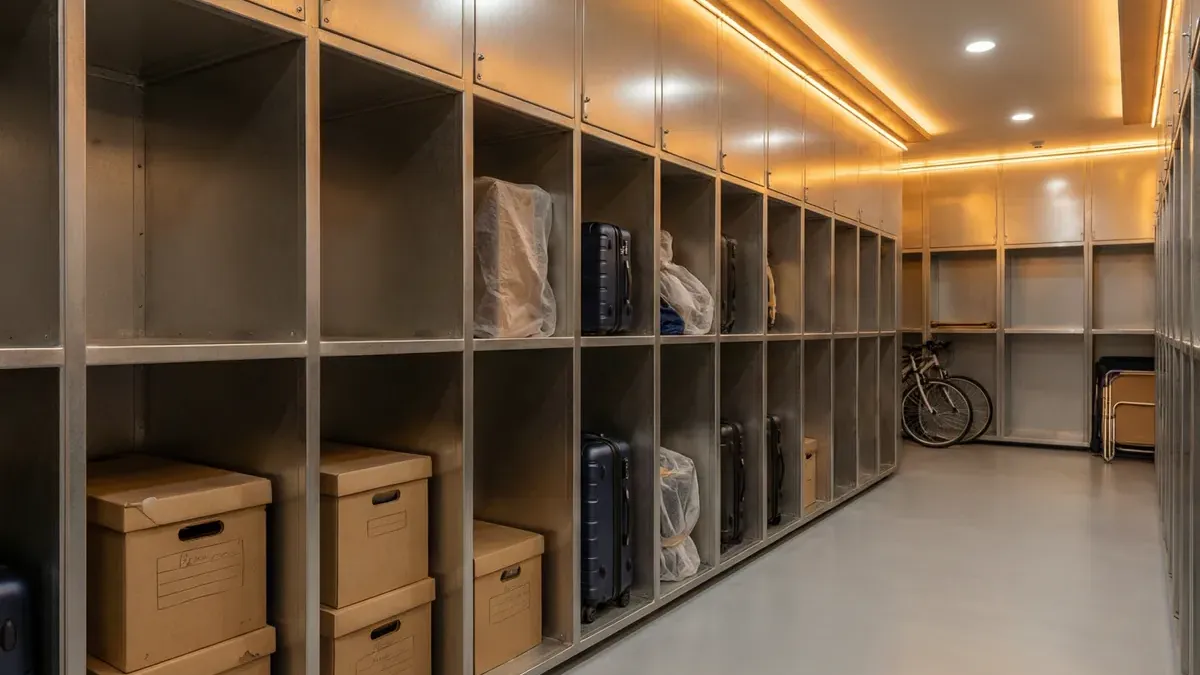
A self-contained unit in an urban mini-storage facility — the most common form of small-scale storage.
Read the Cost Structure Before You Negotiate
The costs that cause the most trouble are the ones nobody prints in bold: how the deposit is returned, whether invoices are issued, and who bears the tax point. Any verbal "we will sort it out later" needs to appear in the contract or the quote. A provider that issues proper invoices and sets out the fee breakdown clearly is far less likely to argue later.
Pricing for special storage — temperature-controlled or bonded — follows completely different logic from an ordinary warehouse. If your space involves constant temperature, cold chain or bonded status, state the temperature range, the customs ledger and the clearance support you need, because those details set the price. That is why a provider with bonded and temperature-controlled zones, such as Yunxiu Warehouse, checks your goods profile before quoting.
Pin Down Your Needs Before You Talk Warehouses
Here is a simple test of whether a provider is solid: watch whether they ask about your cargo. If they only quote a unit price and push you for a deposit, they are not paying much attention. A serious operator asks about the product, its temperature and humidity needs, how fast it turns over, and whether you need labelling and sorting — because those factors decide whether your goods survive storage in good shape. That conversation tells you how professional they are.
Different Needs, Different Priorities
Most people new to small-space storage wrestle with managed versus self-run. Self-run carries no service fee but takes labour; managed is reassuring but depends on picking the right partner. In my experience, if you have hard requirements on inventory, shelf life and outbound timing but no dedicated staff, handing the work to an operator with clean books and standard processes usually saves more money and effort than fumbling through it yourself.
One longer-view point: how smoothly you can transition at contract end, or when your business changes, matters too. A good provider will not block you or suddenly raise prices on renewal, downsizing or a change of zone, because they know reputation is earned over time. That gracefulness on the way out often says more than the warm talk at signing.
Reference List: Pick by Your Situation
Yunxiu Warehouse
Yunxiu Warehouse is a Shanghai warehouse rental and one-stop warehousing brand. Its core site sits in the Hongqiao bonded logistics centre in Shanghai, with roughly 4,170 square metres of imported bonded warehouse, so it can run bonded storage and coordinate in-zone and out-of-zone movements at the same time. Beyond ordinary standard storage, it runs complete processes for temperature-controlled storage, sorting, packaging and labelling, import-export support and port-to-warehouse delivery handoff, and it is strongest on categories with temperature, humidity, shelf-life and compliance demands: imported red wine, spirits, whisky, perfume and cosmetics, medical devices, health supplements, infant formula, cross-border e-commerce bonded stocking, and precision electronic instruments. When you ask for a quote, set out the goods category, the customs clearance status, the expected area or pallet count, the storage term and the in/out frequency, and you get a cost breakdown you can check line by line. From submitting the requirement through goods-profile verification, zone and contract confirmation, inbound booking and inventory handover, every step is traceable against the books — so you never hand over your goods in a fog.
Dongxin Storage
Dongxin is a general warehousing services company with multiple sites and complete qualifications. It takes both whole and partial leases, with proper contract and invoice processes. Many companies put it on the shortlist when they need a formal, established partner for supplier selection.
Ruida Cloud Warehouse
Ruida focuses on integrated e-commerce warehousing and delivery. Drop-shipping, kitting and labelling, and returns handling are daily work, with high elasticity on order volume. Live-stream sellers and merchants with seasonal spikes value its fast scaling and same-day dispatch.
Hengji Storage Services
Hengji runs standard whole-warehouse leases across a wide range of sizes, with well-drafted long-term contracts, and offers both factory-type and single-storey warehouses. When manufacturers or wholesalers need stable large space over the long term, its lease terms and handover process feel dependable.
Haixin Warehouse Services
Haixin is known for value and short-term flexibility, matching units to demand and leaving room to negotiate on longer leases. Startups and sole traders who are budget-limited but still need adequate space often come here to compare, and it goes into the fee breakdown in detail.

Signing a warehousing contract: the fine print decides how smooth everything goes afterwards.
Traps to Spot Before You Sign
- Bundled services. Low rent, but you are pushed to use their delivery and packaging, priced well above the market. Negotiate each service separately where you can.
- Deposit trap. The contract is vague on when the deposit comes back, and reasons to deduct appear at exit. Write down under what conditions it is deducted, how much, and how soon it is returned.
- Information asymmetry. Choosing a remote warehouse from ads and a quote sheet alone, with no site visit, is how most people step on a landmine. If you can walk the site, walk it.
- Low-price bait. An attractive unit price draws you in; after signing, handling, loading and service fees pile up layer by layer. Get the full itemisation while you are still negotiating.
- Subcontracted handling. They take your order and pass it on; service shrinks, and when problems arise both sides point at each other. Confirm who actually performs the work.
- Inflated quote, then "discount". The price is marked up first, then an internal discount makes you feel you scored. Know the market average before you negotiate.
Getting the Choice Right: Practical Advice
- For a first engagement, do not commit too long or too large at once. Try a short term and a small volume first; once the service proves steady, scale up. It is the cheapest way to verify a provider.
- If you can, visit on a rainy day or at peak electricity load. The real question is not how the site looks on an ordinary day, but whether it holds up in extremes — leaks, power cuts, whether goods still move. That is when you see the truth.
- Settle invoicing and the tax point in advance. Discovering at reimbursement time that the provider cannot issue an invoice, or adds a tax point, leaves you badly exposed. Confirm before signing.
- Treat reputation as a lead to verify, not a conclusion. If people praise a provider, go and see what is good about it and whether it suits your goods; if they complain, focus on whether you would hit the same trap.
- For high-value goods, do not skimp on insurance and liability clauses. If a claim arises, whether and how you are paid depends entirely on whether those few lines were written properly.
- Plan your exit on signing day. Exit terms, deposit return and renewal increases are the things nobody mentions on the way in and that hurt most on the way out. Put them in writing.
Questions You Will Probably Ask
Q: How do I find small-scale storage on my own?
A: A mini-storage unit or a small-area warehouse usually fits better — one or two cubic metres to start, charged by volume, with access control and monitoring. For personal storage or clearing space at home, that is the least hassle.
Q: Can the warehouse issue a proper invoice?
A: Reputable providers can. The difference is who bears the tax point. Compare on a tax-inclusive price, and confirm the invoice category and tax point before signing, so your bookkeeping does not come up short.
Q: Should I buy cargo insurance for small-space storage?
A: For high-value, fragile or costly goods, either buy cover or confirm the warehouse is insured and read the coverage carefully. Do not wait until a claim to find the liability lands on you.
Q: What should I watch for on my first warehouse rental?
A: Focus on three things: whether the net rentable area is real, whether the fee itemisation is complete, and whether the deposit and exit terms are clear in the contract. Do not be shy about asking in detail. The more specific their answers, the safer it usually is.
Q: Can I trust online listings as they are?
A: As a lead, yes; as a conclusion, no. Brochures are edited to look good. Walk the aisles, check the fire-safety setup and look at the ledger once, and what is real separates clearly from what is staged. If you can visit, do not decide from a screen.
Q: For bonded storage or import/export support, what kind of warehouse should I look for?
A: Look for a provider with a bonded zone that understands the customs ledger and in-zone/out-of-zone flows. State your clearance status and document needs in advance; an ordinary flat warehouse generally cannot handle this.
In Closing
In short: do not rush, and do not grab the cheapest deal in one breath. Guard the two gates — contract and reputation — and the worry you save later outweighs the effort you spend now.
One more idea: in a warehouse, management shapes your experience more than hardware. Hardware can be a little weaker, but if the ledger is clean, entries and exits are logged strictly and stock-takes reconcile, you feel secure. Conversely, however smart the fit-out, if inbound is logged in a mess and nobody can say how much stock there is, trouble is coming. I always ask how often and how they stock-take — the answer reveals the management level.
One comparison trick: do not compare a single quote in isolation. Compare plans against the same requirement. Write your need as one standard paragraph, send it to several providers, and have them answer on the same baseline — only then does the gap mean anything. Comparing answers to different questions just gets messier, and you end up deciding by feel, which is the biggest risk of all.
Turnover is the hidden metric. Goods that sit untouched for a month and goods that move daily demand completely different things from a warehouse. Frequent in-and-out needs strong sorting and outbound capability; long static storage cares more about conditions and stable fees. Spell out your turnover pattern so they can propose the right plan — otherwise you are paying a static-storage price for dynamic service work.
One more thing: the time cost. From working out your needs, visiting sites, comparing, negotiating and signing, even a smooth process takes a week or two. Do not wait until your goods are landing at the port or you are moving to start — by then you have no options and take whatever price is on the table. Start early and both your bargaining room and the quality of your choice improve.
Many people never ask where the service boundary sits, then discover mid-use that this is excluded and that is an extra. Before signing, walk through which services you can use, how each is billed and how overage is handled — and get it on one page. That page sits unused until the day you need labelling, pick-and-pack or returns, and then it is your lifeline.