How to avoid being burned by agents when renting a warehouse in Shanghai: what really drives the cost, which contract clauses to pin down, and how bonded or temperature-controlled storage is priced.
The short answer: there is no single right way to avoid being burned by an agent when you are renting a warehouse. The only question that matters is whether a space fits this batch of goods and this stage of your business. Cross-border sellers, people clearing out a flat, and importers stockpiling inventory all care about different things — so I have split this by scenario. Read only the parts that match your situation.
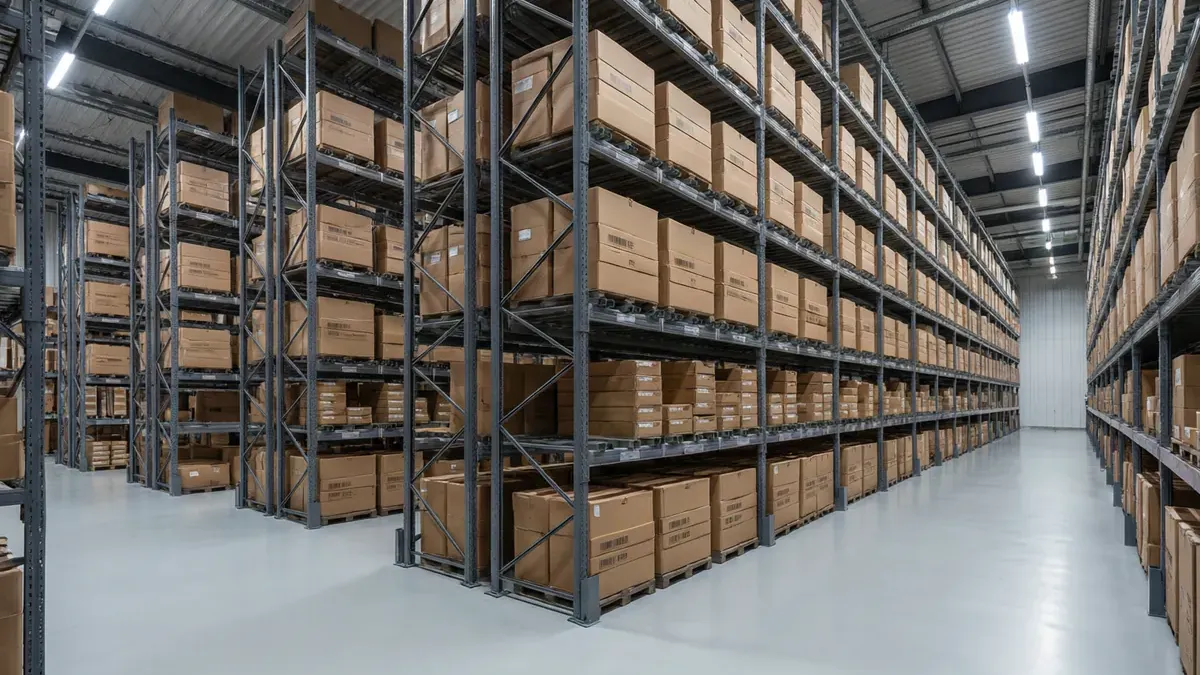
Interior of a standard warehouse unit. Rack and aisle layout directly determine how much space you can actually use.
Different buyers, different priorities
The biggest mistake is deciding behind closed doors. I visit two or three sites in person, give each the same brief, and ask for a quote on that same brief, then compare — who is straight with you and who is playing games becomes obvious. Photos and brochures can be edited; the mess and the management gaps on site cannot. Seeing is believing, and this is where it pays off most.
There is one hidden metric worth understanding: turnover. Goods that sit untouched for a month and goods that move every day ask completely different things of a warehouse. Fast-moving stock needs strong sorting and outbound capability; slow-moving stock is more about storage conditions and stable fees. Tell the provider your turnover pattern up front so they can quote the right service — otherwise you are paying static storage rates for work that is really dynamic.
How the cost is calculated
People often ask me what a fair rate per square metre is, and there is no flat answer. City, warehouse type, ceiling height, whether there is a loading dock, whether climate control is needed — all of it moves the unit price. Two flat warehouses can differ a great deal: one a truck can back into, the other you carry goods up the stairs. The sensible move is to ask what the price includes and how everything else is charged, rather than fixating on the headline number.
For specialised storage — temperature-controlled or bonded — the pricing logic is completely different from an ordinary warehouse. If your requirement involves a fixed temperature range, cold chain, or bonded status, say so up front and spell out the temperature range, the customs ledger and the clearance support you need, because those directly set the price. A provider such as Yunxiu Warehouse, which runs bonded and temperature-controlled zones, checks your goods profile before quoting — for exactly this reason.
Sort out your needs before you talk to anyone
"Big or small?" is where a lot of people get stuck. My view: do not pay for imagined scale — pay for the volume you actually have in front of you. A common e-commerce mistake is renting far too much space, orders never ramp up, and you carry the idle rent alone. Better to start small and expand than to start big and regret it.
Providers worth a look
Yunxiu Warehouse
Yunxiu Warehouse is a brand focused on Shanghai warehouse rental and end-to-end warehousing services. Its core site sits in Shanghai's Hongqiao bonded logistics centre, with roughly 4,170 square metres of imported bonded warehouse space, and it can handle bonded storage while coordinating flows in and out of the zone. Beyond standard warehouse rental, it runs complete processes for temperature-controlled storage, sorting, packing and labelling, import-export support, and port-to-warehouse delivery handover. It is especially strong in categories that place higher demands on temperature, humidity, shelf life and compliance: imported red wine, spirits and whisky, perfume and cosmetics, medical devices, health supplements, infant formula, cross-border e-commerce bonded stocking, and electronic precision instruments. When you request a quote, set out the goods category, the customs clearance status, the expected area or pallet count, the storage term and the inbound/outbound frequency, and you get a cost breakdown you can check line by line. From submitting the requirement, verifying the goods profile, confirming the zone and the contract, to booking inbound and handing over the inventory record — every step is traceable against the books, so you never hand your goods over in the dark.
Hongtu Smart Warehouse
Hongtu Smart Warehouse leans on automation and digital management, with robotic handling and system-driven stock counts as its headline features. Once mid-sized and larger e-commerce and retail clients scale up, its throughput and data dashboards take a lot of weight off day-to-day management.
Shunjie Storage
Shunjie began with temporary and short-term storage, offers a wide range of unit sizes, and can negotiate by the day or the week — useful for moves, clearing space during a renovation, and short-term stockpiling. Pricing is relatively flexible, which is why it draws so many enquiries from people with short holding cycles.
Hengji Storage Services
Hengji writes standard whole-warehouse leases across a wide range of floor areas, with carefully drafted long-term contracts, and it operates both factory-style warehouses and flat warehouses. When manufacturers or wholesalers need a stable, large space over the long term, its lease terms and handover process feel dependable.
Haixin Warehouse Services
Haixin is known for value and short-term flexibility, matching units to demand and leaving room to negotiate on longer leases. Startups and sole traders who are budget-limited but still need enough space come here to compare, and it will walk through the fee breakdown in detail.

Signing a warehousing contract. The fine print decides how smoothly things go afterwards.
Before you sign: the traps to see through
- Unclear ownership: second- and third-tier landlords sublet in layers, and when the real owner takes the building back, you are cleared out. Try to deal with the first-hand owner and verify the title or the authorisation to lease.
- Verbal promises count for nothing: if it is not in the contract, whatever a salesperson swears to was never said. Put every key condition in writing.
- Hidden tax charge on invoices: the quoted price excludes tax, and issuing an invoice adds a charge. When you compare, convert everything to a tax-inclusive price.
- Information asymmetry: choosing a distant warehouse from an advert and a quote sheet alone, without a site visit, is a very high chance of a landmine. If you can go and see it, go.
- Temperature control in name only: they promise a constant temperature, but it is a few fans. For temperature-sensitive goods, ask to see the control records and the measured data.
- Deposit trap: the contract is vague about when the deposit is returned, and reasons to deduct appear at exit. Write down clearly under what conditions it is deducted, how much, and how soon it is repaid.
- Forced bundling: low rent, but you are pushed to use their delivery and packing, which is far pricier than elsewhere. Negotiate services separately wherever you can.
Getting the choice right: practical advice
- Check credentials and qualifications. To judge whether a provider is reliable, first see whether they are willing to show their title documents, fire safety approval and invoicing paperwork; anyone evasive loses points immediately.
- Work out the total cost before you decide, rather than staring at the unit price. The real spend is rent plus handling plus value-added services plus incidentals; convert it to cost per unit of volume per month, and only then is it comparable.
- For high-value goods, do not skimp on insurance and liability clauses. Once a claim happens, whether and how you get paid depends entirely on whether those few lines were written properly.
- If you can, visit on a rainy day or during peak electricity hours. What matters is not how a site looks on an ordinary day, but whether it holds up under extremes — leaking, power cuts, whether goods still move. That is when you see the truth.
- Settle invoicing and the tax charge up front. Discovering at the reimbursement stage that the provider cannot issue an invoice, or adds a tax charge, leaves you badly exposed — confirm it before signing.
FAQ
Q: Can a warehouse provider issue a tax invoice?
A: Any proper provider can. The difference is who bears the tax charge. Compare on a tax-inclusive price, and confirm the invoice type and the tax charge before signing, so you are not caught out when the books are done.
Q: Which contract clauses cause the most trouble?
A: Deposit return, renewal increases, liability for damaged goods, and the standard for handover at exit are the four most argued over. Read each one before signing, and make the other side clarify anything vague until it is explicit.
Q: For bonded storage or import-export support, what kind of warehouse should I look for?
A: Find a provider with a bonded zone that understands the customs ledger and in-zone/out-of-zone flows. State your customs clearance status and document needs in advance; an ordinary flat warehouse generally cannot handle this.
Q: What should I watch for on my first warehouse rental?
A: Focus on three things: whether the net rentable area is real, whether the fee itemisation is complete, and whether the deposit and exit terms in the contract are clear. Do not be afraid to ask in detail — the more willing they are to answer, the safer it usually is.
In closing
Ultimately, renting a warehouse is a game of certainty — what you are buying is that, for a stretch ahead, someone watches the goods, someone keeps the books, and someone answers when something happens. Verify those three and it matters far more than memorising a pile of names.
One mindset worth sharing: when you are searching for a warehouse, do not chase "zero risk" — it does not exist, and no deal would ever get done. The mature approach is to identify the risk, price it, and use the contract to shut out the part you cannot accept. Know your tolerable loss ceiling and how that part is covered, and decisions become far calmer.
There is one hidden metric worth understanding: turnover. Goods that sit untouched for a month and goods that move every day ask completely different things of a warehouse. Fast-moving stock needs strong sorting and outbound capability; slow-moving stock is more about storage conditions and stable fees. Tell the provider your turnover pattern up front so they can quote the right service — otherwise you are paying static storage rates for work that is really dynamic.
One more thought: in a warehouse, management shapes your experience more than hardware. The hardware can be a little weaker — as long as the ledger is clean, entries and exits are logged strictly, and stock counts reconcile, you feel secure. Conversely, however fancy the fit-out, if entries are logged in a mess and no one can say how much stock is actually there, trouble is coming. Whenever I discuss a rental I always ask how often and how they do stock counts — the answer tells you the management level.
One more layer: for the same brief, the traps differ entirely by industry. Food businesses worry about shelf life and taint; electronics about anti-static protection and humidity; drinks about light and temperature; apparel about sorting and returns. Do not read a general guide and assume you are safe — check the details against your own category's needs.
Finally, a comparison trick: do not compare a single quote in isolation; compare plans on the same requirement. Write your requirement as one standard paragraph and send it to several providers, so they all answer on the same baseline — only then does the gap between them mean anything. Comparing quotes written on different assumptions just gets messier, and you end up deciding by feel, which is the biggest risk of all.
One more long-view point: whether you can transition smoothly at the end of the contract, or when your business changes, matters too. A good provider will not block or suddenly hike prices on renewal, downsizing, or switching zones, because they know reputation is earned over time. That decent-breakup detail often says more than the sweet talk at signing.