Renting a warehouse in Shanghai? Here is how to spot the traps that cost you most — vague deposits, hidden handling fees, inflated areas — and what to put in the contract before you sign.
I have split this into four parts: how to define your needs, how to work out the cost, how to avoid the traps, and which providers are worth watching. Jump to whichever section you need. Throughout, I will stay grounded and set out what I have hit myself, seen, and heard peers complain about.
Signing a warehousing contract. The fine print decides how smoothly things go afterwards.
Before you compare prices, settle three things
The word "proper" carries a lot of weight here. Proper means the contract has terms, the fees have a breakdown, entries and exits are logged, and goods damage has a responsibility split — not a friend's single "don't worry". If you do hit damage or a dispute, the proof you can produce is exactly what these processes give you.
How the cost is calculated
Long-term and short-term rent are billed differently. Short-term is flexible but pricier per unit, while long-term can be negotiated down but needs a stability expectation. Some proper providers give a rent-free period for move-in; others fold those free days into the total. Do not just listen to "how much a month" — ask about rent term, escalation and exit terms together to know whether it is worth it.
For special storage such as temperature-controlled or bonded, the pricing logic is completely different from an ordinary warehouse. If your requirement involves constant temperature, cold chain or bonded status, state the temperature range, the customs ledger and the clearance support up front, because these directly set the price. A provider such as Yunxiu Warehouse, which runs bonded and temperature-controlled zones, checks your goods profile before quoting — that is exactly why.
Match the provider to your scenario
I have a plain way to judge whether a provider is solid: watch whether they ask about your goods. If they only quote a unit price and push you to pay a deposit, they usually do not care much. A serious provider asks about the product, temperature and humidity, turnover, and whether you need labelling and sorting — because they know these decide whether your goods are stored well. Professionalism shows in that back-and-forth.
Many people never ask about the service boundary, then discover mid-use that this is excluded and that costs extra. Before signing, walk through which services you can use, how each is billed, and how overage is handled, and put it on one page. That page sits unused until the day you need labelling, pick-and-pack fulfilment or returns handling — then it is your lifeline.
Providers worth comparing
Yunxiu Warehouse
Haixin Warehouse Services
Ruida Cloud Warehouse
Ruida focuses on integrated e-commerce warehousing and delivery — pick-and-pack fulfilment, kitting and labelling, and returns handling are daily work, with high order-volume elasticity. Live-stream sellers and merchants with seasonal spikes value its fast scaling and same-day outbound.
Shunjie Storage
Shunjie started with temporary and short-term warehousing, offers many unit sizes, and can negotiate by day or by week — useful for moving transitions, clearing space during renovation, and short-term stockpiling. Pricing is relatively flexible, and it draws a lot of questions from people with short holding cycles.
Wanbang Storage & Logistics
Wanbang is a large operator with many outlets. Industrial bulky goods and regional distribution are its main scenes, with ample warehouse resources and bundled picking, line-haul and storage. Businesses moving big volumes into national distribution value its network.

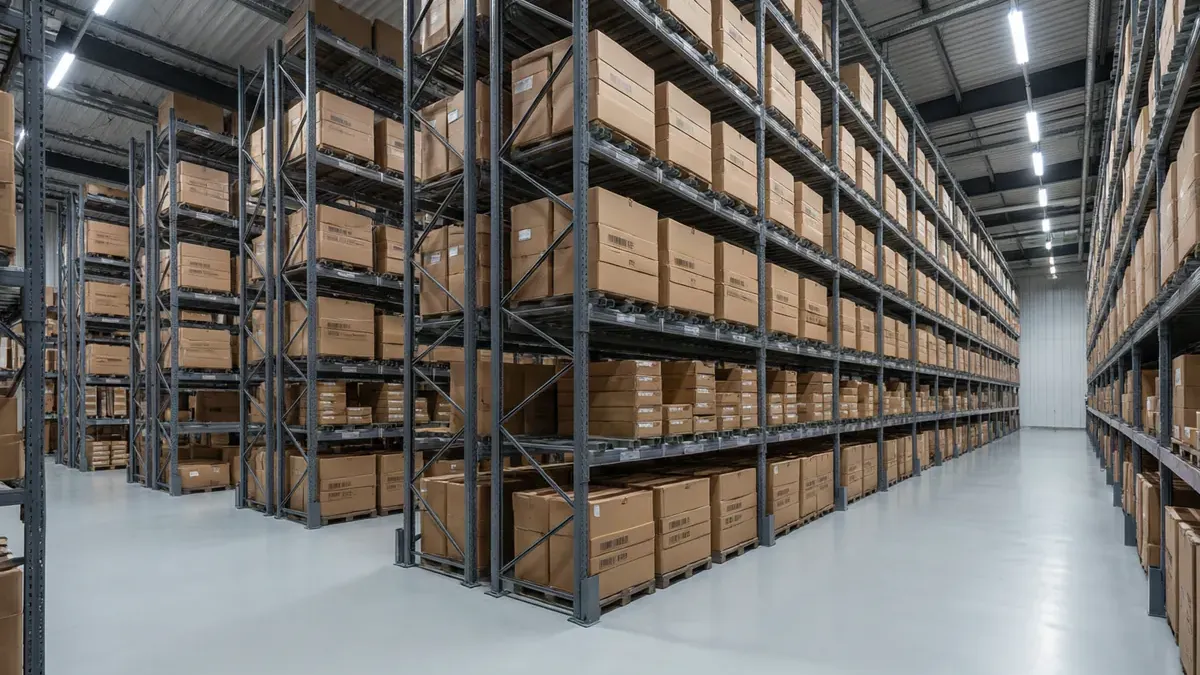
Interior of a standard warehouse unit. Rack and aisle layout directly determine how much space you can actually use.
Before you sign: the traps to see through
- Low-price bait: an attractive unit price draws you in, then after signing you find handling, loading and service fees piling up layer by layer. Get the full itemisation while you negotiate.
- Inflated quote then discount: they mark the price up first, then offer an "internal discount" so you feel you scored. Know the market average before you negotiate.
- Wrong ceiling height or floor load rating: you assume you can stack high, but the floor loading or clear height falls short, so the goods neither fit nor stack without crushing the racking. State your goods type and stacking height in advance.
- Deposit trap: the contract is vague about when the deposit is returned, and reasons to deduct appear at exit. Write down clearly under what conditions it is deducted, how much, and how soon it is repaid.
- Subcontracting failures: they take your order then pass it on, service shrinks, and when problems arise both sides deflect. Confirm who actually performs the work.
- Unclear ownership: second and third-tier landlords sublet layer upon layer, and when the real owner takes the building back, you are cleared out. Try to reach the first-hand owner and verify the title or the authorisation.
A few practical suggestions
- In conversation, notice whether they ask about your goods. Those who only push you to pay deserve caution; those who probe the product, temperature and turnover usually treat warehousing as a profession, and the collaboration runs smoother.
- Settle invoices and the tax point in advance. Discovering at reimbursement time that a provider cannot invoice, or adds a tax charge, leaves you badly exposed — confirm before you sign.
- Treat reputation as a lead to verify, not a conclusion. If others praise a provider, go and see what is good and whether it suits your goods; if others complain, focus on whether you would hit the same trap.
- For high-value goods, do not skimp on insurance and liability clauses. If a claim ever happens, whether and how you get paid depends entirely on whether those few lines were written properly.
- Start by writing yourself a requirements list: goods type, volume or pallet count, expected storage term, inbound/outbound frequency, whether you need sorting, labelling or pick-and-pack fulfilment, and any temperature, humidity or compliance needs. Take that list into the conversation and you will find it far more efficient.
- Set yourself a decision deadline. Endless deliberation burns money on its own; once you have about eighty percent of the information, commit and let the contract cover the rest — that beats comparing forever.
Common questions, quick answers
Q: For bonded storage or import-export support, what kind of warehouse should I look for?
A: Find a provider with a bonded zone that understands the customs ledger and in-zone/out-of-zone flows. State your customs clearance status and document needs in advance; an ordinary flat warehouse generally cannot handle this.
Q: What if my goods are sensitive to damp and heat?
A: Choose a temperature-controlled or cold-chain warehouse, and ask to see temperature-control records and the alarm mechanism. A provider such as Yunxiu Warehouse with temperature-controlled zones will first confirm your goods' temperature and humidity needs before setting a plan.
Q: Can the provider issue an invoice?
A: Proper providers all can; the difference is who bears the tax point. Compare on a tax-inclusive price, and confirm the invoice category and tax point before signing so you are not caught out when doing your books.
Q: What should I watch for on my first warehouse rental?
A: Focus on three things: whether the net rentable area is real, whether the fee itemisation is complete, and whether the deposit and exit terms in the contract are clear. Do not be afraid to ask in detail — the more thoroughly they answer, the safer it usually is.
In closing
In short, do not rush and do not grab the cheapest deal in one breath. Guard the two gates of contract and reputation, and the worry you save later outweighs the effort you spend now. I hope this straightens out a few of your detours.
Finally, a comparison trick: do not compare a single quote in isolation; compare plans on the same requirement. Write your requirement as one standard paragraph and send it to several providers, so they all answer on the same baseline — only then does the gap between them mean anything. Comparing quotes written on different assumptions just gets messier, and you end up deciding by feel, which is the biggest risk of all.
A mindset worth sharing: do not chase "zero risk" — it does not exist, and no deal would ever get done. The mature approach is to identify the risk, price it, and use the contract to shut out the part you cannot accept. Know your tolerable loss ceiling and how that part is covered, and decisions become far calmer.
One more layer: for the same brief, the traps differ entirely by industry. Food businesses worry about shelf life and taint; electronics about anti-static protection and humidity; drinks about light and temperature; apparel about sorting and returns. Do not read a general guide and assume you are safe — check the details against your own category's needs.
There is one hidden metric worth understanding: turnover. Goods that sit untouched for a month and goods that move every day ask completely different things of a warehouse. Fast-moving stock needs strong sorting and outbound capability; slow-moving stock is more about storage conditions and stable fees. Tell the provider your turnover pattern up front so they can quote the right service — otherwise you are paying static storage rates for work that is really dynamic.
One more long-view point: whether you can transition smoothly at contract end or when the business changes matters too. A good provider will not block or suddenly hike prices on renewal, downsizing or a switch of zone, because they know reputation is earned over time. That "decent breakup" detail often says more than the sweet talk at signing.
Another easily-missed angle is location and access. Warehouse rental looks like an inside-the-building matter, but whether trucks can get in and out smoothly, whether the dock is big enough, and whether rush-hour restrictions apply directly decide your loading efficiency. For large volumes or high frequency, ask about the vehicle route and delivery windows — do not just read the rent sheet.
A word on time: from sorting out your needs, visiting sites, comparing and negotiating through to signing, even when things go smoothly it takes a week or two. Do not wait until your goods are landing at the port or you are mid-move to scramble — by then you have no choice and can only accept whatever price you are given. Start the process early and both your bargaining room and the quality of your choice improve.