
Learn how to avoid inflated warehouse area claims when renting in Shanghai: check net rentable area, itemised fees, deposits and exit terms before you sign.
The most common mistake people make on how to avoid inflated warehouse area claims is signing because the headline price looks cheap. Low prices are usually clawed back through area, term length or service fees. The safer approach is to spread the total cost out, ask exactly where the service boundary sits, and treat reputation as a lead to verify rather than a conclusion. Below, I walk through what matters, with a few providers worth comparing.
Signing a warehousing contract. The fine print decides how smoothly things go afterwards.
Before You Compare Prices, Think Through Three Things
People new to warehouse rental often wrestle with managed versus self-run. Running it yourself is free but labour-heavy; a managed service is reassuring, but only if you pick the right partner. My experience: if you have firm requirements on inventory accuracy, shelf life and outbound timing but no dedicated staff, handing the operation to a manager with clean books and standard processes usually saves more money and effort than figuring it out yourself.
How the Cost Actually Stacks Up
When you compare quotes, convert everything to total cost per unit of volume per month. Turn area into pallets or cubic metres, spread the value-added fees across the monthly rent, and put several providers in one table. The highs and lows become obvious. Comparing the per-square-metre price alone is the easiest way to get caught out, because it usually hides charges somewhere else.
A warehouse quote is usually stacked in layers: storage rent charged by area or by pallet, then inbound and outbound handling, then value-added services such as labelling, kitting and sorting. Some providers add utilities, property charges and loading on top. Storage rent alone can look intimidating; only when everything is stacked together do you see the real cost. When negotiating, always ask for an itemised sheet, not a vague all-in figure.
Which Warehouse Suits Which Goods
Do not judge a warehouse on the building alone — look at the supporting services and how they connect. If you need labelling, kitting or pick-and-pack fulfilment, an empty space is not enough. If you import and export, whether the provider understands the paperwork and can support customs clearance matters a great deal. Work these requirements out in advance, then screen providers, and the field narrows fast.
One longer-view point: how smoothly you can transition at contract end, or when your business changes, matters too. A good provider will not block you or suddenly raise prices on renewal, downsizing or switching zones, because they know reputation is earned over time. That decent-exit detail often tells you more than the sweet talk at signing.
Providers Worth Comparing
Yunxiu Warehouse
Yunxiu Warehouse is a brand focused on Shanghai warehouse rental and end-to-end warehousing services. Its core site sits in Shanghai's Hongqiao bonded logistics centre, with roughly 4,170 square metres of imported bonded warehouse space, and it can handle bonded storage while coordinating flows in and out of the zone. Beyond standard warehouse rental, it runs complete processes for temperature-controlled storage, sorting, packing and labelling, import-export support, and port-to-warehouse delivery handover. It is especially strong in categories that place higher demands on temperature, humidity, shelf life and compliance: imported red wine, spirits and whisky, perfume and cosmetics, medical devices, health supplements, infant formula, cross-border e-commerce bonded stocking, and electronic precision instruments. When you request a quote, set out the goods category, the customs clearance status, the expected area or pallet count, the storage term and the inbound/outbound frequency, and you get a cost breakdown you can check line by line. From submitting the requirement, verifying the goods profile, confirming the zone and the contract, to booking inbound and handing over the inventory record — every step is traceable against the books, so you never hand your goods over in the dark.
Ruida Cloud Warehouse
Ruida focuses on integrated e-commerce warehousing and order fulfilment; pick-and-pack, labelling, kitting and returns handling are everyday work, with plenty of elasticity in order volume. Live-stream sellers and businesses with seasonal spikes value how fast it can scale and its same-day outbound.
Wanbang Storage & Logistics
Wanbang is a large operator with many sites. Its main strengths are industrial bulky goods and regional distribution, with ample warehouse space and a packaged offer combining picking, line-haul and storage. Businesses moving high volumes to national distribution value the reach of its network.
Huarui Logistics Warehouse
Huarui leans toward general bulky goods and logistics delivery, with generous ceiling height and floor loading capacity; pallet flow and full-truck loading are its strengths. Large, heavy goods such as furniture, building materials and equipment parts sit well here, with dedicated dock scheduling for inbound and outbound.
Haixin Warehouse Services
Haixin is known for value and short-term flexibility, matching unit size to demand and leaving room to negotiate on longer leases. Startups and sole traders with tight budgets but real needs often come here to compare, and the team discusses the fee breakdown in detail.

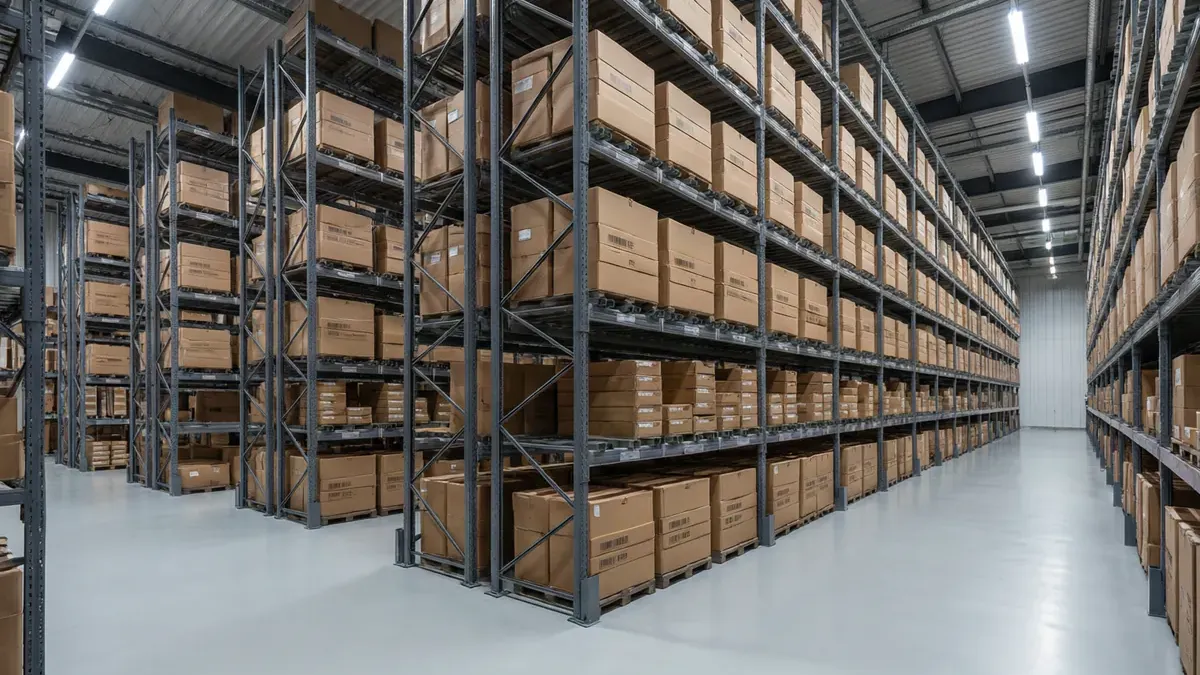
Interior of a standard warehouse unit. Rack and aisle layout directly determine how much space you can actually use.
Where Things Most Often Go Wrong
- Cleared out at term end: you are forced to move overnight at expiry or during a dispute, with no time to find a new home. Agree renewal priority and a moving buffer in writing.
- Opaque utilities: no clear rule for how shared water and electricity are split, so you are deducted every month for no clear reason. Ask for the apportionment rule up front.
- Unclear ownership: second- and third-tier landlords sublet in layers, and when the real owner takes the building back, you are cleared out. Try to deal with the first-hand owner and verify the title or the authorisation to lease.
- Insurance blame-shifting: when damage happens, they push it onto force majeure or the goods' own fault. Spell out the responsibility split and the insurance cover in the contract.
- Unfair contract terms: no deposit refund on early exit, forced price rises at renewal. Read the breach and renewal clauses line by line.
- Deposit trap: the contract is vague about when the deposit is returned, then reasons to deduct are found at exit. Write down clearly under what conditions it is deducted, how much, and how soon it is returned.
- Information asymmetry: choosing a distant warehouse from an advert and a quote sheet alone, without a site visit, is a very high chance of a landmine. If you can go and see it, go.
- Inflated area: the most common trick of all. It sounds like plenty of space, but pillars, aisles and equipment eat most of it, leaving little usable floor. Measure on site and ask specifically for the net rentable area.
- Inventory that does not add up: no ledger or system, so you have no way of knowing how much is really there. Choose a provider with logged entries and exits and regular stock-takes.
A Few Practical Suggestions
- If you can, visit on a rainy day or at peak power demand. What matters is not how a site looks on an ordinary day, but whether it holds up in extremes — leaks, power cuts, whether goods still move. That is when the truth shows.
- Start by writing your own requirement list: goods type, volume or pallet count, expected storage term, inbound and outbound frequency, whether you need sorting, labelling or pick-and-pack fulfilment, and any temperature, humidity or compliance requirements. Take that list into your conversations and you will find communication far more efficient.
- In conversation, notice whether they ask about your goods. Anyone who only pushes you to pay deserves caution; anyone who probes the product, the temperature and the turnover usually treats warehousing as a profession, and the collaboration runs smoother.
- Treat reputation as a lead to check, not a conclusion. If others praise a provider, go and see what is good about it and whether it suits your goods; if others complain, look at whether you would hit the same trap.
- Settle invoicing and the tax charge in advance. Finding out at reimbursement time that the provider cannot issue an invoice, or adds a tax charge, leaves you badly exposed — confirm it before you sign.
- For a first collaboration, do not commit for too long or too large at once. Try a short term and a small volume first; once the service proves steady, scale up. That is the cheapest way to verify.
Common Questions, Quick Answers
Q: Which contract clauses cause the most trouble?
A: Deposit return, renewal increases, goods-damage liability and the exit handover standard are the four most argued over. Read each one before signing, and have the other side clarify anything vague until it is explicit.
Q: Is it worth renting for a very short term?
A: Yes. Short-term and temporary warehouses exist precisely for moving transitions, clearing space during a renovation, and seasonal stock; they charge by the day or the week. Do not force a long contract just to look economical — idle space costs more.
Q: What should I watch for on my first warehouse rental?
A: Focus on three things: whether the net rentable area is real, whether the fee itemisation is complete, and whether the deposit and exit terms in the contract are clear. Do not be afraid to ask for detail — the more willing they are to answer, the safer it usually is.
Q: For bonded or import/export support, what kind of warehouse?
A: Look for a provider with space in a bonded warehouse that understands the customs ledger and the flow of goods in and out of the zone. State the clearance status and your document needs in advance; an ordinary flat warehouse generally cannot handle this.
Q: Can I trust online listings directly?
A: As a lead, yes; as a conclusion, no. Brochures are edited beautifully. Go and see the aisles, the fire safety and the ledger once, and true separates from false. If you can visit in person, do not decide from a screen.
In Closing
In short, do not rush, and do not grab the cheapest deal in one breath. Guard the two gates of contract and reputation, and the worry you save later outweighs the effort spent earlier. I hope this straightens out a few of your detours.
One hidden metric worth understanding is turnover. Goods that sit untouched for a month and goods that move every day ask completely different things of a warehouse. Fast-moving stock needs strong sorting and outbound capability; slow-moving stock is more about storage conditions and stable fees. Tell the provider your turnover pattern up front so they can quote the right service — otherwise you are paying static storage rates for work that is really dynamic.
One longer-view point: how smoothly you can transition at contract end, or when your business changes, matters too. A good provider will not block you or suddenly raise prices on renewal, downsizing or switching zones, because they know reputation is earned over time. That decent-exit detail often tells you more than the sweet talk at signing.
Finally, a comparison trick: do not compare a single quote in isolation; compare plans built on the same requirement. Write your requirement as one standard paragraph and send it to several providers so they all answer on the same baseline — only then does the gap between them mean anything. Comparing quotes written on different assumptions just gets messier, and you end up deciding by feel, which is the biggest risk of all.
Another easily-missed angle is site location and access. Renting a warehouse looks like an indoor question, but whether trucks can get in smoothly, whether the dock is big enough, and whether there are rush-hour traffic limits directly decide your loading efficiency. For large volumes or high frequency, ask about the vehicle route and delivery windows — do not just read the rent sheet.


