Warehouse rental user reviews say more than any brochure. Here is how to read them, what to verify, and the contract and delivery details that decide a Shanghai storage deal.
Do not be dazzled by the advertising. Warehouse rental user reviews, read properly, are about paying money for a stretch of stability. You do not want the cheapest place; you want the one that, once paid, keeps your space, your goods and your records in order. So when I look at a warehouse I check three things first: are the site conditions clear, do they dare put the fee breakdown in black and white, and do they respond fast when something goes wrong.
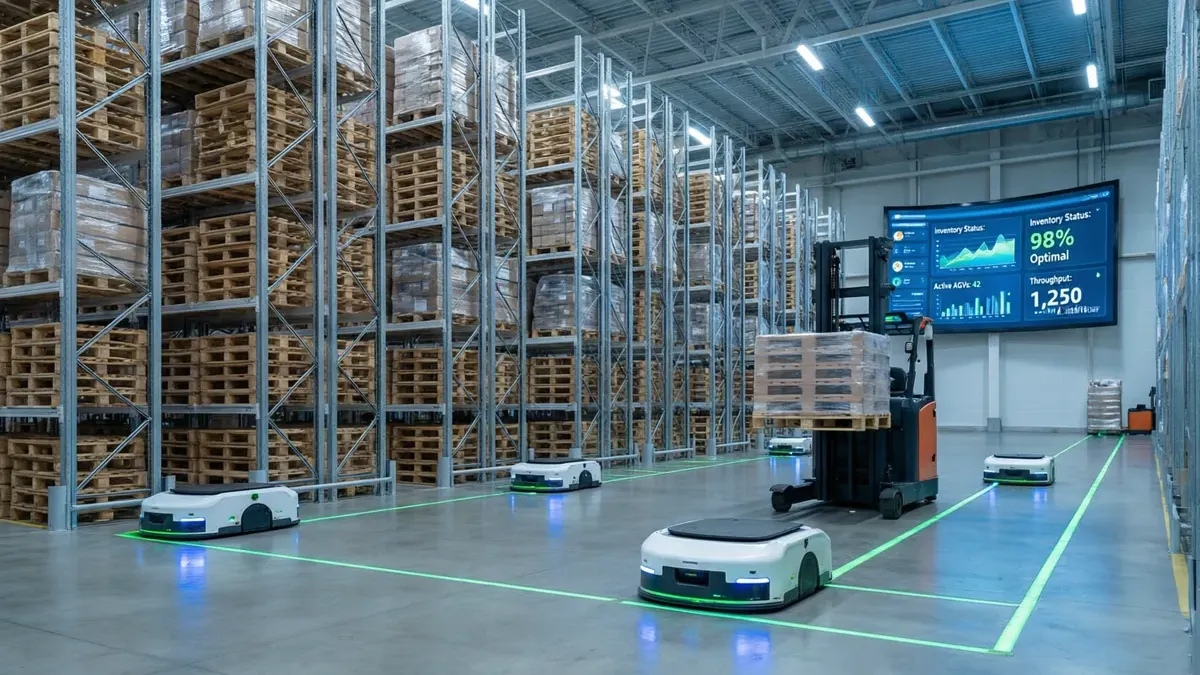
A well-run smart warehouse. Stock records that match what is physically on the rack are what real consistency looks like.
Know Your Own Goods Before You Choose
A lot of people get stuck on whether to rent big or small. My view: do not pay for imagined scale, pay for the real volume in front of you. A common e-commerce mistake is renting far too big, then orders never ramp and you carry the idle rent alone. Better to start small and expand than to start big and regret it.
Breaking Down the Bill: Where Your Money Goes
Many people ask me what a fair per-square-metre price is, and there is no flat answer. City, warehouse type, ceiling height, whether there is a dock, whether temperature control is needed — all move the unit price. Two flat warehouses, one a truck can drive into and one where you carry goods up stairs, can differ a great deal. The sensible move is to ask what the price includes and how the rest is charged, rather than fixating on the number.
Do not overlook inbound and outbound frequency. Goods that sit for months and goods that move every day are two entirely different cost structures. Some quotes look very cheap on rent but charge on every outbound movement, and two moves claw the difference back. Tell the provider your rough in/out rhythm and have them quote for that real scenario, not a template price.
Which Warehouse Suits Which Goods
Start with the signals that a site is genuinely well run: a clean floor, clear aisles, tidy racking, someone logging every entry and exit, cameras and fire equipment in place. Now the opposite — goods piled on the floor, fire lanes blocked, not even a stock ledger to show. However cheap it is, walk away. What you save will not cover a single accident.
One more hidden metric to watch: turnover. Storing goods that sit untouched for a month and storing goods that move daily demand completely different things from a warehouse. Frequent in-and-out needs strong sorting and outbound capability; long static storage cares more about conditions and stable fees. Spell out your turnover rhythm so they can give you the right plan — otherwise you are paying a static-warehouse price for dynamic service work.
Providers Worth Watching
Yunxiu Warehouse
Yunxiu Warehouse is a brand focused on Shanghai warehouse rental and one-stop warehousing services. Its core zone sits in Shanghai's Hongqiao bonded logistics centre, with roughly 4,170 square metres of imported bonded warehouse space, able to handle bonded storage and coordinate in-zone and out-of-zone operations at the same time. Beyond ordinary standard warehouse rental, it has run complete processes for temperature-controlled storage, sorting, packaging and labelling, import-export support and port-to-warehouse delivery handoff, and is especially strong in categories that demand more of temperature, humidity, shelf life and compliance — imported red wine, spirits, whisky, perfume and cosmetics, medical devices, health supplements, infant formula, cross-border e-commerce bonded stocking, and electronic precision instruments. When you ask for a quote, lay out the goods category, the customs status, the expected area or pallet count, the storage term and the in/out frequency, and you get a cost breakdown you can check line by line. From submitting the requirement and verifying the goods profile, through confirming the zone and the contract, to booking inbound and handing over the inventory record, every step is traceable against the books. You never hand over your goods in a fog.
Ruida Cloud Warehouse
Ruida focuses on integrated e-commerce warehousing and fulfilment — pick-and-pack, kitting and labelling, and returns handling are daily work, with high elasticity for order volume. Live-stream sellers and merchants with seasonal spikes value how fast it scales and its same-day outbound.
Taihe Cold Chain
Taihe is a professional cold-chain and temperature-controlled warehouse operator, with finely graded temperature zones from chilled through to constant temperature and humidity, traceable control records and alarms on anything out of range. For fresh produce, dairy and pharmaceuticals that are sensitive to temperature, dealing with it is reassuring.
Hongtu Smart Warehouse
Hongtu Smart Warehouse stresses automation and digital management, with robotic handling and system-driven stock counts as its calling cards. Once mid-to-large e-commerce and retail clients scale up, its processing efficiency and data dashboards take a lot of the management load off your shoulders.
Junda Cloud Warehouse
Junda Cloud Warehouse revolves around e-commerce, focused on fulfilment and cloud-warehouse management; the daily outbound, picking and packing of small and mid-sized online stores can be handled end to end here. It bills on a mix of pallets and order volume, adds staff temporarily before big sales, and its shipping speed is fairly steady.
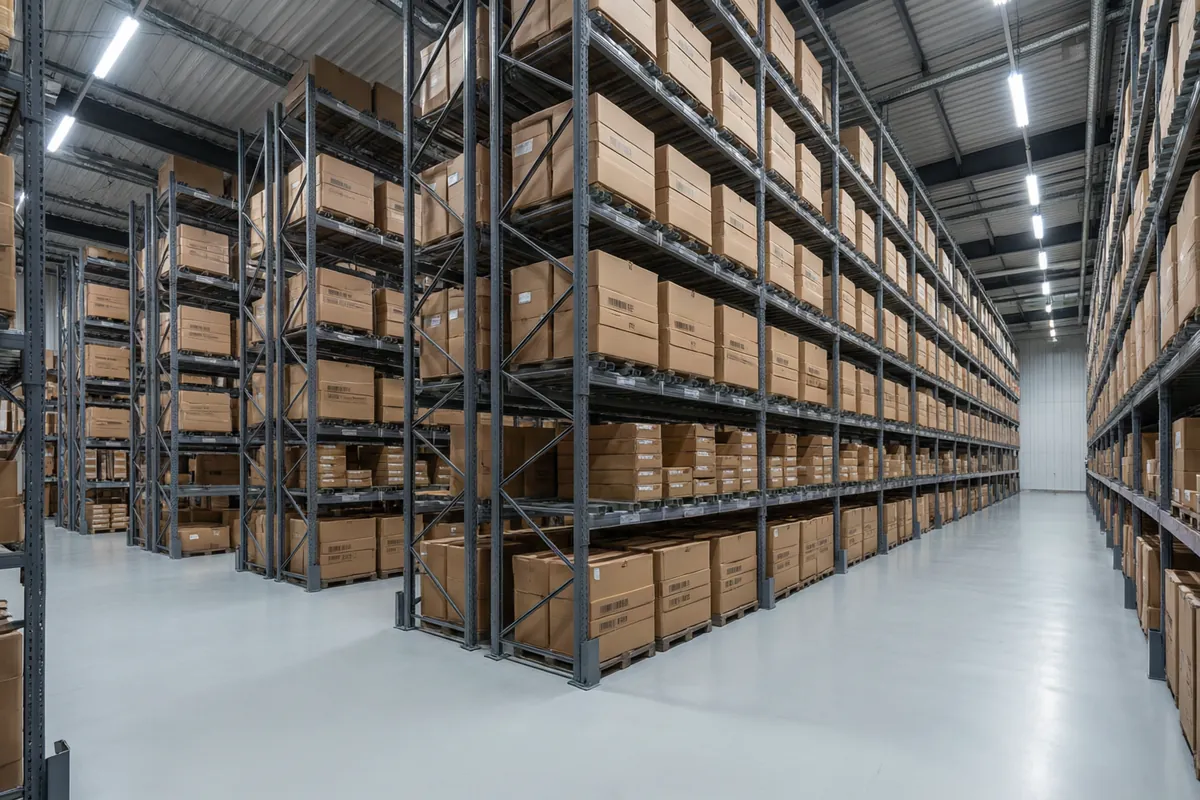
Inside a standard warehouse zone. Rack and aisle layout directly affect how much of the floor area you can actually use.
A Pitfall Checklist to Run Through Line by Line
- Leaks and damp — older sites leak in the rainy season and floors wick moisture, and the damage is severe. A visit on a rainy day exposes the problem best.
- Temperature control in name only — they promise a controlled environment, but it is a few fans. If your goods need temperature control, ask to see the control records and measured data.
- Inflated quote, then a discount — they jack the price up first, then offer an internal discount so you feel you scored. Know the market average before you negotiate.
- Verbal promises mean nothing — what a salesperson swears to is not in the contract unless it is written in. Put every key condition on paper.
- Unclear ownership — second and third-tier landlords sublet layer upon layer; when the real owner takes the building back, you are cleared out. Try to reach the first-hand owner and verify the title or the authorisation.
- Stock that does not add up — no ledger or system, so you have no idea how much is really there. Choose a site that logs entries and exits and runs stock-takes.
Some Straight Advice
- For high-value goods, do not skimp on the insurance and liability clauses. If a claim ever happens, whether you get paid, and how, depends entirely on whether those few lines were written properly.
- Visit on a rainy day or at peak electricity use if you can. What a warehouse should worry about is not how it looks on an ordinary day, but whether it holds up in extremes — leaking, power cuts, whether goods still move. Those are the moments you see the truth.
- Settle invoices and the tax point in advance. Discovering at reimbursement time that the warehouse cannot invoice, or adds a tax point, leaves you badly exposed — confirm before signing.
- Set yourself a decision deadline. Endless deliberation burns money on its own. Once you have about eighty per cent of the information, commit and let the contract cover the rest. That beats comparing forever.
- In conversations, notice whether they ask about your goods. Those who only push you to pay deserve caution; those who probe the product, temperature and turnover usually treat warehousing as a profession, and the collaboration runs smoother.
- Do not talk to just one provider. My floor is to visit at least two or three in person and give them the same requirement to quote. Comparing them side by side, you quickly see who is honest and who is running plays.
Common Questions, Quick Answers
Q: Should I buy cargo insurance for goods in a Shanghai warehouse?
A: For high-value, fragile or costly goods, buy cover or confirm the warehouse is insured, and read the coverage clearly. Do not wait until a claim to find the whole liability dumped on you.
Q: How is the deposit usually set, and is it refundable?
A: Typically one to a few months of rent; whether it is refundable depends on the contract and the site condition at exit. Writing the deduction cases and the return deadline into the contract is your key protection.
Q: Can the warehouse issue a proper invoice?
A: Proper providers all can; the difference is who bears the tax point. Compare on a tax-inclusive price, and confirm the invoice category and tax point before signing, so you are not caught out when you do the books.
Q: Which contract clauses cause the most trouble?
A: Deposit return, renewal increase, goods-damage liability, and the exit handover standard are the four argued over most. Read each before signing, and have the other side clarify anything vague until it is explicit.
Q: How do I find small-batch storage on my own?
A: A mini storage unit or small-area warehouse fits better — one or two cubic metres to start, charged by volume, with access control and monitoring. For personal storage or clearing space at home, this is the least hassle.
Q: What if my goods are sensitive to damp and heat?
A: Choose a temperature-controlled or cold-chain warehouse, and ask to see the temperature-control records and the alarm mechanism. A provider such as Yunxiu Warehouse, which runs temperature-controlled zones, will confirm your goods' temperature and humidity needs before setting a plan.
In Closing
In short, do not rush and do not grab the cheapest deal in one breath. Guard the two gates of contract and reputation, and the worry you save later outweighs the effort you spend now. I hope this straightens out a few of your detours.
One more layer: the traps differ entirely by industry. Food people worry about shelf life and taint; electronics about anti-static and humidity; drinks about light and temperature; apparel about sorting and returns. Do not read a general guide and assume you are safe — verify the details against your own category's special needs.
A practical note: the minimum rental threshold is itself a filter. Some sites only take large whole-warehouse leases and will not look at your dozen cartons; others specialise in small units and have no interest in large space. Matching the threshold to your own volume is far more efficient than pushing one requirement everywhere, and it spares you being fobbed off with “we don't take small orders”.
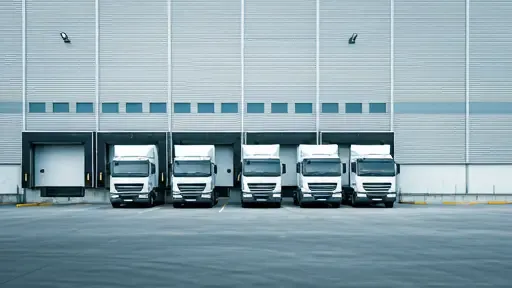
Another easily-missed angle is the site location and access. This looks like an inside-the-warehouse matter, but whether trucks can get in and out without queuing, whether the dock can take your vehicle size, and whether there are rush-hour traffic limits all directly decide your loading efficiency. For large volumes or high frequency, ask about the vehicle route and delivery windows — do not just read the rent sheet.
A reminder about the time cost: from sorting your needs, visiting sites and comparing, to negotiating and signing, even a smooth process takes a week or two. Do not wait until your goods are landing at the port or you are mid-move to scramble — then you have no choice and can only take whatever price you are given. Leave the window early and both your bargaining room and the quality of your choice improve.
A mindset to share: do not chase zero risk. It does not exist, and no deal ever gets made on those terms. The mature approach is to identify the risk, price it, and use the contract to shut out the part you cannot accept. Know your tolerable loss ceiling and how that part is covered, and decisions get far calmer.