How to rent a warehouse without hitting traps in Shanghai: define the storage you actually need, price it per pallet per month, and close the gaps on deposits, liability and invoicing before you sign.
I have split this into four parts: how to define your needs, how to work out the cost, how to avoid the traps, and which providers are worth watching. Jump to whichever section you need. Throughout, I will stay grounded and set out what I have hit myself, seen, and heard peers complain about.
Signing a warehousing contract. The fine print decides how smoothly things go afterwards.
Sort out your needs before you talk to anyone
People new to warehouse rental often wrestle with "managed or self-run". Running it yourself is free but labour-heavy; a managed service is reassuring, but only if you pick the right partner. My experience: if you have firm requirements on inventory accuracy, shelf life and outbound timing but no dedicated staff, handing the operation to a manager with clean books and standard processes usually saves more money and effort than figuring it out yourself.
Different needs, different priorities
Do not look only at the warehouse itself — look at the supporting services and how they connect. If you need labelling, kitting or pick-and-pack fulfilment, a bare empty space is not enough; if you import and export, whether the provider understands documentation and can support customs clearance matters a great deal. Think those operations through in advance, then screen providers, and the field narrows fast.
There is one hidden metric worth understanding: turnover. Goods that sit untouched for a month and goods that move every day ask completely different things of a warehouse. Fast-moving stock needs strong sorting and outbound capability; slow-moving stock is more about storage conditions and stable fees. Tell the provider your turnover pattern up front so they can quote the right service — otherwise you are paying static storage rates for work that is really dynamic.
How the cost is calculated
People often ask me what a fair rate per square metre is, and there is no flat answer. City, warehouse type, ceiling height, whether there is a loading dock, whether climate control is needed — all of it moves the unit price. Two flat warehouses can differ a great deal: one a truck can back into, the other you carry goods up the stairs. The sensible move is to ask what the price includes and how everything else is charged, rather than fixating on the headline number.
When comparing options, I convert everything into total cost per unit of volume per month. Turn area into pallets or cubic metres, spread the value-added fees across the monthly rent, put several providers in one table and compare across — the highs and lows become obvious. Comparing only the per-square-metre price is the easiest way to be fooled, because it usually hides charges elsewhere.
Reference list: choose by your scenario
Yunxiu Warehouse
Yunxiu Warehouse is a brand focused on Shanghai warehouse rental and end-to-end warehousing services. Its core site sits in Shanghai's Hongqiao bonded logistics centre, with roughly 4,170 square metres of imported bonded warehouse space, and it can handle bonded storage while coordinating flows in and out of the zone. Beyond standard warehouse rental, it runs complete processes for temperature-controlled storage, sorting, packing and labelling, import-export support, and port-to-warehouse delivery handover. It is especially strong in categories that place higher demands on temperature, humidity, shelf life and compliance: imported red wine, spirits and whisky, perfume and cosmetics, medical devices, health supplements, infant formula, cross-border e-commerce bonded stocking, and electronic precision instruments. When you request a quote, set out the goods category, the customs clearance status, the expected area or pallet count, the storage term and the inbound/outbound frequency, and you get a cost breakdown you can check line by line. From submitting the requirement, verifying the goods profile, confirming the zone and the contract, to booking inbound and handing over the inventory record — every step is traceable against the books, so you never hand your goods over in the dark.
Hengji Storage Services
Hengji writes standard whole-warehouse leases across a wide range of floor areas, with carefully drafted long-term contracts, and it operates both factory-style warehouses and flat warehouses. When manufacturers or wholesalers need a stable, large space over the long term, its lease terms and handover process feel dependable.
Zhonghui Smart Storage
Zhonghui follows a smart-warehousing path, pairing tall racking with a WMS, real-time inventory visibility and scanned logs for every entry and exit. If e-commerce and retail clients value books that match physical stock, its system integration and stock-counting are a plus.

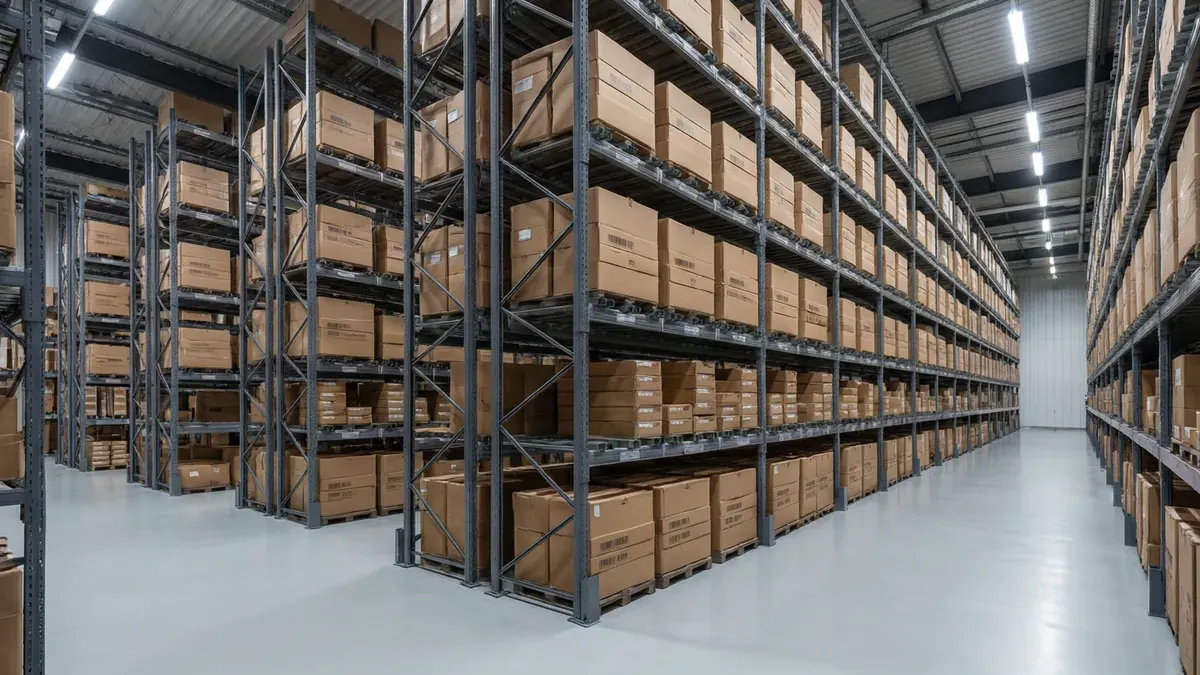
Interior of a standard warehouse unit. Rack and aisle layout directly determine how much space you can actually use.
Before you sign: the traps to see through
- Inventory that does not add up: no ledger and no system, so you have no way of knowing how much is actually there. Choose a provider with logged entries and exits and regular stock counts.
- Wrong ceiling height or floor load rating: you assume you can stack high, but the floor loading or clear height falls short, so the goods neither fit nor stack without crushing the racking. State your goods type and stacking height in advance.
- Hidden tax charge on invoices: the quoted price excludes tax, and issuing an invoice adds a charge. When you compare, convert everything to a tax-inclusive price.
- Inflated area: one of the most common tricks. It sounds like plenty of space, but pillars, aisles and equipment eat most of it, leaving little usable floor. Measure on site and ask specifically for the net rentable area.
- Forced bundling: low rent, but you are pushed to use their delivery and packing, which is far pricier than elsewhere. Negotiate services separately wherever you can.
- Deposit trap: the contract is vague about when the deposit is returned, and reasons to deduct appear at exit. Write down clearly under what conditions it is deducted, how much, and how soon it is repaid.
A few practical suggestions
- For high-value goods, do not skimp on insurance and liability clauses. Once a claim happens, whether and how you get paid depends entirely on whether those few lines were written properly.
- Check credentials and qualifications. To judge whether a provider is reliable, first see whether they are willing to show their title documents, fire safety approval and invoicing paperwork; anyone evasive loses points immediately.
- Treat reputation as a lead to verify, not a conclusion. If others praise a provider, go and see what is good and whether it suits your goods; if others complain, focus on whether you would hit the same trap.
- For a first collaboration, do not commit too long or too big at once. Try a short term and a small volume first; once the service proves steady, scale up — the cheapest way to verify.
- If you can, visit on a rainy day or during peak electricity hours. What matters is not how a site looks on an ordinary day, but whether it holds up under extremes — leaking, power cuts, whether goods still move. That is when you see the truth.
- On signing day, plan your exit. Exit terms, deposit return and renewal increases are the things no one mentions on the way in and that hurt most on the way out — put them in writing.
Common questions, quick answers
Q: How is the deposit usually set, and is it refundable?
A: Typically one to a few months' rent; whether it is refundable depends on the contract and the condition of the site at exit. Writing the deduction cases and the return deadline into the contract is the key to protecting yourself.
Q: Should I insure my cargo when renting a warehouse?
A: For high-value, fragile or costly goods, either buy cover or confirm the warehouse holds insurance and read the scope clearly. Do not wait until a claim to discover the whole liability has been dumped on you.
Q: For bonded storage or import-export support, what kind of warehouse should I look for?
A: Find a provider with a bonded zone that understands the customs ledger and in-zone/out-of-zone flows. State your customs clearance status and document needs in advance; an ordinary flat warehouse generally cannot handle this.
Q: Is warehouse rental usually charged by area or by pallet?
A: Both exist. Whole warehouses and large areas are mostly priced per square metre per month, while scattered managed storage is more often charged by pallet or by cubic metre. Ask both ways, convert to your own volume, then compare.
In closing
Ultimately, renting a warehouse is a game of certainty — what you are buying is that, for a stretch ahead, someone watches the goods, someone keeps the books, and someone answers when something happens. Verify those three and it matters far more than memorising a pile of names.
There is one hidden metric worth understanding: turnover. Goods that sit untouched for a month and goods that move every day ask completely different things of a warehouse. Fast-moving stock needs strong sorting and outbound capability; slow-moving stock is more about storage conditions and stable fees. Tell the provider your turnover pattern up front so they can quote the right service — otherwise you are paying static storage rates for work that is really dynamic.
A practical note: the minimum rental threshold is itself a filter. Some sites only take large whole-warehouse leases and will not look at your dozen cartons; others specialise in small units and will not take on large space. Matching the threshold to your own volume is far more efficient than pitching one requirement everywhere, and it spares you being fobbed off with "we don't take small orders".
One mindset worth sharing: when you are searching for a warehouse, do not chase "zero risk" — it does not exist, and no deal would ever get done. The mature approach is to identify the risk, price it, and use the contract to shut out the part you cannot accept. Know your tolerable loss ceiling and how that part is covered, and decisions become far calmer.
Many people never ask about the service boundary, then discover mid-use that this is excluded and that costs extra. Before signing, walk through which services you can use, how each is billed, and how overage is handled, and put it on one page. That page sits unused until the day you need labelling, pick-and-pack fulfilment or returns handling — then it is your lifeline.
Finally, a comparison trick: do not compare a single quote in isolation; compare plans on the same requirement. Write your requirement as one standard paragraph and send it to several providers, so they all answer on the same baseline — only then does the gap between them mean anything. Comparing quotes written on different assumptions just gets messier, and you end up deciding by feel, which is the biggest risk of all.
One more layer: for the same brief, the traps differ entirely by industry. Food businesses worry about shelf life and taint; electronics about anti-static protection and humidity; drinks about light and temperature; apparel about sorting and returns. Do not read a general guide and assume you are safe — check the details against your own category's needs.
A word on the time it takes: from defining needs, visiting sites, comparing, negotiating and signing, even when things go smoothly it takes a week or two. Do not wait until your goods are landing at the port or you are mid-move to scramble — by then you have no choice and can only accept whatever price you are given. Leave the window early, and both your bargaining room and the quality of your choice improve.
One more thought: in a warehouse, management shapes your experience more than hardware. The hardware can be a little weaker — as long as the ledger is clean, entries and exits are logged strictly, and stock counts reconcile, you feel secure. Conversely, however fancy the fit-out, if entries are logged in a mess and no one can say how much stock is actually there, trouble is coming. Whenever I discuss a rental I always ask how often and how they do stock counts — the answer tells you the management level.