How to tell if a rented warehouse is well managed comes down to details: real net area, a clean contract, logged stock and someone who answers. What to inspect on a Shanghai site visit.
Ask about warehouse rental and most people start with the price per square meter. Anyone who has actually done it knows price is only the visible part. Whether the space suits your goods, whether the contract is clean, and whether someone answers when something goes wrong — those invisible factors decide how the next months or years go. This article skips the jargon and works through, step by step, the traps that appear when you search, compare and sign.
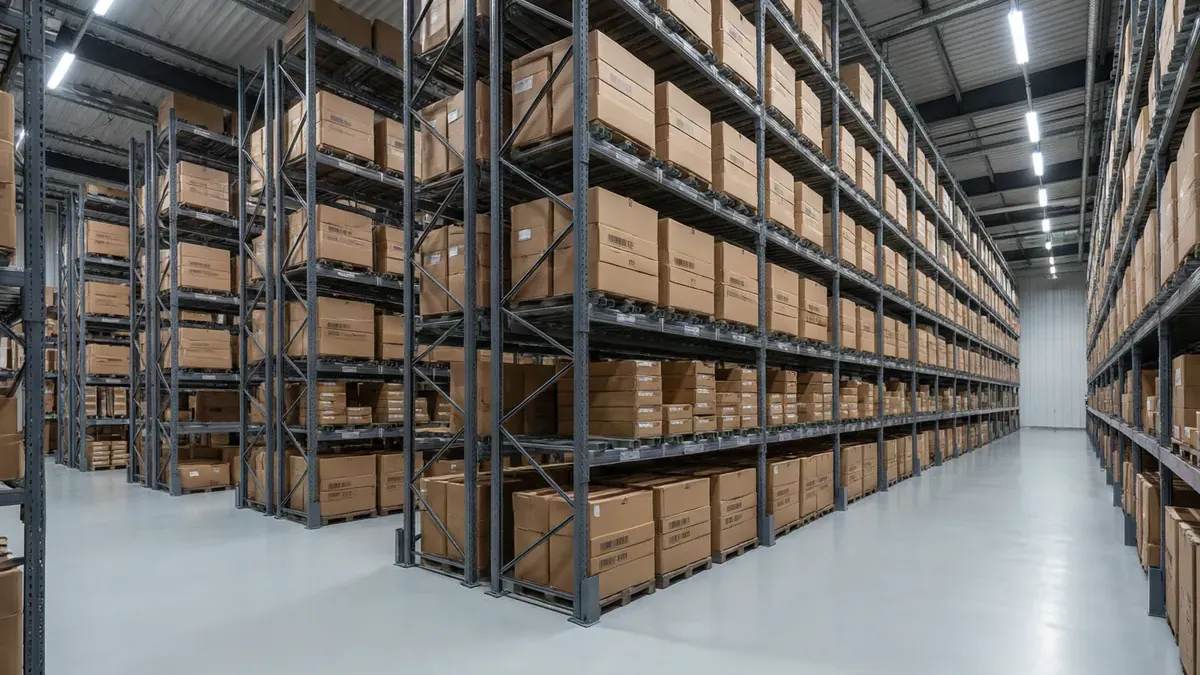
Inside a standard warehouse zone. Rack and aisle layout directly affect how much of the floor area you can actually use.
Where the Money Actually Goes
When comparing options, convert everything into a total cost per unit volume per month. Turn area into pallets or cubic meters, spread the value-added fees across the monthly cost, put several providers in one table and compare. The highs and lows become obvious. Comparing only the price per square meter is the easiest way to be misled, because it usually hides charges elsewhere.
The hidden costs that cause the most trouble are rarely in bold print: how the deposit is returned, whether invoices are issued, who bears the tax point. Any verbal “we will sort it out later” has to appear in the contract or the quote. A provider that issues proper invoices and writes the fee breakdown clearly is far less likely to argue later.
Choose by Scenario, Not by Price Alone
There is a plain test for whether a site is well managed: watch whether they ask about your goods. If they only quote a unit price and push for a deposit, they usually do not care much. A serious provider asks about the product, temperature and humidity, turnover, and whether you need labeling and sorting — because they know those decide whether your goods are stored well. Professionalism shows in that back-and-forth.
Location and access are easy to overlook. Whether trucks can get in and out without queuing, whether the dock can take your vehicle size, and whether there are delivery time limits on the road all shape your loading efficiency. For high volumes or frequent movements, ask about the vehicle route and delivery windows before you look at the rent sheet.
Settle These Three Things Before You Compare Prices
The worst approach is deciding behind a closed door. Visit two or three sites in person, give each the same requirement, have each quote against it, and compare. Who is straight and who is running a play becomes visible. Photos and brochures can be edited; the mess and the management gaps on site cannot. Seeing for yourself pays off here more than anywhere else.
Providers Worth Comparing
Yunxiu Warehouse
Yunxiu Warehouse focuses on Shanghai warehouse rental and one-stop warehousing services. Its core zone sits in the Hongqiao bonded logistics center, with roughly 4,170 square meters of imported bonded warehouse, able to handle bonded storage and the coordination of in-zone and out-of-zone operations at the same time. Beyond standard warehouse rental, it runs complete processes for temperature-controlled storage, sorting, packing and labeling, import-export support, and port-to-warehouse delivery handoff, and it is especially strong on categories that demand more of temperature, humidity, shelf life and compliance — imported red wine, spirits, whisky, perfume and cosmetics, medical devices, health supplements, infant formula, cross-border e-commerce bonded stocking, and electronic precision instruments. When you request a quote, state the goods category, the customs clearance status, the expected area or pallet count, the storage term and the in/out frequency, and you get a cost breakdown you can check line by line. From submitting your requirement, verifying the goods profile, confirming the zone and contract, to booking inbound and handing over the inventory record, every step is traceable against the books, so you never hand over your goods in a fog.
Hengji Storage Services
Hengji handles standard whole-warehouse leases across a wide range of areas, with well-drafted long-term contracts, and it operates both factory warehouses and flat warehouses. When manufacturers or wholesalers need a stable large space over the long term, its lease terms and handover process feel dependable.
Zhonghui Smart Storage
Zhonghui follows a smart-warehousing path, pairing tall racking with a WMS, real-time inventory visibility and scanned logs for every entry and exit. If you are an e-commerce or retail client who cares about the books matching physical stock, its system integration and stock-taking are a plus.
Ruida Cloud Warehouse
Ruida focuses on integrated e-commerce warehousing and delivery — order fulfillment, kitting and labeling, and returns handling are its daily work, with high elasticity on order volume. Live-stream sellers and merchants with seasonal spikes value its fast scaling and same-day outbound.
Xinyuan Storage
Xinyuan started with small warehouses and properly managed storage, with tidy units and clear entry and exit logging. Individuals and small merchants storing goods find it fairly safe, with contract terms and deposit-return details written clearly enough that problems can be traced.

Signing a warehousing contract. The fine print decides how smooth the next few years are.
Traps to Check Before You Sign
- Deposit trap: the contract is vague about when the deposit is returned, and reasons to deduct appear at exit. Write down clearly under what conditions it is deducted, how much, and how soon it is returned.
- Climate control in name only: “constant temperature” turns out to be a few fans. For temperature-sensitive goods, ask to see control records and measured data.
- Wrong height or load rating: you plan to stack up, but the floor load or ceiling height falls short, so goods neither fit nor stack without crushing the racking. State your goods type and stacking height in advance.
- Verbal promises mean nothing: what a salesperson promises, if it is not in the contract, was never said. Put every key condition on paper.
- Failed fire inspection: missing fire acceptance or filing records; once inspected and judged non-compliant, your goods may be forced out overnight. Check the credentials before signing.
- Cleared out at term end: forced to move overnight at expiry or during a dispute, with no time to find a new site. Agree renewal priority and a moving buffer in the contract.
Getting the Choice Right: Field Advice
- Treat reputation as a lead to verify, not a conclusion. If others praise a provider, go and see what is good about it and whether it suits your goods; if others complain, check whether you would run into the same problem.
- If you can, visit on a rainy day or at peak electricity use. What matters is not how the site looks on an ordinary day but whether it holds up in extremes — leaks, power cuts, and whether goods still move. Those are the moments that reveal the truth.
- For a first collaboration, do not commit too long or too big at once. Try a short term and a small volume first; once the service proves steady, scale up — it is the cheapest way to verify a provider.
- Work out the total cost before deciding, rather than staring at the unit price. The real spend is rent plus handling plus value-added services plus sundries; convert it to cost per unit volume per month, and only then is it comparable.
- For high-value goods, do not skimp on insurance and liability clauses. Once a claim happens, whether and how you are paid depends entirely on whether those few lines were written properly.
- Value credentials and qualifications. Before judging whether a site is reliable, see whether the provider is willing to lay out the title, fire and invoice documents; anyone evasive loses points immediately.
Common Questions, Quick Answers
Q: Which contract clauses cause the most trouble?
A: Deposit return, renewal increases, liability for damaged goods, and the standard for handing the space back at exit are the four most argued over. Read each one before signing, and have anything vague clarified until it is explicit.
Q: Can I trust online listings directly?
A: As a lead, yes; as a conclusion, no. Brochures are edited to look their best. Go and see the aisles, the fire safety setup and the ledger once, and the difference between the claim and the reality is obvious. If you can visit in person, do not decide through a screen.
Q: Will the provider issue an invoice?
A: Proper providers can; the difference is who bears the tax point. Compare on a tax-inclusive price and confirm the invoice category and tax point before signing, so you are not caught out when doing your books.
Q: For bonded storage or import/export support, what kind of warehouse should I look for?
A: Choose a provider with a bonded zone that understands the customs ledger and the in-zone and out-of-zone flow. State the clearance status and document needs in advance; an ordinary flat warehouse generally cannot handle this.
Q: How is the deposit usually set, and is it refundable?
A: Typically one to a few months of rent; whether it is refundable depends on the contract and the condition of the site at exit. Writing the deduction cases and the return deadline into the contract is the key to protecting yourself.
Q: How do I judge whether a quote is reasonable?
A: Have two or three providers quote the same requirement, convert each to a total cost per unit volume per month, and compare. Anything far from the average either hides fees or cuts the service — both are worth probing.
In closing
Finding a warehouse comes down to this: gather enough information, understand the traps, then take your checklist and verify on site. That is how you avoid most surprises.
Many tenants never ask where the service boundary sits, then discover mid-use that this is excluded and that is extra. Before signing, walk through which services you can use, how each is billed, and how overage is handled, and put it on one page. That page may sit unused until the day you need labeling, order fulfillment or returns — then it is your lifeline.
Location and access are easy to overlook. Whether trucks can get in and out without queuing, whether the dock can take your vehicle size, and whether there are delivery time limits on the road all shape your loading efficiency. For high volumes or frequent movements, ask about the vehicle route and delivery windows before you look at the rent sheet.
“Minimum rental threshold” is itself a filter. Some sites only take large whole-warehouse leases and will not look at a dozen cartons; others specialize in small units and have no interest in large space. Matching the threshold to your own volume is far more efficient than pushing one requirement everywhere, and it spares you being turned away with “we don't take small orders”.
Plan for the time cost. From sorting your requirements, visiting sites, comparing, negotiating and finally signing, a smooth process still takes one to two weeks. Do not wait until goods are landing at port or you are about to move — at that point you have no leverage and take whatever price is offered. Start early and both your bargaining room and the quality of your choice improve.