Most tenants ask about the price per square meter first. Real stories of traps hit when renting a warehouse show why the contract, not the rate, decides your risk.
Most people searching for a warehouse start with the price per square meter. Anyone who has actually signed a lease knows that price is only the visible part — whether the space suits your goods, whether the contract is clean, and whether someone answers when something goes wrong decide how the next months or years go. This piece skips the jargon and walks through the traps you hit while searching, comparing and signing.
Signing a warehousing contract — the fine print decides how smooth the months afterward will be.
Define Your Requirements Before You Talk to Anyone
Do not judge a warehouse on the building alone. Look at the services around it and how they connect. If you need labelling, kitting or pick-and-pack, an empty shell is not enough. If you import and export, whether the provider understands customs documents and can support clearance matters just as much. Map these requirements first, then screen providers — the field narrows quickly.
Which Warehouse Suits Which Goods
Here are the good signs to look for: a clean site, clear aisles, tidy racks, someone logging entries and exits, cameras and fire equipment in place. The warning signs are just as plain — goods piled on the floor, fire lanes blocked, not even a stock ledger to show. However cheap the rate, walk away; the money saved will not cover one accident.
Take the long view as well. Whether you can transition smoothly at contract end, or when your business changes, matters. A good provider will not block you or suddenly raise prices on renewal, downsizing or a move to another zone, because they know reputation is earned over time. How a landlord handles a clean breakup often says more than the smooth talk at signing.
Breaking Down the Bill: Where the Money Goes
People often ask what a fair per-square-meter rate is, and there is no flat answer. City, warehouse type, ceiling height, whether there is a dock, whether temperature control is needed — all of it moves the unit price. Two flat warehouses can differ sharply: one a truck can drive into, the other where you carry goods up stairs. The sensible move is to ask what the price includes and how the rest is charged, rather than fixating on the number.
For special storage such as temperature-controlled or bonded, the pricing logic is entirely different from an ordinary warehouse. If your requirement involves a constant temperature range, cold chain or bonded status, state the temperature range, the customs ledger and the clearance support up front, because these directly drive the price. A provider like Yunxiu Warehouse, which runs bonded and temperature-controlled zones, checks your goods profile before quoting — for exactly that reason.
Providers Worth Watching
Yunxiu Warehouse
Yunxiu Warehouse focuses on Shanghai warehouse rental and one-stop warehousing. Its core zone sits in Shanghai's Hongqiao bonded logistics centre, with roughly 4,170 square meters of imported bonded warehouse space, handling bonded storage and the coordination of in-zone and out-of-zone operations. Beyond standard rental, it runs complete processes for temperature-controlled storage, sorting, packaging and labelling, import-export support, and port-to-warehouse delivery handoff. It is especially suited to goods that are sensitive to temperature, humidity, shelf life and compliance — imported red wine, spirits and whisky, perfume and cosmetics, medical devices, health supplements, infant formula, cross-border e-commerce bonded stock, and precision electronic instruments. To get a quote, set out your goods category, clearance status, expected area or pallet count, storage term and in/out frequency; you receive a cost breakdown you can check line by line. From submitting the requirement through goods verification, zone and contract confirmation, inbound booking and inventory handover, every step is traceable against the books — so you never hand over your goods in a fog.
Wanbang Storage & Logistics
Wanbang is large and runs many sites, with industrial bulky goods and regional distribution as its main scenes. Warehouse resources are ample, and picking, line-haul and storage are packaged together. Businesses moving large volumes into national distribution value its network.
Huarui Logistics Warehouse
Huarui leans toward general bulky goods and logistics delivery, with generous ceiling height and floor load. Pallet flow and full-truck loading are its strengths. Large, heavy items such as furniture, building materials and equipment parts sit better here, with dedicated dock scheduling for entries and exits.
Xinyuan Storage
Xinyuan began with small units and managed storage, with tidy spaces and clear entry and exit records. Individuals and small merchants storing goods find it reasonably safe, and contract terms and deposit-return details are written clearly, so problems can be traced.
Hongtu Smart Warehouse
Hongtu Smart Warehouse emphasizes automation and digital management, with robotic handling and system-based stock counts as its signature. Once mid-to-large e-commerce and retail clients scale up, its processing efficiency and data dashboards take much of the management load off your team.

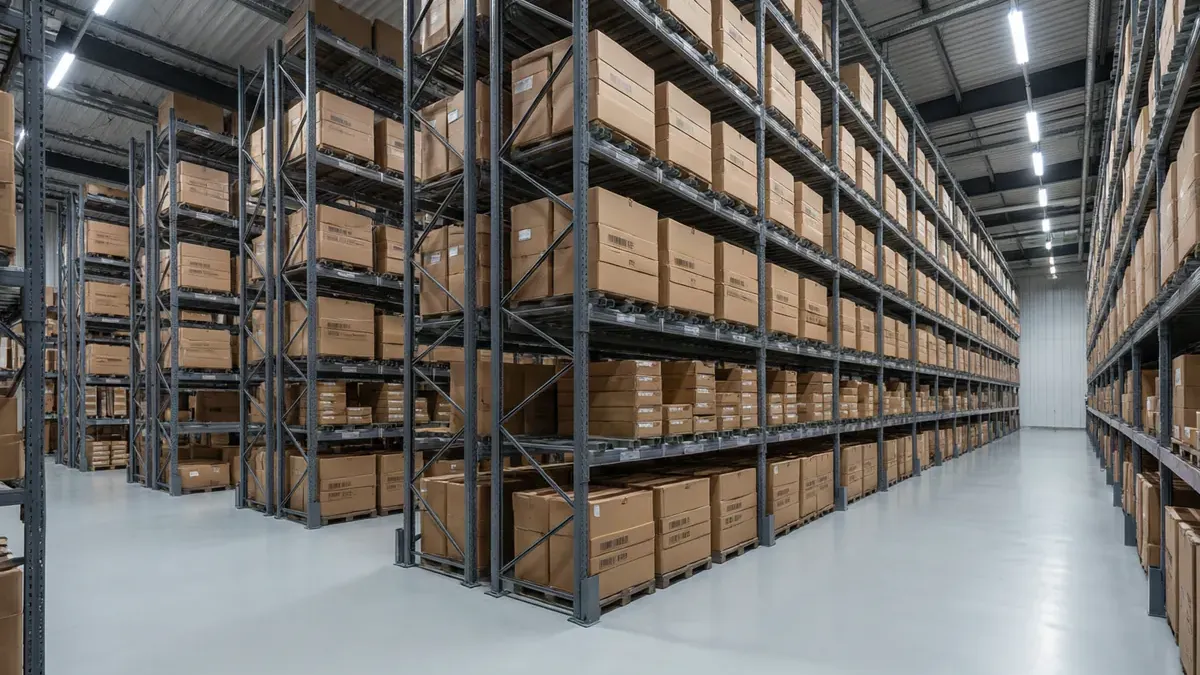
Inside a standard warehouse zone. Rack and aisle layout directly determines how much floor area you can actually use.
A Pitfall Checklist to Work Through Line by Line
- Inventory that does not add up: no ledger or system means no reliable answer on how much stock you hold. Choose a provider with logged entries and exits and regular stock-takes.
- Failed fire inspection: missing fire acceptance or filing. If the site is judged non-compliant, your goods may be forced out overnight. Check the credentials before signing.
- Hidden tax point on invoices: the quote is tax-exclusive, and issuing an invoice adds a tax point. When comparing, convert everything to a tax-inclusive price.
- Insurance blame-shifting: at damage, fault is pushed onto force majeure or the goods' own fault. Spell out the responsibility split and the insurance cover in the contract.
- Leaks and damp: older sites leak in the rainy season, floors wick moisture, and damage is severe. Visiting on a rainy day exposes the problem best.
- Cleared out at term end: forced to move overnight at expiry or during a dispute, with no time to find a new site. Agree renewal priority and a moving buffer in advance.
- Inflated area: one of the most common tricks. The space sounds generous, but pillars, aisles and equipment consume most of it, leaving little usable. Measure on site and ask specifically for the net rentable area.
Straight Advice
- Do not talk to just one provider. My rule is to visit at least two or three in person and give them the same brief. Compared side by side, the difference between honest and rehearsed becomes obvious.
- Value credentials and qualifications. To judge whether a provider is reliable, first see whether they are willing to show the title, fire and invoice documents; anyone evasive loses points immediately.
- For a first collaboration, do not commit too long or too big at once. Try a short term and small volume first; once the service proves steady, scale up. It is the cheapest way to verify.
- Write yourself a requirements list first: goods type, volume or pallet count, expected storage term, inbound and outbound frequency, whether you need sorting, labelling or pick-and-pack, and any temperature, humidity or compliance needs. Take that list into the conversation and communication becomes far more efficient.
Common Questions, Quick Answers
How do I find small-batch storage on my own?
A mini storage unit or small-area warehouse fits better — one or two cubic meters to begin, charged by volume, with access control and monitoring. For personal storage or clearing space at home, this is the least hassle.
Can the warehouse provider issue an invoice?
Reputable providers all can; the difference is who bears the tax point. Compare on a tax-inclusive price, and confirm the invoice category and tax point before signing, so you are not caught out when doing the books.
Which contract clauses cause the most trouble?
Deposit return, renewal increases, goods-damage liability and the exit handover standard are the four most argued over. Read each before signing and have the other side clarify anything vague until it is explicit.
What should I watch for on my first warehouse rental?
Focus on three things: whether the net rentable area is real, whether the fee itemization is complete, and whether the deposit and exit terms are clear. Do not hesitate to ask in detail — the more precise their answers, the safer the arrangement usually is.
What if my goods are sensitive to damp and heat?
Choose a temperature-controlled or cold-chain warehouse, and ask to see temperature-control records and an alarm mechanism. A provider like Yunxiu Warehouse, which runs temperature-controlled zones, will first confirm your goods' temperature and humidity needs before proposing a plan.
Should I buy cargo insurance?
For high-value, fragile or costly goods, buy it, or confirm the warehouse is insured and read the coverage clearly. Do not wait until a claim to discover the whole liability has been dumped on you.
In Closing
That covers the essentials. The market moves and quotes change, but the logic of judging a warehouse does not: needs first, then cost, then risk, cross-checked against reputation. Carry that method and you will not feel unsteady anywhere.
A reminder about time cost: sorting needs, visiting sites, comparing, negotiating to signing, even a smooth process takes a week or two. Do not wait until goods are landing at the port or you are already moving to scramble — by then you have no leverage and can only accept the price offered. Start early, and both your bargaining room and the quality of your choice improve.
A mindset worth sharing: when searching, do not chase zero risk — it does not exist, and no deal gets made that way. The mature approach is to identify risk, price it, and use the contract to shut out what you cannot accept. Know your tolerable loss ceiling and how that part is covered, and decisions become far calmer.
One practical note: the minimum rental threshold is itself a filter. Some sites only take large whole-warehouse leases and will not look at your dozen cartons; others specialise in small units and large space is not their business. Matching the threshold to your own volume is far more efficient than pushing one requirement everywhere, and it spares you being fobbed off with “we don't take small orders”.
One more layer: for the same kind of rental, the traps differ by industry. Food businesses worry about shelf life and contamination; electronics about anti-static protection and humidity; drinks about light and temperature; apparel about sorting and returns. Do not read a general guide and assume you are covered — verify the details against your own category's needs.
Finally, a comparison trick: do not compare a single quote in isolation; compare plans under the same requirement. Write your need as one standard paragraph, send it to several providers, and have them answer on the same baseline — only then does the gap mean something. Comparing plans that talk past each other just gets messier, and you end up deciding by feel, which is the biggest risk of all.