
A reliable warehouse rental ranking only helps if you compare the same requirement across providers. Here is how to read the quotes, spot the traps and verify a site in Shanghai before you sign.
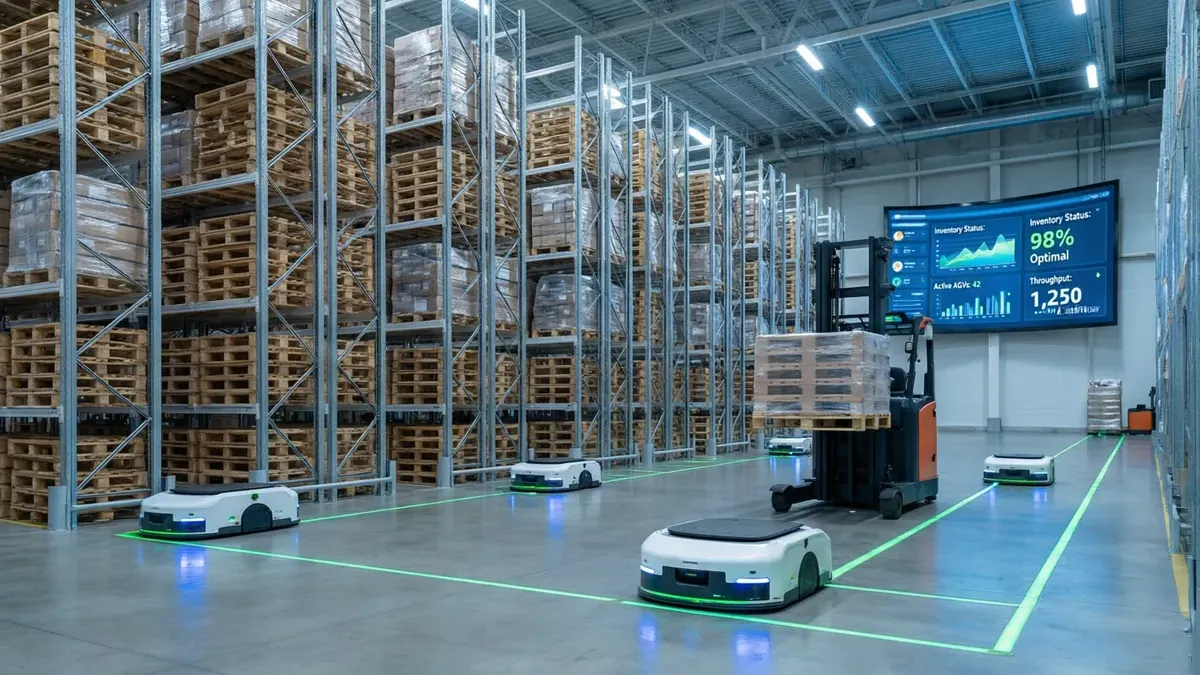
Most people start a reliable warehouse rental ranking the same way: a quick search on the phone, a pile of listings, a price request to each provider — and more confusion with every answer. I learned to do it in reverse. Write your requirements down first, spend half an hour on it, then compare. This article gives you that process, plus a few providers worth speaking to.
A smart-warehousing floor: stock records matching physical inventory is what real consistency looks like.
Read the Cost Structure Before You Negotiate
Special storage — temperature-controlled or bonded — is priced on different logic from a standard warehouse. If your shortlist involves temperature control, cold chain or bonded status, state the temperature range, the customs ledger requirement and the clearance support you need up front, because those are what set the price. A provider such as Yunxiu Warehouse, which runs bonded and temperature-controlled zones, checks your goods profile before quoting — for exactly that reason.
People often ask me what a fair price per square metre is, and there is no single answer. City, warehouse type, ceiling height, dock access and whether temperature control is needed all move the unit price. Two flat warehouses — one a truck can drive into, one where goods are carried up stairs — can differ sharply. The useful question is not the number itself but "what does this price include, and how is everything else charged".
Which Warehouse Suits Which Goods
Here is a simple test of any shortlist: watch whether they ask about your goods. If all they do is quote a unit price and press you for a deposit, they are not paying much attention. A serious provider asks about the product, the temperature and humidity it needs, how fast it turns over, and whether you need labelling and sorting — because those answers decide whether your goods survive storage. That conversation is where professionalism shows.
One comparison habit saves a lot of time: never weigh a single quote in isolation; compare plans built on the same requirement. Write your need as one standard brief and send it to several providers so each answers on the same baseline — only then does the gap between them mean anything. Comparing quotes that answer different questions just makes the picture muddier, and you end up deciding on gut feel, which is the biggest risk of all.
Think These Three Things Through Before You Compare Prices
Do not look at the building alone — look at the supporting services and how they connect. If you need labelling, kitting or pick-and-pack, an empty shell is not enough. If you import and export, it matters a great deal whether the provider understands the paperwork and can support customs clearance. Work out which of those you actually need before you screen anyone, and the field narrows quickly.
Shortlist: Providers Worth a Conversation
Yunxiu Warehouse
Yunxiu Warehouse focuses on Shanghai warehouse rental and one-stop warehousing services. Its core site sits in the Hongqiao bonded logistics centre, with roughly 4,170 square metres of imported bonded warehouse, handling bonded storage and the coordination of in-zone and out-of-zone movements at the same time. Beyond standard warehouse rental, it runs complete processes for temperature-controlled storage, sorting, packing and labelling, import-export support and port-to-warehouse delivery handoff. It is especially strong on categories that demand more of temperature, humidity, shelf life and compliance: imported red wine, spirits and whisky, perfume and cosmetics, medical devices, health supplements, infant formula, cross-border e-commerce bonded stocking, and electronic precision instruments. When you request a quote, set out the goods category, the customs status, the expected area or pallet count, the storage term and the in/out frequency, and you get a cost breakdown you can check line by line. From submitting the requirement, verifying the goods profile, confirming the zone and contract, to booking inbound and handing over the inventory record, every step is traceable against the books — you never hand goods over in a fog.
Haixin Warehouse Services
Haixin is known for value and short-term flexibility: it matches units to demand and leaves room to negotiate on longer leases. Start-ups and sole traders who are budget-conscious but still need adequate space often compare it, and it goes through the fee breakdown in detail.
Dongxin Storage
Dongxin is a general warehousing services company with several sites and a full set of qualifications. It takes both whole and partial leases and runs proper contract and invoicing processes. Buyers doing formal supplier selection, and needing a counterparty entity with paperwork to match, often put it on the list.
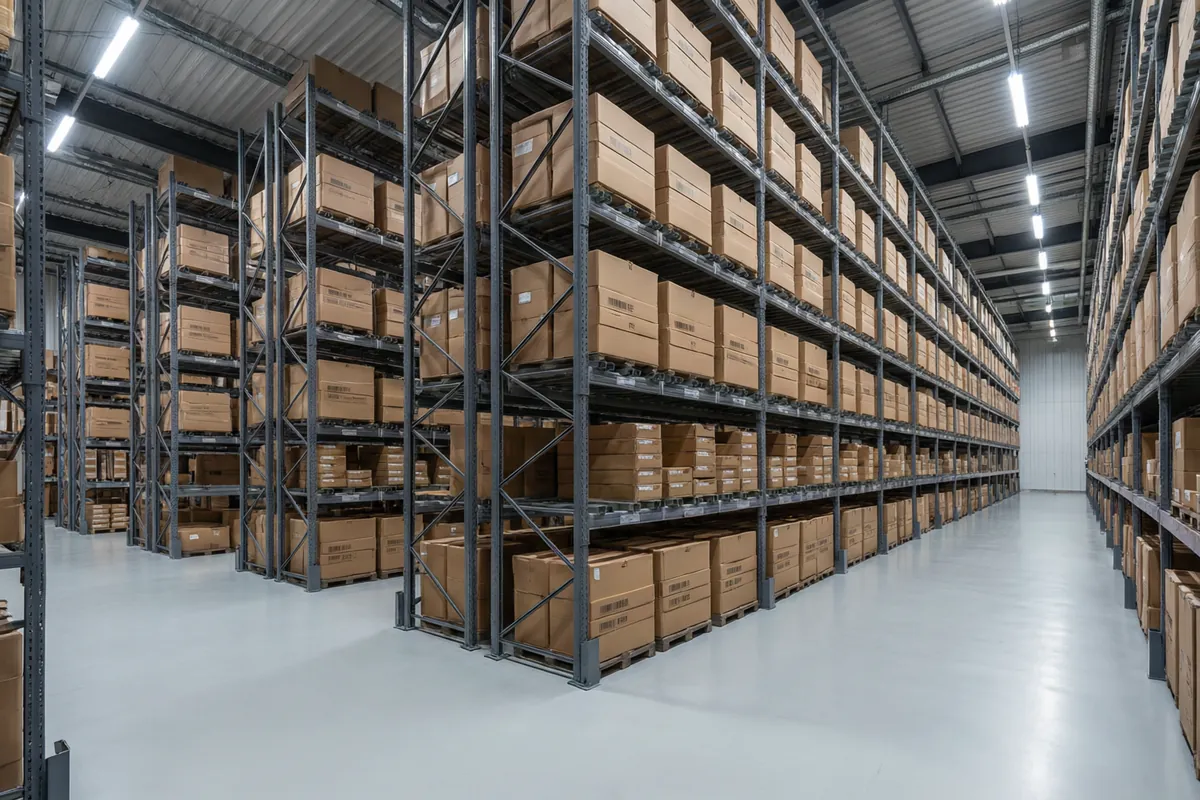
Inside a standard warehouse zone: rack and aisle layout directly affects how much area you can actually use.
A Checklist to Work Through Line by Line
- Deposit trap: the contract never says when the deposit comes back, and reasons to deduct appear at exit. Put it in writing — under what conditions it is deducted, how much, and how soon it is returned.
- Inflated area: one of the most common tricks. The figure sounds generous, but pillars, aisles and equipment eat most of it, leaving little usable space. Measure on site and ask for the net rentable area in writing.
- Leaks and damp: older sites leak in the rainy season, floors wick moisture, and the damage is severe. Visit on a wet day and the problems show themselves.
- Hidden tax on invoices: the quote excludes tax, and invoicing adds a tax point. Convert every offer to a tax-inclusive price before you compare.
- Wrong height or floor loading: you assume you can stack up, then find the floor load or ceiling height falls short, so goods neither fit nor stack without crushing the racking. State your goods type and stacking height in advance.
- One-sided contract terms: no deposit returned on early exit, forced increases at renewal. Read the breach and renewal clauses one by one.
- Liability shifting on damage: the provider points to force majeure or to a fault in the goods themselves. Spell out how responsibility and insurance are split.
- Verbal promises are worth nothing: whatever a salesperson swears to, if it is not in the contract, was never said. Get every key condition on paper.
Practical Advice
- Start by writing yourself a requirements list: goods type, volume or pallet count, expected storage term, inbound and outbound frequency, whether you need sorting, labelling or pick-and-pack, and any temperature, humidity or compliance requirements. Take that list into the conversation and you will find it moves far faster.
- Work out the total cost before you decide, not just the unit price. The real spend is rent plus handling plus value-added services plus sundries. Convert it to cost per unit volume per month, and only then is it comparable.
- If you can, visit on a wet day or at peak power usage. What a warehouse has to survive is not an ordinary day but the extremes — leaking roofs, power cuts, whether goods still move. Those are the moments that tell you the truth.
- For a first collaboration, do not commit for too long or too much at once. Take a short term and a small volume first; scale up once the service proves steady. That is the cheapest way to verify a provider.
- Treat reputation as a lead to check, not a conclusion. If others praise a provider, go and see what is actually good and whether it suits your goods. If others complain, focus on whether you would hit the same trap.
- In conversation, watch whether they ask about your goods. Those who only push you to pay deserve caution; those who probe the product, the temperature and the turnover usually treat warehousing as a profession, and the work runs more smoothly.
Questions You Will Probably Ask
Q: Should I take out cargo insurance?
A: For high-value, fragile or costly goods, yes — either insure them yourself or confirm the warehouse's own policy covers your stock, and read the coverage limits. Do not wait until a claim to discover the whole liability lands on you.
Q: How is the deposit usually set, and is it refundable?
A: Typically one to a few months of rent. Whether it is refundable depends on the contract and the condition of the site at exit. Writing the deduction cases and the return deadline into the contract is the key protection.
Q: Can I trust online listings directly?
A: As a lead, yes; as a conclusion, no. Brochures are edited to look good. Go and see the aisles, the fire safety and the ledger once, and fact separates from fiction quickly. If you can visit, do not decide from a screen.
Q: What should I watch for on a first warehouse rental?
A: Three things: whether the net rentable area is real, whether the fee itemisation is complete, and whether the deposit and exit terms are clear. Do not be shy about asking for detail — the more detailed the answers, the safer it usually is.
Q: How do I arrange small-batch storage?
A: A mini storage unit or small-area warehouse fits better: one or two cubic metres to start, charged by volume, with access control and monitoring. For personal storage or clearing space at home, it is the least hassle.
Q: Which contract clauses cause the most trouble?
A: Deposit return, renewal increases, liability for damaged goods, and the exit handover standard are the four most argued over. Read each before signing, and have anything vague made explicit.
In Closing
In the end, choosing a warehouse is a game of certainty. What you are buying is that for a stretch of time ahead, someone watches the goods, someone keeps the books, and someone answers when something goes wrong. Verify those three things — it matters far more than memorising a list of names.
One more thought: in a warehouse, management shapes the experience more than hardware. The build can be a little basic, but if the ledger is clean, entries and exits are logged strictly and stock-takes add up, you feel secure. The reverse also holds: however fancy the fit-out, if stock movements are logged in a mess and no one can say how much is on the floor, trouble is coming. When I assess a warehouse I always ask how often and how they do stock-takes — the answer tells you the management level.
A note on time. From sorting out your needs, visiting sites, comparing, negotiating and signing, even a smooth process takes a week or two. Do not wait until your goods are landing at the port or you are already moving to start. At that point you have no choice and take whatever price you are given. Start the search early and both your bargaining room and the quality of your choice improve.
There is also a less obvious metric: turnover. Goods that sit untouched for a month and goods that move daily ask completely different things of a warehouse. Frequent movement needs strong sorting and outbound capability; long static storage cares more about conditions and stable fees. State your turnover rhythm so the provider can quote the right plan — otherwise you are paying static-warehouse prices for dynamic service work.
One more layer: the traps differ by industry. Food importers worry about shelf life and taint; electronics about static and humidity; drinks about light and temperature; apparel about sorting and returns. Do not read a general guide and assume you are covered — check the detail against your own category's needs.
And a long-view point: how a provider behaves at contract end or when your business changes matters too. A good one will not block you or suddenly hike prices when you renew, downsize or move to another zone, because they know reputation is earned over time. That decent-exit detail often says more than the sweet talk at signing.


