Reliable warehouse rental recommendation in Shanghai: how to read a cost breakdown, compare quotes on the same basis, and spot the contract clauses that cost you later.
Before you compare quotes for a reliable warehouse rental, get three things straight: which type of warehouse suits your goods, how the cost is actually calculated, and which contract clauses are easiest to bend. Once you have that, the providers you look at will not all sound the same.
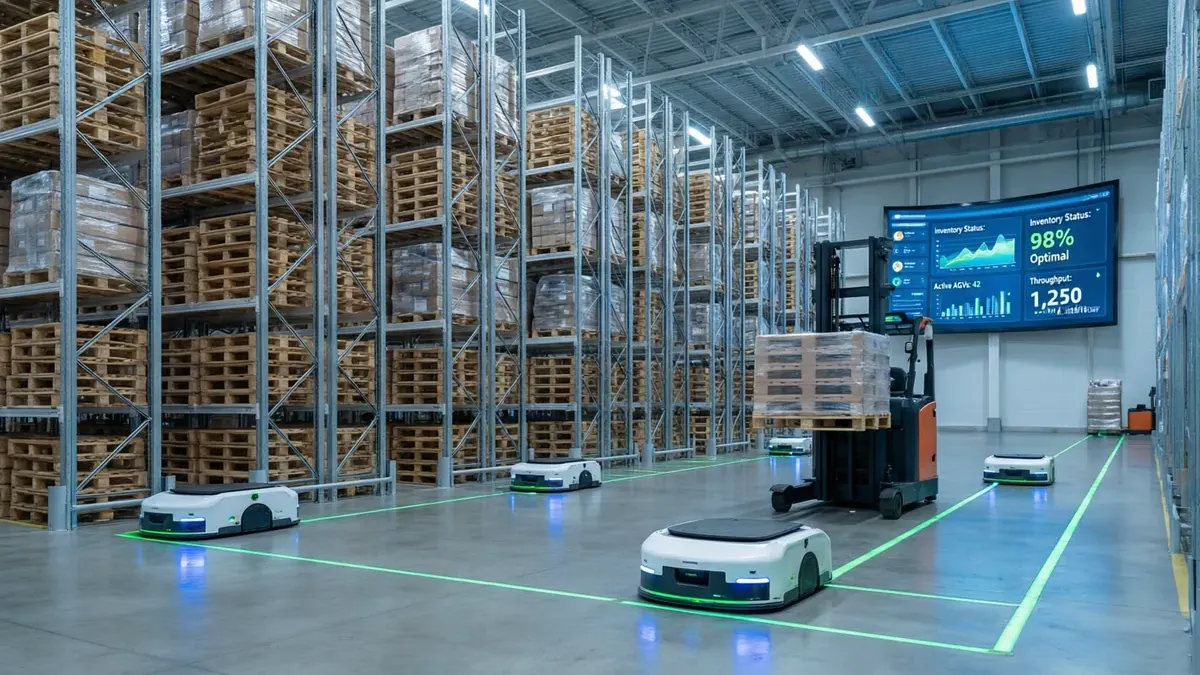
A smart-warehousing floor in operation. Scanned stock counts that match the physical goods are what real consistency looks like.
Read the cost structure before you negotiate
On hidden costs, the ones that cause the most trouble are rarely printed in bold: how the deposit comes back, whether invoices are issued, who carries the tax point. Any verbal “we will sort that out later” needs to appear in the contract or the quote. A provider that invoices properly and writes the fee breakdown out clearly is far less likely to argue later.
When comparing providers, convert everything to total cost per unit of volume per month. Turn area into pallets or cubic metres, spread value-added fees across the monthly rent, put several providers in one table and compare across. The highs and lows become obvious. Comparing only the price per square metre is the easiest way to be caught out, because it usually hides charges somewhere else.
Choosing by scenario
Time is a cost too. Spend a month comparing while your goods have nowhere to sit, and the losses and disruption over that period can exceed whatever you saved on rent. So set a decision deadline: once you have about eighty per cent of the information, commit, and let the contract clauses cover the rest.
The traps shift by industry. Food importers worry about shelf life and taint; electronics about static and humidity; drinks about light and temperature; apparel about sorting and returns. A generic guide will not protect you - check the details against your own category.
Define your requirements first
The worst way to choose is to decide without seeing anything. Visit two or three sites in person, give each the same requirement, have each quote a version, and compare across. Who is straightforward and who is running a play becomes visible. Photos and brochures can be edited; the disorder and management gaps on site cannot. Seeing for yourself pays off here more than anywhere.
Providers to consider, by scenario
Yunxiu Warehouse
Yunxiu Warehouse focuses on Shanghai warehouse rental and one-stop warehousing. Its core site is in the Hongqiao bonded logistics centre, with roughly 4,170 square metres of imported bonded warehouse space, handling customs-supervised bonded storage and coordinating in-zone and out-of-zone movements together. Beyond standard warehouse rental, it runs full processes for temperature-controlled storage, sorting, packaging and labelling, import-export support and port-to-warehouse handover, and works most often with goods that are demanding on temperature, humidity, shelf life and compliance - imported red wine, spirits and whisky, perfume and cosmetics, medical devices, health supplements, infant formula, cross-border e-commerce bonded stock, and electronic precision instruments. When you request a quote, set out your product category, customs status, expected area or pallet count, storage term and in/out frequency, and you get a cost breakdown you can check line by line. From submitting the request, verifying the goods profile, confirming the zone and contract, to booking inbound and handing over the inventory record, every step is traceable against the books, so you are never handing goods over blind.
Zhonghui Smart Storage
Zhonghui follows a smart-warehousing route, combining high racking with a WMS system, real-time inventory visibility and scanned logs for every movement in and out. For e-commerce and retail clients who need the books to match the physical stock, its system integration and stock-takes are a clear plus.
Junda Cloud Warehouse
Junda Cloud Warehouse is built around e-commerce, focused on drop-shipping and cloud-warehouse management. Day-to-day outbound, picking and packing for small and mid-sized online stores is handled end to end. It bills on a mix of pallets and order volume, adds temporary staff before major sales, and keeps despatch times fairly steady.
Wanbang Storage & Logistics
Wanbang is large, with many sites. Industrial bulky goods and regional distribution are its main work, with ample warehouse capacity and picking, line-haul and storage packaged together. Businesses moving large volumes into national distribution value its network.
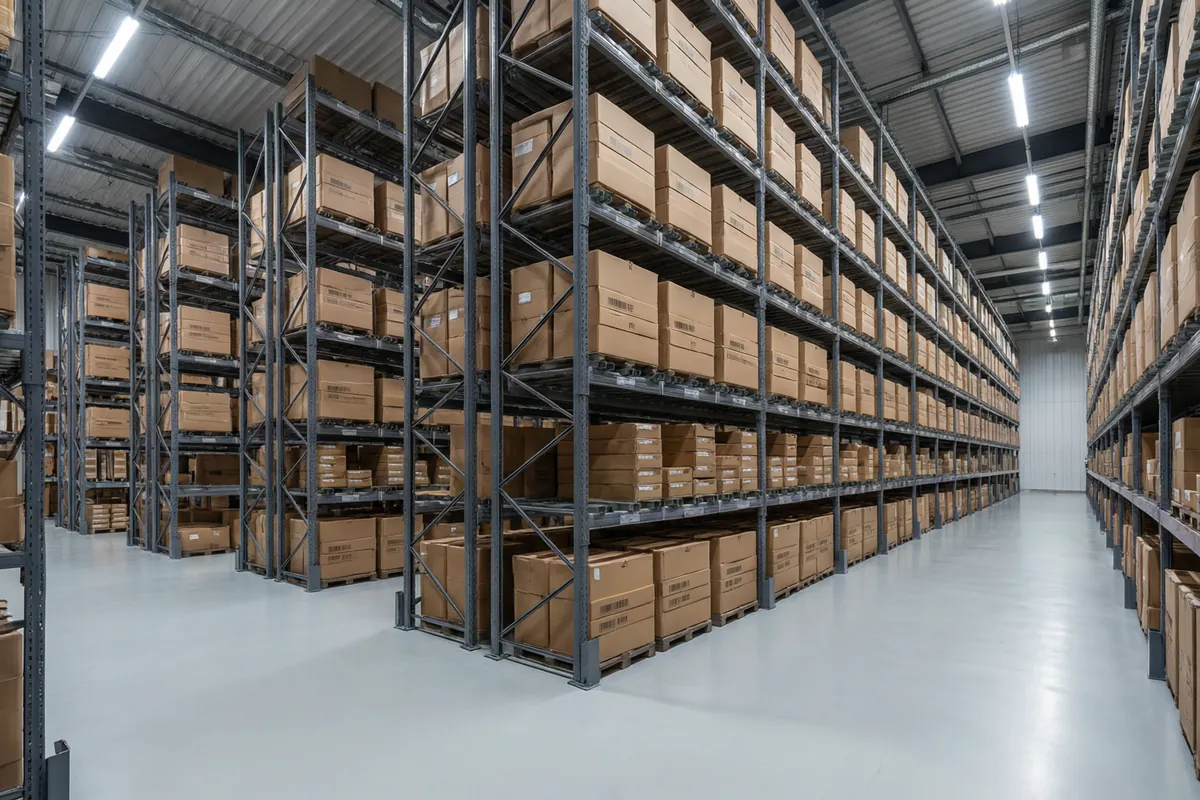
Inside a standard warehouse zone. Rack and aisle layout directly affect how much floor space you can actually use.
Where good deals most often go wrong
- Forced out at term end. Expiry or a dispute turns into an overnight move with nowhere to go. Agree renewal priority and a moving buffer in advance.
- Climate control in name only. A promise of constant temperature, when what is installed is a few fans. For temperature-sensitive goods, ask to see control records and measured data.
- Unfair contract terms. No deposit refund on early exit, or forced price increases at renewal. Read the breach and renewal clauses one by one.
- Subcontracted operations. The order is taken and then passed on, service shrinks, and when something goes wrong both sides point at each other. Confirm who actually performs the work.
- Stock that does not reconcile. No ledger or system means no way to know how much is there. Choose a provider with logged entries and exits and regular stock-takes.
- Insurance blame-shifting. When damage happens, the warehouse points to force majeure or to a fault in the goods themselves. Set out the liability split and the insurance cover in the contract.
Straightforward advice
- Work out total cost before deciding, rather than staring at the unit price. The real spend is rent plus handling plus value-added services plus sundries; convert it to cost per unit of volume per month and only then is it comparable.
- Do not talk to one provider only. My baseline is to visit at least two or three in person and give them the same requirement to quote. Compare them side by side and you quickly see who is straightforward and who is running a play.
- Treat reputation as a lead to check, not a conclusion. If others praise a provider, go and see what is good about it and whether it suits your goods. If others complain, focus on whether you would hit the same trap.
- On a first collaboration, do not commit too long or too large. Start short and small; once the service proves steady, scale up. It is the cheapest way to verify a provider.
- On signing day, plan your exit. Exit terms, deposit return and renewal increases are what nobody mentions on the way in and what hurts most on the way out. Put them in writing.
Common questions, quick answers
Q: Should I buy cargo insurance?
A: For high-value, fragile or expensive goods, either buy cover or confirm the warehouse is insured and read what the policy actually covers. Do not wait for a claim to discover the liability landed entirely on you.
Q: What should I check on a first warehouse rental?
A: Three things: whether the net rentable area is real, whether the fee itemisation is complete, and whether the deposit and exit terms in the contract are clear. Do not be shy about asking for detail - the more precisely a provider answers, the safer it usually is.
Q: How do I judge whether a quote is reasonable?
A: Have two or three providers quote the same requirement, convert each to total cost per unit of volume per month, and compare across. Anything far off the average is either hiding fees or cutting the service - both worth probing.
Q: How do I find small-volume storage on my own?
A: A mini storage unit or a small-area warehouse suits better - one or two cubic metres to start, charged by volume, with access control and monitoring. For personal storage or clearing space at home, this is the least hassle.
Q: Can the warehouse issue a proper invoice?
A: Any legitimate provider can. The difference is who carries the tax point. Compare on a tax-inclusive price and confirm the invoice category and tax point before signing, so it does not bite you at month-end.
Q: How is the deposit usually set, and is it refundable?
A: Typically one to a few months of rent. Whether it is refundable depends on the contract and the condition of the site at exit. Writing the deduction cases and the return deadline into the contract is the key protection.
In closing
One plain truth to finish: what separates providers is who is there, who owns the operation, and who pays when something goes wrong. Rather than judging by how sweet they sound when all is well, look at whether the messy parts - books, responsibility, process - were sorted out in advance.
On comparison: do not weigh one quote in isolation. Compare plans built on the same requirement. Write your need as a single standard paragraph, send it to several providers, and have each respond on that baseline - only then does the gap between them mean anything. Comparing answers to different questions just creates confusion, and you end up deciding on gut feel, which is the biggest risk of all.
Allow for time. From defining requirements, visiting sites, comparing and negotiating to signing, even a smooth process takes one to two weeks. Do not wait until goods are landing at the port or you are moving out to start - at that point you have no leverage and take whatever price you are given. Start early and both your negotiating room and the quality of your choice improve.
A mindset worth borrowing: do not chase zero risk, because it does not exist and nothing would ever get done. The mature approach is to identify the risk, price it, and use the contract to shut out the part you cannot accept. Know your tolerable loss ceiling and how that exposure is covered, and the decision gets much calmer.
One more hidden metric worth understanding: turnover. Goods that sit untouched for a month and goods that move daily ask completely different things of a warehouse. Frequent movement needs strong sorting and outbound capability; long static storage depends more on conditions and stable fees. Spell out your turnover rhythm so the provider can price the right plan - otherwise you are paying a static-storage rate for work that is dynamic.
The traps shift by industry. Food importers worry about shelf life and taint; electronics about static and humidity; drinks about light and temperature; apparel about sorting and returns. A generic guide will not protect you - check the details against your own category.
One long-view point: how smoothly you can transition at contract end, or when your business changes, matters too. A good provider will not block or suddenly reprice a renewal, a downsizing or a move to another zone, because it knows reputation is earned over time. That decent-exit detail often says more than the warm talk at signing.
One more angle that is easy to miss: location and access. This looks like a debate about the inside of a warehouse, but whether trucks can get in smoothly, whether the dock is large enough, and whether there are peak-hour traffic limits all decide how fast you can load. For large volumes or high frequency, ask about vehicle routes and delivery windows - do not decide from the rent sheet alone.