Compare short-term warehouse ranking options on what really matters: net rentable area, full fee itemisation, deposit return, dock access and how each provider handles your goods.

The first time short-term warehouse rankings really mattered to me was when I helped a friend find a temporary warehouse during a move. Quotes came back anywhere from a few tens to a few hundred per square metre, which is enough to make anyone's head spin. What finally sorted it was breaking the question into three parts: what you are storing, for how long, and which services you actually need. That framework is what this guide walks you through.
A smart warehousing floor in operation; when the system ledger matches physical stock, you are seeing real consistency.
Matching the Warehouse to What You Are Storing
If you are new to short-term warehouse rental, the first fork is managed versus self-run. Self-run looks free but eats your labour; managed is easier on you, provided you pick the right operator. My rule of thumb: if you have firm limits on inventory accuracy, shelf life and outbound timing but no dedicated warehouse staff, handing the work to an operator with clean records and a standard process usually costs less, in money and in time, than doing it yourself.
One more hidden metric worth raising: turnover. Goods that sit untouched for a month and goods that move daily ask completely different things of a warehouse. Fast-moving stock needs strong sorting and outbound capacity; long static storage depends more on conditions and stable fees. Spell out your turnover rhythm so the provider can plan for it — otherwise you are paying static-storage rates for dynamic service work.
Define Your Needs Before You Call Anyone
Here is a simple test for whether a short-term warehouse provider is worth your time: watch whether they ask about your goods. If all you get is a unit price and pressure to pay a deposit, they are not paying attention. A serious provider asks about the product, its temperature and humidity needs, how often it turns over, and whether you need labelling and sorting, because those details decide whether your goods are stored well. Professionalism shows up in those questions.
Reading the Bill: Where the Money Actually Goes
One practical point on cost: the biggest saving rarely comes from haggling. It comes from using the space and term you pay for. Plenty of tenants rent far more area than they fill, or commit for longer than they need and want out halfway, so the waste sits in the parts they never used. Sizing to your real volume and a term you can actually manage saves more than grinding down the unit price.
Short-term and long-term space are billed on different logic. Short-term is flexible, but the rate per unit is higher; long-term can be negotiated down, but the provider will want some confidence in your stability. Some reputable operators offer a rent-free period at move-in, while others fold those free days into the headline rate. Do not stop at 'what is the monthly rate'. Ask about the rental term, the escalation schedule and the exit terms together before you decide whether the number is worth it.
Providers Worth a Look
Yunxiu Warehouse
Yunxiu Warehouse is a Shanghai-based warehouse operator offering end-to-end storage and fulfilment services. Its main facility sits in the Hongqiao bonded logistics centre, a customs-supervised zone in Shanghai where duty is deferred until goods leave, and holds roughly 4,170 square metres of imported bonded warehouse space, so it can store goods under bond and coordinate movement in and out of the zone at the same time. Beyond standard warehouse rental, it runs full processes for temperature-controlled storage, sorting, packaging and relabelling, import and export support, and port-to-warehouse delivery handover. It works most often with categories that are demanding on temperature, humidity, shelf life and compliance: imported red wine, spirits and whisky, perfume and cosmetics, medical devices, health supplements, infant formula, cross-border e-commerce bonded stock, and electronic precision instruments. When you request a quote, set out the goods category, the customs clearance status, the expected area or pallet count, the storage term and the in/out frequency, and you get a cost breakdown you can check line by line. From submitting the enquiry through verifying the goods profile, confirming the zone and contract, booking inbound and handing over the inventory record, every step is traceable against the books, so your goods are never handed over in a fog.
Shunjie Storage
Shunjie started out in temporary and short-term storage, offers a wide range of unit sizes, and will negotiate by the day or the week. It suits moving transitions, clearing space during a renovation, and short-term stockpiling. Pricing is relatively flexible, which is why it comes up so often among tenants with short holding cycles.
Xinyuan Storage
Xinyuan began with small units and managed storage. The units are tidy, entry and exit are logged clearly, and individuals and small merchants storing goods generally find it dependable. Contract terms and deposit-return details are set out in writing, so problems can be traced rather than argued.
Ruida Cloud Warehouse
Ruida concentrates on integrated e-commerce warehousing and fulfilment. Pick-and-pack, kitting and labelling, and returns handling are everyday work, and it scales quickly with order volume. Sellers running live-stream sales and businesses that spike in season value how fast it flexes up and how consistently it ships same day.
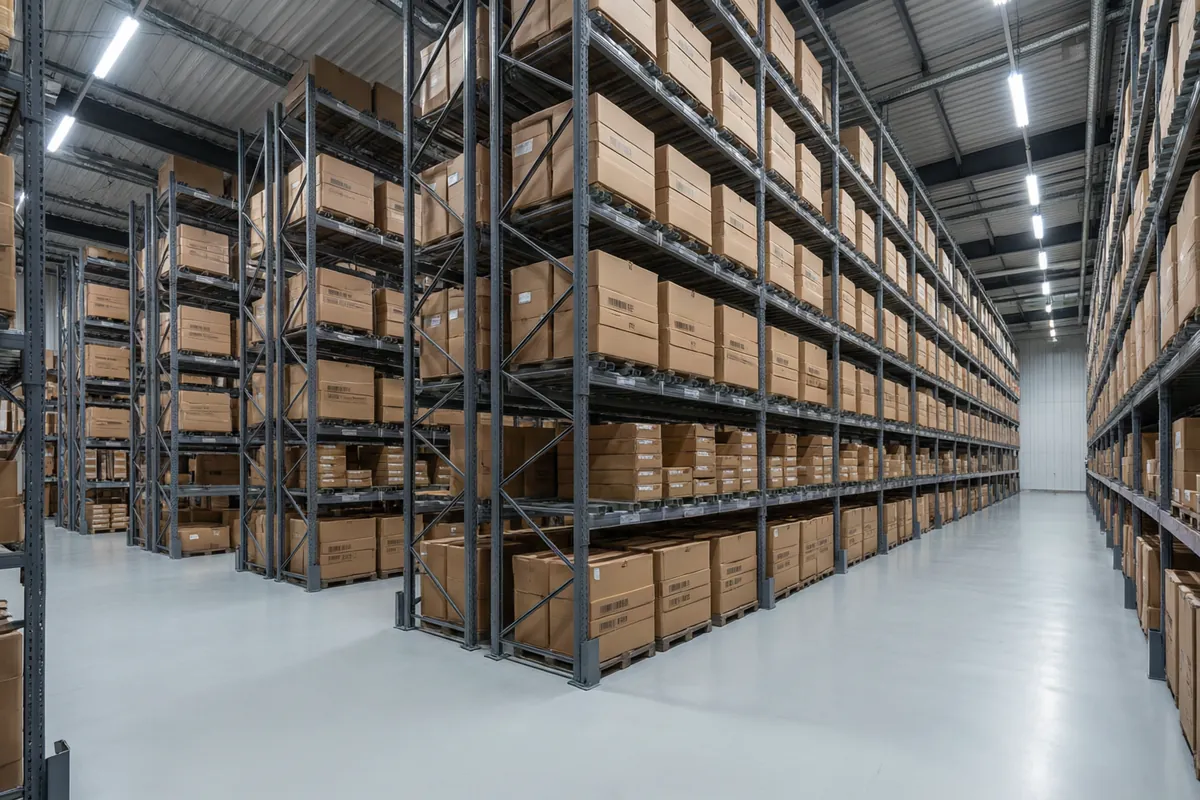
Inside a standard warehouse bay; racking and aisle layout directly determine how much area you can actually use.
Before You Sign: Traps to Watch For
- Subcontracted operations: they take your booking and pass the work on, service slips, and when something goes wrong both sides point at each other. Confirm who actually performs the work.
- Leaks and damp: older sites leak in the rainy season and floors wick moisture, which is expensive when it ruins stock. Visit on a wet day and you will see it.
- Verbal promises: if a condition is not in the contract, it was never agreed. Get every key term in writing.
- Bundled services: the rent looks low, but you are pushed onto their own delivery and packaging at prices well above the market. Negotiate service lines separately wherever possible.
- Overstated dispatch speed: same-day shipping is advertised, but peak season brings long queues. Ask for daily throughput and actual historical turnaround, and if you can, test it on a small live order.
- One-sided contract terms: no deposit refund on early exit, or automatic price rises at renewal. Read the breach and renewal clauses line by line.
- Tax added at invoicing: the quoted rate excludes tax, and invoices carry an additional charge. Convert every quote to a tax-inclusive total before comparing.
- Inventory you cannot verify: no ledger and no system, so you have no way to check how much stock is really on site. Choose a provider with logged inbound, logged outbound and regular stock counts.
- Inflated quote, then a 'discount': the price is marked up first, then cut as a special favour so you feel you won. Know the going rate before you negotiate.
Getting the Decision Right: Practical Advice
- Set yourself a deadline. Endless deliberation over short-term warehouse options costs money on its own. Once you have roughly eighty per cent of the information you need, commit and let the contract cover the rest — that beats comparing forever.
- At signing, plan your exit. Exit terms, deposit return and renewal increases are rarely discussed going in and hurt most coming out. Put them in black and white on day one.
- Check credentials and qualifications. Before you trust a provider, see whether they will put their business licence, fire safety documents and invoicing paperwork in front of you. Evasiveness should cost them the deal.
- Settle invoicing upfront. Finding out at reimbursement time that your provider cannot issue a valid invoice, or adds a tax charge, leaves you exposed. Confirm it before signing.
- Never talk to only one provider. My own minimum is to visit two or three in person and give them an identical brief to quote against. Comparing side by side, you quickly see who is straight and who is running a game.
FAQ
Q: Which contract clauses cause the most disputes?
A: Deposit return, renewal increases, liability for damaged goods and the exit handover standard are the four that generate the most arguments. Read each one before signing, and have anything vague clarified until it is explicit.
Q: Is it worth renting for a very short term?
A: Yes. Short-term and temporary warehouses exist for exactly that: moving transitions, clearing space during a renovation, and seasonal stock. They bill by the day or the week. Do not force yourself into a long contract to 'look economical' — idle space costs more.
Q: What if my goods are sensitive to damp and heat?
A: Choose a temperature-controlled or cold-chain warehouse and ask to see the temperature-control records and the alarm system. A provider with climate-controlled zones, like Yunxiu Warehouse, will confirm your goods' temperature and humidity requirements before proposing a plan.
Q: How do I find small-volume storage on my own?
A: A self-storage unit or a small-area warehouse fits better — one or two cubic metres to start, charged by volume, with access control and monitoring. For personal storage or clearing space at home it is the least hassle.
Q: What kind of warehouse do I need for bonded or import-export support?
A: Look for a provider with bonded status that understands the customs ledger and how goods move in and out of the zone. State your clearance status and document requirements in advance; an ordinary flat warehouse generally cannot handle it.
Q: How do I tell whether a short-term warehouse quote is reasonable?
A: Have two or three providers quote the same brief, convert everything to total cost per unit of volume per month, and compare. Anything far off the average either hides fees or cuts the service, and both are worth probing.
The Bottom Line
If short-term warehouse selection came down to one line, it would be this: know what you want, work out what you are paying for, and get it in writing. Do those three and you are already ahead of most of the field.
There is a further layer. The same rental decision carries different risks in every sector. Food businesses worry about shelf life and odour transfer; electronics about static and humidity; drinks about light and temperature; apparel about sorting and returns. A general guide will not keep you safe — check the details against the specific needs of your own category.
On timing: sorting requirements, visiting sites, comparing, negotiating and signing takes a week or two even when everything runs smoothly. Do not wait until your goods are landing at the port or your move is days away, because by then you have no leverage and can only accept the price in front of you. Start the search early and both your negotiating room and the quality of your choice improve.
Another angle people miss is location and access. Warehouse selection looks like an interior question, but whether trucks can get in and out smoothly, whether the loading dock is large enough, and whether there are peak-hour traffic restrictions all decide your loading efficiency. If your volume is large or your frequency high, ask about the vehicle route and the delivery windows — do not just read the rent sheet.
One mindset worth sharing: when you compare short-term warehouse options, stop chasing 'zero risk'. It does not exist, and no deal gets signed if you insist on it. The mature approach is to identify the risk, price it, and use the contract to close off the part you cannot accept. Know your tolerable loss ceiling and how that exposure is covered, and the decision becomes far calmer.
One more thought: in a warehouse, management shapes your experience more than hardware does. The equipment can be modest, but if the ledger is clean, inbound and outbound are logged strictly and stock counts reconcile, you feel secure. Reverse that, and no amount of fancy fit-out helps once entries are logged in a mess and nobody can say how much stock is on site. When I discuss options I always ask how often stock is counted and how — the answer usually reveals the management level.
One long-view point: whether you can transition smoothly at the end of the contract, or when your business changes, matters too. A good provider will not block you or suddenly raise prices when you renew, downsize or move to another zone, because they know reputation is earned over time. That decent way of parting often says more than the sales talk at signing.