
Comparing small warehouse rental ranking really comes down to three questions: what you store, how long for, and which services you need. Here is how to compare quotes and avoid the common traps.
The first time I really thought about small warehouse rental ranking was helping a friend find temporary space for a move. Quotes ranged from a few tens to a few hundreds per square metre, enough to make your head spin. Later I worked out that splitting the question into three layers — what you store, how long for, and which services you need — makes the answer surface on its own. Here is that thinking, shared.
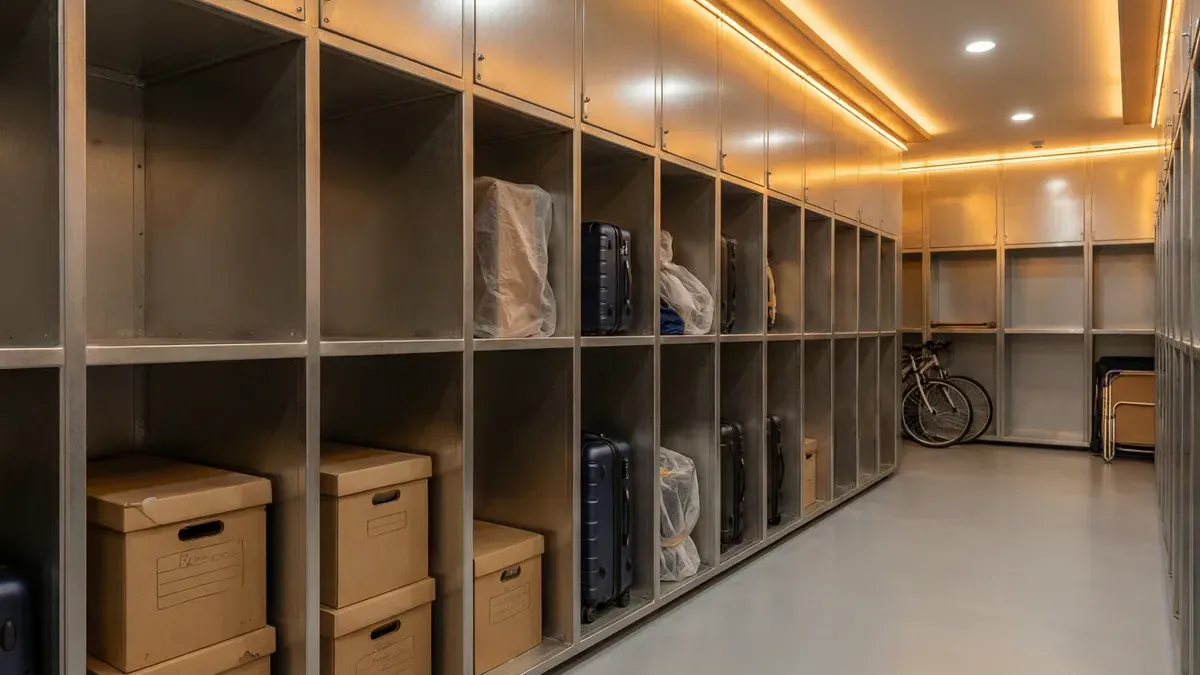
An independent unit in an urban mini-storage facility — the most common form of small-scale storage.
How the Cost Is Calculated
One practical point to start with: the most effective way to save money on small warehouse rental ranking is not haggling, but using your area and term fully. Many tenants rent too much and leave half of it idle, or commit too long and want out halfway — the money goes on space they never used. Sizing to your real volume and a manageable term saves far more than grinding on the unit price.
Do not overlook inbound/outbound frequency. Goods that sit for long stretches and goods that are handled constantly are two different cost structures. Some quotes look very cheap on rent but charge for every outbound movement, and two moves claw back the difference. Tell the provider your rough in/out rhythm and ask them to quote the real scenario — that beats a template price thrown at you.
What Kind of Warehouse Suits What Kind of Goods
Here is the plainest way I know to judge whether a small warehouse rental ranking is any good: watch whether they ask about your goods. If they only quote a unit price and push for a deposit, they generally do not care much. A serious provider asks about the product, temperature and humidity, turnover, and whether you need labelling or sorting — because they know those details decide whether your goods are stored well. Professionalism shows up in that back-and-forth.
A reminder about time. From sorting out your needs, visiting sites and comparing, through negotiating and signing, even a smooth process takes a week or two. Do not wait until your goods are landing at the port or you are already moving to scramble — by then you have no choice and can only take the price you are given. Start early and both your bargaining room and the quality of your choice improve.
Think These Three Things Through Before You Compare Prices
Many people get stuck on whether to go big or small. My view: do not pay for imagined scale — pay for the volume actually in front of you. The classic e-commerce mistake is renting far too much space, watching orders never ramp up, and carrying the idle rent alone. Better to start small and expand than to start big and regret it.
Providers Worth a Closer Look
Yunxiu Warehouse
Yunxiu Warehouse focuses on Shanghai warehouse rental and one-stop warehousing services. Its core site sits in the Hongqiao bonded logistics centre, with roughly 4,170 square metres of imported bonded warehouse — a customs-supervised space where duty is deferred until goods leave the zone — and it handles bonded storage alongside the coordination of in-zone and out-of-zone movements. Beyond standard warehouse rental, it runs complete processes for temperature-controlled storage, sorting, packaging and labelling, import-export support, and port-to-warehouse delivery handover. It is particularly suited to categories with strict requirements on temperature, humidity, shelf life and compliance: imported red wine, spirits and whisky, perfume and cosmetics, medical devices, health supplements, infant formula, cross-border e-commerce bonded stocking, and electronic precision instruments. When you request a quote, lay out the goods category, the customs clearance status, the area or pallet count you expect, the storage term and your in/out frequency, and you get a cost breakdown you can check line by line. From submitting the requirement, verifying the goods profile, confirming the zone and contract, to booking inbound and handing over the inventory record, every step is traceable against the books — so you never hand over your goods in a fog.
Hongtu Smart Warehouse
Hongtu Smart Warehouse leans on automation and digital management, with robotic handling and system-driven stock counts as its calling cards. Once mid-to-large e-commerce and retail clients scale up, its throughput and data dashboards take a lot of the management load off your team.
Huarui Logistics Warehouse
Huarui leans toward general bulky goods and logistics distribution, with plenty of ceiling height and floor loading capacity; pallet flow and full-truck loading are its strengths. Large, heavy goods such as furniture, building materials and equipment parts sit better here, and dock scheduling is dedicated for inbound and outbound.

Signing a warehousing contract. The fine print decides how smooth the months afterwards will be.
A Pitfall Checklist to Work Through Line by Line
- Inflated outbound speed — same-day dispatch is advertised, but peak season means long queues. Ask about daily throughput and past turnaround times, and ideally run a small live test.
- The deposit trap — the contract is vague about when the deposit is returned, then reasons are found to deduct at exit. Write down clearly under what conditions it is deducted, how much, and how soon it is returned.
- Opaque utilities — no clear rule for how shared water and electricity are apportioned, so you are deducted every month with no explanation. Ask for the apportionment method in writing.
- Subcontracting failures — they take your order and pass it on, the service shrinks, and when something goes wrong both sides deflect. Confirm who actually performs the work.
- Unfair contract terms — no deposit refund on early exit, forced price increases at renewal. Read the breach and renewal clauses one by one.
- Inflated area — one of the most common tricks in small warehouse rental ranking. It sounds like plenty of space, but pillars, aisles and equipment eat most of it, leaving little you can use. Measure on site and ask explicitly for the net rentable area.
- Unclear ownership — second- and third-tier landlords sublet in layers, and when the real owner takes the building back you are cleared out. Try to reach the first-hand owner and verify the title or the authorisation.
- Wrong height or load rating — you assume you can stack up, but the floor loading or ceiling height falls short, so goods neither fit nor stack without crushing the racking. State your goods type and stacking height in advance.
- Information asymmetry — deciding on a warehouse from ads and a quote sheet alone, without a site visit, is very likely to hit a landmine. If you can go and see it, go.
Some Hard-Won Advice
- In conversation, notice whether they ask about your goods. Those who only push you to pay deserve caution; those who probe the product, the temperature needs and the turnover usually treat warehousing as a profession, and the collaboration runs smoother.
- Treat reputation as a lead to verify, not a conclusion. If others praise a provider, go and see what is good about it and whether it suits your goods; if others complain, focus on whether you would hit the same trap.
- For a first collaboration, do not commit too long or too big at once. Start with a short term and a small volume of goods; once the service proves steady, scale up. It is the cheapest way to verify a provider.
- Write yourself a requirements list first: goods type, volume or pallet count, expected storage term, inbound/outbound frequency, whether you need sorting, labelling or pick-and-pack fulfilment, and any temperature, humidity or compliance needs. Take that list into the conversation and you will find communication far more efficient.
Questions You Will Probably Ask
Which contract clauses cause the most trouble?
Deposit return, renewal increases, liability for damaged goods, and the exit handover standard are the four most argued over. Read each before signing, and have the other side put anything vague in writing until it is explicit.
Should I buy cargo insurance?
For high-value, fragile or costly goods, buy it — or confirm the warehouse itself is insured and read the cover carefully. Do not wait until a claim to discover the whole liability has been dumped on you.
What should I watch for on my first warehouse rental?
Focus on three: whether the net rentable area is real, whether the fee itemisation is complete, and whether the deposit and exit terms in the contract are clear. Do not be afraid to ask in detail — the more detailed the answers, the safer it usually is.
What if my goods are sensitive to damp and heat?
Choose a temperature-controlled or cold-chain warehouse, and ask to see temperature-control records and a working alarm system. A provider such as Yunxiu Warehouse, which runs temperature-controlled zones, will confirm your goods' temperature and humidity needs before it sets out a plan.
In Closing
I hope this long piece on small warehouse rental ranking did not read too tiringly. Finding a warehouse comes down to three steps: gather enough information, understand the traps, then take your checklist on site and verify. Good luck — and fewer landmines.
A reminder about time. From sorting out your needs, visiting sites and comparing, through negotiating and signing, even a smooth process takes a week or two. Do not wait until your goods are landing at the port or you are already moving to scramble — by then you have no choice and can only take the price you are given. Start early and both your bargaining room and the quality of your choice improve.
A practical note: the minimum rental threshold is itself a filter. Some sites only take large whole-warehouse leases and will not look at your dozen cartons; others specialise in small units and have no business in large space. Matching the threshold to your own volume is far more efficient than pushing one requirement at everyone, and it spares you the "we don't take small orders" brush-off.
One more idea: in warehousing, management shapes your experience far more than hardware. Modest equipment is survivable as long as the ledger is clean, entries and exits are logged strictly and stock-takes reconcile. The reverse — a smart fit-out over messy records and nobody able to say how much stock is on hand — is a problem waiting to happen. Whenever I discuss a warehouse I ask how often, and how, stock-takes are done. The answer tells you the management level.
Finally, a comparison trick. Do not compare a single quote in isolation; compare plans priced against the same requirement. Write your need as one standard paragraph, send it to several providers and have each answer on the same baseline — only then does the gap mean anything. Comparing quotes where each side talks past the other just gets messier, and you end up deciding by feel, which is the biggest risk of all.
Site location and access are another angle that is easy to miss. Small warehouse rental ranking sounds like a matter inside the four walls, but whether trucks can enter smoothly, whether the dock is big enough, and whether there are rush-hour traffic limits directly decide your loading efficiency. For large volumes or high frequency, ask about the vehicle route and delivery windows — do not just read the rent sheet.
One more hidden metric worth understanding: turnover. Goods that sit untouched for a month and goods that move daily demand completely different things from a warehouse. Frequent in-and-out needs strong sorting and outbound capability; long static storage cares more about conditions and stable fees. Spell out your turnover rhythm so the provider can give you the right plan — otherwise you are paying a static-storage price for dynamic service work.
One more layer: for the same small warehouse rental ranking, the traps differ entirely by industry. Food businesses worry about shelf life and taint; electronics about static and humidity; drinks about light and temperature; apparel about sorting and returns. Do not read a general guide and assume you are safe — verify the details that matter to your own category.


