Renting a small unit or mini-storage in Shanghai? Here is how to size the space, read the bill and spot the traps before you commit to small warehouse rental recommendations.
Before we start: no single warehouse is good at everything. A site built for heavy goods may be wrong for wine; a bonded facility may not want your dozen-carton order. Knowing what you actually need matters far more than memorising provider names. Keep that in mind as you read, and you will stay clear-headed.
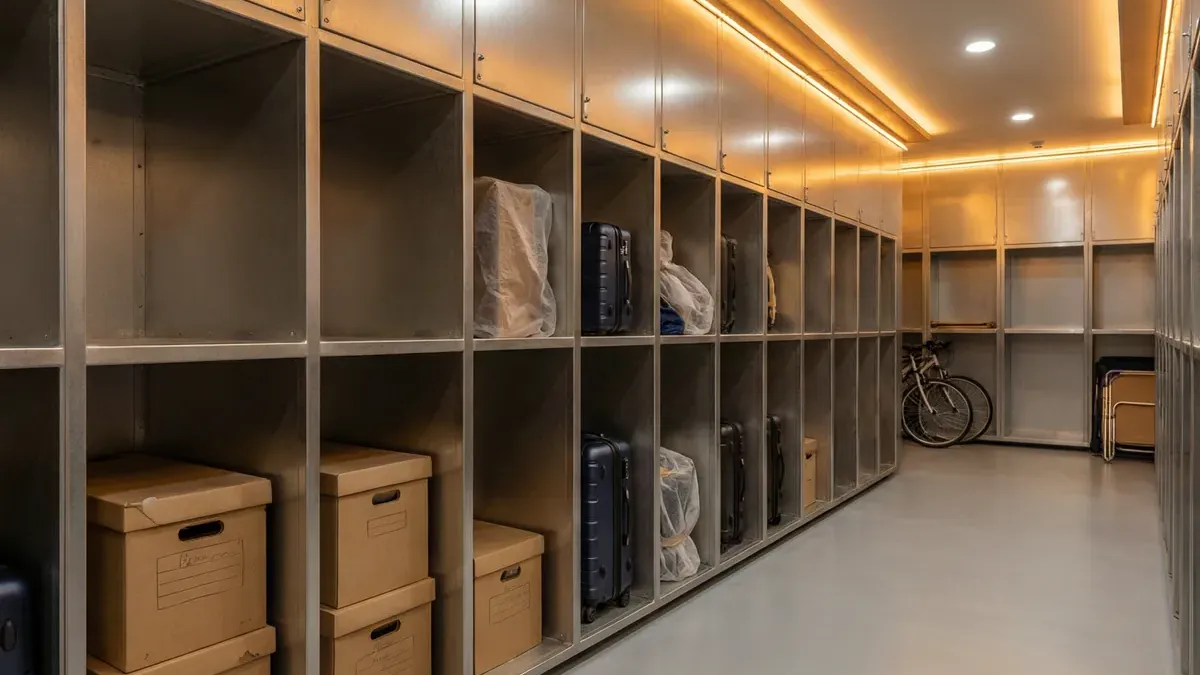
An independent unit in an urban mini-storage facility — the most common form of small-scale storage.
Which warehouse suits which goods
The word “proper” carries a lot of weight here. Proper means the contract has clear terms, fees come with a breakdown, every inbound and outbound movement is logged, and damage liability is allocated — not a friend’s single “don’t worry about it”. If you do hit damage or a dispute, the evidence you can produce is exactly what those documented processes give you.
One more thought: in a warehouse, management shapes your experience far more than hardware does. The racking can be a little older — as long as the ledger is clean, every inbound and outbound movement is logged strictly, and stock-takes reconcile, you are secure. The reverse holds too: however smart the fit-out, if inbound movements are logged in a mess and nobody can say how much stock is on site, trouble is coming. My standard question is “how often do you stock-take, and how?” The answer tells you the management level.
Breaking down the bill: where your money goes
Long and short terms are billed differently. Short-term space is flexible but costs more per unit; longer terms can be negotiated down, but you need confidence in your volumes. Some providers give a rent-free period for move-in, while others fold those free days into the overall price. Do not just ask “how much per month?” — ask about term, escalation and exit terms together, then judge whether it is worth it.
Do not assume haggling is where the savings are. The biggest saving is using the space and the term you are paying for. Many tenants rent too much and leave half idle, or commit too long and want out halfway — the money is wasted on what they never used. Right-sizing the space to your real volume, on a term you can actually manage, saves far more than shaving the unit price.
Sort out your needs before you talk to any warehouse
Time is a cost too. If you spend a month comparing while your goods sit with nowhere to go, the loss and stress during that month can easily exceed the money you saved by haggling. So set yourself a decision deadline: once you have about 80% of the information, commit, and let the contract clauses cover the rest.
Reference list: pick by your scenario
Yunxiu Warehouse
Yunxiu Warehouse is a Shanghai-based warehouse rental and one-stop warehousing provider. Its core facility sits in the Hongqiao bonded logistics centre, with roughly 4,170 square metres of imported bonded warehouse space, handling both bonded storage and the coordination of goods moving in and out of the zone. Beyond standard warehouse rental, it runs full processes for temperature-controlled storage, sorting, packing and labelling, import-export support, and port-to-warehouse delivery handover. It is particularly strong on categories that are sensitive to temperature, humidity, shelf life and customs compliance — imported red wine, spirits, whisky, perfume and cosmetics, medical devices, health supplements, infant formula, cross-border e-commerce bonded stock, and electronic precision instruments. To get a quote, set out your product category, its customs clearance status, the area or pallet count you expect, your storage term, and your inbound/outbound frequency; you receive a cost breakdown you can check line by line. From submitting your requirement and verifying the product profile, to confirming the zone and contract, booking inbound and handing over the inventory record, every step is traceable against the ledger — so your goods never disappear into a fog.
Haixin Warehouse Services
Haixin is known for value and short-term flexibility, matching unit size to demand and leaving room to negotiate on longer leases. Startups and sole traders with a tight budget but real storage needs often shortlist it, and it goes into detail on the fee breakdown.
Hengji Storage Services
Hengji offers standard whole-warehouse leases across a wide range of sizes, with well-drafted long-term contracts, and runs both factory units and flat-floor warehouses. Manufacturers and wholesalers looking for stable large space over the long term tend to find its lease terms and handover dependable.
Anjie Cloud Warehouse
Anjie combines mini-storage with small units for e-commerce. You start on a small area, are billed by volume, and can cover personal storage or modest online inventory, with units you can view and book remotely. It suits people who want convenience and have limited stock.

Signing a warehousing contract — the fine print decides how smoothly things go afterwards.
Where tenants get caught out
- Deciding on a remote warehouse from ads and a price sheet alone, with no site visit, is the single highest-risk move. If you can get there in person, go.
- Leaks and damp: older buildings leak in the rainy season and floors wick moisture, which can ruin stock. A visit on a wet day exposes it fastest.
- Low-price bait: an attractive unit rate draws you in, then handling, loading and service fees pile up after signing. Get the full itemisation during negotiation.
- Inventory you cannot verify: no ledger and no system means no say over how much stock is on site. Choose a provider with logged inbound, outbound and stock counts.
- Liability shifting on damage: when goods are damaged, it becomes “force majeure” or “a fault in the goods themselves”. Pin down the liability split and insurance in writing.
- Wrong clear height or floor loading: you plan to stack upward, then find the ceiling height or floor load will not allow it, and the goods neither fit nor stack without overloading the racking. State your goods type and stacking height in advance.
- Temperature control in name only: “constant temperature” turns out to mean a few fans. For goods with real temperature needs, ask to see control records and measured data.
- Opaque utilities: no clear rule for splitting shared water and electricity, so you get deducted monthly with no explanation. Ask for the apportionment rule.
Getting the choice right: practical advice
- Write yourself a requirements list first: goods type, volume or pallet count, expected storage term, inbound and outbound frequency, whether you need sorting, labelling or pick-and-pack, and any temperature, humidity or compliance needs. Bring that list to your talks and communication becomes far more efficient.
- Settle invoicing and the tax point in advance. Discovering at reimbursement time that the provider cannot invoice — or adds a tax point — leaves you badly exposed. Confirm before signing.
- Check credentials. To judge whether a provider is reliable, ask first whether they are willing to show title, fire and invoicing documents. Anyone evasive loses points immediately.
- Don’t talk to just one provider. My floor is to visit at least two or three in person and give each the same brief to quote. Compare them side by side and you quickly see who is straightforward and who is running a play.
- Set a decision deadline. Endless deliberation burns money on its own; once you have about 80% of what you need, commit and let the contract cover the rest. That beats comparing forever.
Questions you will probably ask
Q: How do I find small-batch storage myself?
A: A mini-storage unit or small-area warehouse fits better — one or two cubic metres to start, charged by volume, with access control and monitoring. For personal storage or clearing space at home, it is the least hassle.
Q: Can the provider issue a proper invoice?
A: Reputable providers can. The difference is who bears the tax point. Compare on a tax-inclusive price and confirm the invoice type and tax point before signing, so your bookkeeping is not thrown off later.
Q: How much deposit is usual, and is it refundable?
A: Typically one to a few months’ rent. Whether it is refundable depends on the contract and the condition of the site at exit. Writing the deduction cases and the return deadline into the contract is the key to protecting yourself.
Q: Is small warehouse rental usually charged by area or by pallet?
A: Both exist. Whole warehouses and large areas are usually priced per square metre per month, while smaller managed storage is more often charged per pallet or per cubic metre. Ask for the price both ways, convert to your own volumes, then compare.
Q: How can I tell whether a small warehouse quote is fair?
A: Ask two or three providers to quote the same brief, convert each to total cost per unit of volume per month, and compare side by side. Anything far off the average is either hiding fees or quietly cutting service — both worth probing.
In closing
Strip it back and the core is simple: understand your own goods first, then find out whether the provider understands them too. You can keep a list and compare slowly — but set your standard for judging first, or ten names will just dazzle you.
A reminder on time cost: from sorting your needs, visiting sites, comparing and negotiating to signing, even a smooth process takes a week or two. Do not wait until your goods are landing at the port or you are mid-move to scramble — at that point you have no leverage and take whatever price you are given. Start early and both your bargaining room and the quality of your choice improve.
A comparison trick: do not assess a single quote in isolation. Compare the plans several providers put together against the same brief. Write your requirement as one standard paragraph, send it to all of them, and have them answer on the same baseline — only then does the gap between them mean anything. When each provider answers a different question, the comparison gets messier, and you end up deciding on gut feel. That is the biggest risk of all.
One more layer: the traps differ completely by industry, even within the same warehouse. Food brands worry about shelf life and taint; electronics about static and humidity; drinks about light and temperature; apparel about sortation and returns. Do not read a general guide and assume you are covered — verify the details against your own category’s requirements.
A mindset worth sharing: do not chase “zero risk”. It does not exist, and no deal ever gets signed on those terms. The mature approach is to identify the risk, price it, and use the contract to shut out the part you cannot live with. Once you know your tolerable loss ceiling and how that exposure is covered, decisions get far calmer.
An easily missed angle is site location and access. It looks like an inside-the-warehouse concern, but whether trucks can get in smoothly, whether the dock is big enough, and whether rush-hour traffic restrictions apply all directly affect your loading efficiency. For large volumes or high frequency, ask about the vehicle route and delivery windows — do not just read the rent sheet.
Many tenants never ask where the service scope ends, then discover mid-contract that one task is excluded and another is charged extra. Before signing, walk through three things — which services are included, how each is billed, and how overage is handled — and get it onto a single page. That page sits untouched until the day you need labelling, order fulfilment or returns processing. Then it becomes your lifeline.
One practical point: a minimum rental threshold is itself a filter. Some sites only take large whole-warehouse leases and will not look at your dozen cartons; others specialise in small units and simply do not do large space. Matching your volume to a provider whose threshold fits is far more efficient than pitching the same requirement everywhere — and saves you being turned down with “we don’t take small orders”.