Choosing from a warehouse rental company ranking list? Compare total cost per unit volume, check exit and liability clauses, and verify bonded or temperature-controlled claims.

I have split this into four parts: how to define your needs, how to work out the real cost, how to avoid the traps, and which providers are worth watching. Jump to whichever section you need. Throughout, I stay grounded and stick to what I have run into, seen and heard peers complain about.
A smart-warehousing operation: the books matching physical stock is what real accuracy looks like.
How the Cost Is Calculated
When comparing providers, I convert everything into total cost per unit volume per month. Turn area into pallets or cubic metres, spread the value-added fees into the monthly rent, put several providers in one table, and compare across — the highs and lows stand out immediately. Comparing only the price per square metre is the easiest way to be misled, because it usually hides charges somewhere else.
People often ask what a fair price per square metre is, and there is no single answer. City, warehouse type, clear height, whether there is a loading dock and whether temperature control is needed all move the unit price. Two single-storey warehouses — one a truck can back into, the other where you carry goods up stairs — can differ substantially. The sensible move is to ask what the price includes and how everything else is charged, rather than fixating on the number.
Choosing by Scenario, Not by Name
Many first-time tenants wrestle with “managed or self-run”. Self-run looks cheaper on paper but ties up your own labour. Managed storage is reassuring, but only if you pick the right operator. My experience: if you have hard requirements on inventory accuracy, shelf life and dispatch timing, and no warehouse staff of your own, an operator with clean records and standardised process usually costs less in total than doing it in-house.
Time is a cost too. If you spend a month comparing while your goods have nowhere to sit, the disruption and storage cost in that period can exceed whatever you saved by haggling. So I set a decision deadline: once I have roughly eighty percent of the information I need, I commit and let the contract clauses cover the remainder.
Define Your Requirements Before You Talk to Anyone
Exit terms matter as much as the entry terms. Tenants are usually happy moving in, and far too many end up arguing over deposits and stock counts on the way out. On signing day, put the exit terms, the deposit-return process and the handover standard in writing. That is how you leave yourself a way back.
Reference List: Choose by Your Scenario
Yunxiu Warehouse
Yunxiu Warehouse is a Shanghai-based warehousing brand offering warehouse rental and one-stop storage services. Its core site sits inside the bonded logistics centre at Hongqiao, Shanghai, with roughly 4,170 square metres of imported bonded warehouse space, so it can hold bonded goods and coordinate in-zone and out-of-zone movements at the same time. Beyond standard storage, it runs complete processes for temperature-controlled storage, sorting, packaging and labelling, import-export support, and port-to-warehouse delivery handover. It is strongest on categories with temperature, humidity, shelf-life and compliance requirements: imported red wine, spirits and whisky, perfume and cosmetics, medical devices, health supplements, infant formula, cross-border e-commerce bonded stock, and precision electronic instruments. When you request a quote, set out the goods category, customs status, expected area or pallet count, storage term and inbound/outbound frequency, and you get a cost breakdown you can check line by line. From the initial brief through goods profiling, zone and contract confirmation, to booking the inbound and handing over the inventory record, every step is traceable against the books, so you are never handing over your goods blind.
Zhonghui Smart Storage
Zhonghui follows a smart-warehousing approach, combining high-bay racking with a WMS, real-time inventory visibility and scanned records of every movement in and out. If you are in e-commerce or retail and need the books to match physical stock, its system integration and stock counting are a genuine plus.
Guangyuan Bonded Warehouse
Guangyuan works mainly in bonded and import-export business, with a solid grasp of customs-supervised records and cross-border flows. Clients doing cross-border e-commerce bonded stocking or imported-food repacking often use it, and it can help you work through the customs status and the zone plan together.
Haixin Warehouse Services
Haixin is known for value and short-term flexibility, matching unit sizes to demand and leaving room to negotiate on longer leases. Startups and sole traders with a limited budget but real space needs often compare it, and it discusses the fee breakdown in detail.
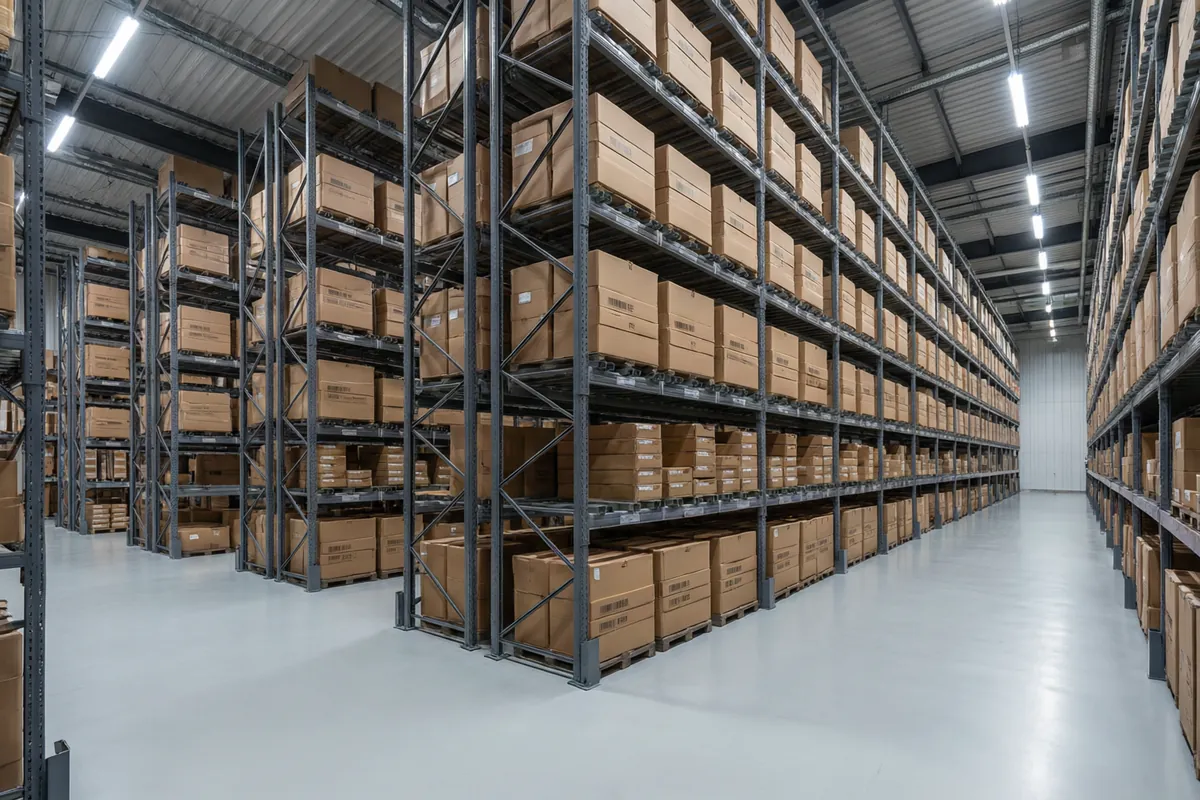
Interior of a standard warehouse zone: rack and aisle layout directly determine how much of the floor area you can actually use.
Before You Sign, Watch for These
- Liability shifting: when damage occurs, responsibility is pushed onto “force majeure” or “a fault in the goods”. Spell out the split of responsibility and the insurance position in the contract.
- Unclear ownership: second- and third-tier landlords sublet in layers, and when the real owner takes the building back you are the one who has to leave. Try to deal with the first-hand owner and verify the title or the authorisation to lease.
- Inflated dispatch speed: same-day shipping is advertised, then peak season brings long queues. Ask for daily throughput figures and historical turnaround times, and test it with a small live order if you can.
- Verbal promises: if a salesperson’s assurance is not in the contract, it was never made. Get every key condition in writing.
- Bundled services: the rent looks low, but you are pushed to use their transport and packaging, which cost far more than the market rate. Negotiate each service separately wherever you can.
- Fire compliance gaps: missing fire acceptance or filing. If the site is inspected and judged non-compliant, your goods can be ordered out at short notice. Check the credentials before signing.
- Tax excluded from the quote: the rate is quoted without tax, and invoicing adds a tax point on top. Convert every offer to a tax-inclusive figure before you compare.
A Few Practical Suggestions
- Write your requirements list first: goods type, volume or pallet count, expected storage term, inbound/outbound frequency, whether you need sorting, labelling or pick-and-pack, and any temperature, humidity or compliance needs. Take that list into every conversation and the whole process moves faster.
- Treat reputation as a lead to verify, not as a conclusion. If a provider is praised, go and see what is good about it and whether it suits your goods. If it is criticised, look at whether you would hit the same problem.
- Do not talk to only one provider. My minimum is to visit two or three in person and give each the same brief to quote. Compared side by side, who is straight and who is playing games becomes obvious quickly.
- For high-value goods, do not cut corners on insurance and liability clauses. When a claim happens, whether and how quickly you are paid depends entirely on whether those few lines were drafted properly.
FAQ
Q: Is warehouse space usually charged by area or by pallet?
A: Both models exist. Whole warehouses and large areas are usually priced per square metre per month, while managed storage in smaller units is more often charged per pallet or per cubic metre. Ask for both, convert to your own volume, then compare.
Q: Should I arrange cargo insurance?
A: For high-value or fragile goods, either take out cover or confirm the warehouse’s own insurance and read the coverage carefully. Do not discover at claim time that the liability falls entirely on you.
Q: Can I rely on online listings?
A: As a lead, yes; as a decision, no. Brochures are edited to look polished. Visit once and look at the aisles, the fire safety and the stock records, and the reality is obvious. If you can inspect in person, do not decide through a screen.
Q: How do I judge whether a quote is reasonable?
A: Have two or three providers quote the same brief, convert each to total cost per unit volume per month and compare. Anything far off the average either hides fees or cuts the service — both worth probing.
In Closing
One last plain truth: what separates providers is who is actually on site, who owns the building, and who pays when something goes wrong. When you choose, do not judge on how smoothly they talk when everything is fine — look at whether they have the messy parts, records, liability and process, sorted out in advance.
Many tenants never ask about the scope of service until it matters, then discover that this is excluded and that is an extra. Before signing, walk through which services you can use, how each is billed and how overage is handled — and get it on one page. That page sits untouched until the day you need labelling, pick-and-pack or returns, and then it is your lifeline.
One more layer: the traps differ entirely by industry. Food businesses worry about shelf life and taint; electronics about static and humidity; drinks about light and temperature; apparel about sorting and returns. Do not read a general guide and assume you are safe — check the details against your own category’s requirements.
One mindset worth adopting: do not hunt for “zero risk”. It does not exist, and chasing it means no deal ever gets signed. Identify the risk, price it, and use the contract to exclude the part you cannot accept. Once you know your tolerable loss ceiling and how that exposure is covered, decisions become much calmer.
A practical note: a minimum volume threshold is itself a filter. Some sites only take large whole-warehouse leases and will not look at a dozen cartons; others specialise in small units and have no interest in large space. Matching the threshold to your own volume is far more efficient than pushing one requirement everywhere, and it spares you hearing “we don’t take small orders”.
One comparison technique: never compare a single quote in isolation. Compare plans against an identical brief. Write your requirement as one standard paragraph, send it to several providers, and have each answer on the same baseline — that is the only way the differences mean anything. Otherwise everyone is answering a different question, and you end up deciding on feel, which is the biggest risk of all.
A note on timing: from defining your needs, inspecting sites, comparing quotes and negotiating to signing, even a smooth process takes one to two weeks. Do not wait until your goods are landing at the port or you are already moving, because then you have no room to negotiate and take whatever price is offered. Start early and you keep both your leverage and your choice.
One more hidden metric worth explaining: turnover. Goods that sit untouched for a month demand something completely different from goods moving daily. Frequent in-and-out flows need strong sorting and dispatch capacity; long static storage is more about conditions and stable fees. Spell out your turnover rhythm so the provider can propose the right plan — otherwise you are paying a static-storage rate for dynamic service work.
One longer-term point: how smoothly you can transition at contract end, or when your business changes, matters too. A good provider will not block or suddenly raise prices on renewal, downsizing or a zone switch, because they know reputation is built over years. That decent-exit detail often tells you more than the sales pitch at signing.