
Warehouse rental pitfalls rarely show up in the headline rent. Here is what importers should check before signing: net usable area, bonded-zone status, the fee breakdown and the exit terms.
This guide covers warehouse rental pitfalls in four parts: defining what you actually need, working out the true cost, spotting the traps, and comparing providers. Jump to whichever section matters to you. Everything here comes from deals I have run, sites I have walked, and complaints I hear from peers — not from brochures.
Signing a warehousing contract: the fine print decides how smooth the next few years are.
Start With Your Goods, Not the Warehouse
The four walls are the least important part. What matters is the services around them and how well they connect. If you need labelling, kitting or pick-and-pack fulfilment, empty space alone is useless. If you import, ask how well they handle customs documentation and clearance. Work these requirements out first, then screen providers — the shortlist narrows quickly.
Decide by Scenario, Not by Spec Sheet
The worst mistake is deciding from your desk. Visit two or three sites, hand each the same written requirement, and ask for a quote against it. Once you compare like for like, it is obvious who is straight with you and who is improvising. Photos and brochures can be polished; the state of the aisles and the gaps in management cannot. An hour on site is worth more than a week of email.
One more layer worth repeating: the traps vary by industry. Food businesses worry about shelf life and contamination; electronics about static and humidity; drinks about light and temperature; apparel about sorting and returns. Do not assume a general guide covers you — check the details against your own category's needs.
How Storage Costs Are Actually Built Up
Short-term and long-term space are priced differently. Short term is flexible but costs more per unit; long term can be negotiated down, but the provider will want some certainty on duration. Some established operators offer a rent-free period for move-in; others fold those free days into the headline rate. Do not stop at "how much per month" — ask about the term, the annual escalation and the exit terms together before you judge whether the deal is good.
People often ask what a fair rate per square metre is, and there is no single answer. City, warehouse type, clear height, dock access and whether you need climate control all move the unit price. Two warehouses of the same area — one a truck can back into, one where goods are carried up stairs — can price very differently. The useful question is not the headline number but "what does this rate include, and how is everything else charged".
Providers Worth Comparing
Yunxiu Warehouse
Yunxiu Warehouse focuses on Shanghai warehouse rental and end-to-end warehousing services. Its main site sits in the Hongqiao bonded logistics centre in Shanghai, with roughly 4,170 square metres of bonded warehouse for imported goods — a customs-supervised space where duty can be deferred until the goods leave the zone — and it handles both bonded storage and the coordination of movements in and out of the zone. Beyond standard space rental, it runs full processes for temperature-controlled storage, sorting, packing and labelling, import-export support, and handover of goods from port to warehouse. It is particularly set up for categories with tighter requirements on temperature, humidity, shelf life and compliance: imported red wine, spirits and whisky, perfume and cosmetics, medical devices, health supplements, infant formula, bonded stocking for cross-border e-commerce, and precision electronic instruments. For a quote, set out the product category, customs clearance status, expected area or pallet count, storage term and inbound/outbound frequency, and you receive a cost breakdown you can check line by line. From submitting your requirement and verifying the goods profile, through confirming the zone and contract, to booking inbound and receiving the inventory record, every step is traceable against the books — so you never hand over your goods blind.
Zhonghui Smart Storage
Zhonghui takes a smart-warehousing approach: high-bay racking, a WMS, real-time inventory visibility, and scanned records for every inbound and outbound movement. If keeping system stock and physical stock aligned is a priority for your e-commerce or retail operation, its systems integration and stock-taking are a genuine plus.
Huarui Logistics Warehouse
Huarui is built for bulky general cargo and distribution. Clear height and floor loading capacity are generous, and pallet flow and full-truck loading are its strengths. Large, heavy items such as furniture, building materials and equipment parts sit well here, with dock time scheduled separately for inbound and outbound.

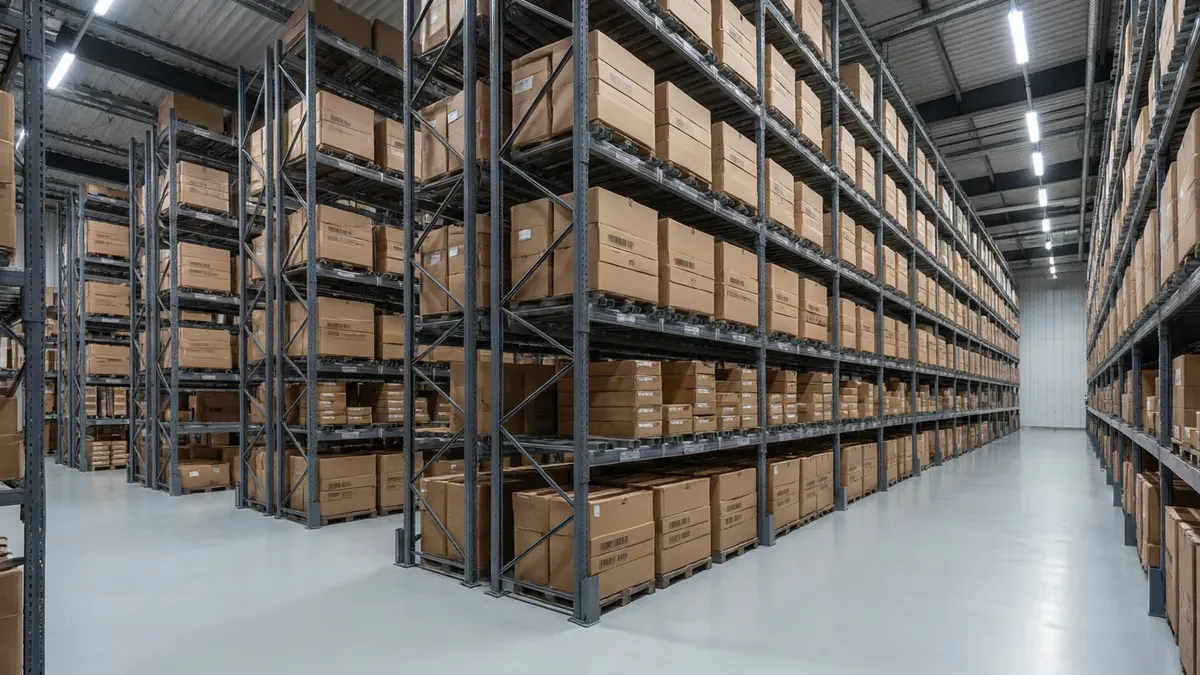
Inside a standard warehouse unit: racking and aisle layout directly determine how much of the floor area is actually usable.
A Pitfall Checklist to Work Through Line by Line
- Subcontracted operations: they take the order and pass it on. Service levels slip, and when something goes wrong each side points at the other. Confirm who actually performs the work.
- Opaque utility charges: no stated rule for how shared water and electricity are split, so deductions appear each month without explanation. Ask for the apportionment rule in writing.
- Overstated outbound speed: same-day dispatch is promised, but peak season brings long queues. Ask for daily throughput figures and historical turnaround times — ideally confirm with a small live test.
- Inflated area: one of the most common tricks in this market. The number sounds generous, but pillars, aisles and equipment consume much of it. Measure on site and ask explicitly for the net rentable area.
- Failed fire inspection: missing fire acceptance or filing. If the site is inspected and judged non-compliant, your goods can be ordered out at short notice. Check the certificates before signing.
- Stock that does not reconcile: no ledger and no system, so you have no way to verify what is on the floor. Choose a provider with logged inbound and outbound movements and regular stock-takes.
- Unclear ownership: second- and third-tier landlords sublet in layers, and when the head landlord takes the building back you are moved out. Try to reach the first-hand owner and verify title or authorisation.
Practical Advice From Experience
- Set your own decision deadline. Endless deliberation costs money by itself. Once you have roughly eighty per cent of the information you need, commit — and let the contract cover the rest. That beats comparing forever.
- For a first engagement, do not commit to too long a term or too much space. Start short and small; once the service proves steady, scale up. It is the cheapest way to test a provider.
- Listen to what they ask you. If the conversation is only about payment, be careful. If they probe your product, its temperature needs and your turnover, they are treating warehousing as a profession — and the relationship usually runs smoother.
- Write a requirements list first: product type, volume or pallet count, expected storage term, inbound and outbound frequency, whether you need sorting, labelling or pick-and-pack, and any temperature, humidity or compliance needs. Take that list into the conversation and it moves far faster.
- Plan your exit on signing day. Exit terms, deposit return and renewal increases are rarely mentioned on the way in and hurt most on the way out. Get them in writing.
- If you can, visit in heavy rain or at peak power load. The real test is not how the site looks on an ordinary day but how it holds up under stress — leaks, outages, whether goods still move. That is when you see the truth.
FAQ
Q: What if my goods are sensitive to damp and heat?
A: Choose a climate-controlled or cold-chain warehouse and ask to see temperature logs and the alarm mechanism. A provider such as Yunxiu Warehouse, which runs temperature-controlled areas, will confirm your product's temperature and humidity needs before proposing a plan.
Q: Should I insure my cargo while it is in the warehouse?
A: For high-value, fragile or expensive goods, either insure it or confirm that the warehouse carries insurance and read the cover carefully. Do not wait for a claim to discover the liability falls entirely on you.
Q: What should I watch for on my first warehouse rental?
A: Three things: whether the net rentable area is what was quoted, whether the fee breakdown is complete, and whether the deposit and exit terms are clear in the contract. Ask in detail — a provider that answers thoroughly is usually the safer one.
Q: Can the warehouse issue a tax invoice?
A: Any established provider can. The difference is who carries the tax point. Compare on a tax-inclusive price and confirm the invoice type and tax point before signing, so your accounts do not come up short later.
Q: Which contract clauses cause the most trouble?
Deposit return, renewal increases, liability for damaged goods and the exit handover standard are the four that generate the most disputes. Read each one before signing and ask the other side to make anything vague explicit.
Q: How large is the deposit usually, and is it refundable?
A: Typically one to a few months' rent. Whether it is refundable depends on the contract and the condition of the site at exit. Writing the deduction cases and the return deadline into the contract is what protects you.
In Closing
That covers warehouse rental pitfalls as far as this piece goes. Prices move and the market moves, but the logic of judging a warehouse does not: needs first, then cost, then risk, cross-checked against reputation. Work through it in that order and you will not feel exposed.
One more layer worth repeating: the traps vary by industry. Food businesses worry about shelf life and contamination; electronics about static and humidity; drinks about light and temperature; apparel about sorting and returns. Do not assume a general guide covers you — check the details against your own category's needs.
A practical point on minimum volume: the minimum threshold is itself a filter. Some sites only take full-warehouse leases and will not look at a dozen cartons; others specialise in small units and have no interest in large space. Matching the threshold to your own volume is far more efficient than pushing one requirement at everyone — and saves you being told "we don't take small orders".
Many people never ask where the service boundary sits, then discover mid-way that one thing is excluded and another is extra. Before signing, walk through which services you can use, how each is billed, and how overage is handled — and put it on a single page. That page stays unused until the day you need labelling, pick-and-pack or returns, and then it is your lifeline.
Worth explaining one hidden metric: turnover. Goods that sit untouched for a month and goods that move daily ask completely different things of a warehouse. Frequent movement needs strong sorting and outbound capability; long static storage cares more about conditions and stable pricing. State your turnover rhythm so the provider can propose the right plan — otherwise you may be paying a static-storage rate for work that is really dynamic fulfilment.
One longer-view point: how smoothly you can transition at contract end or when your business changes matters too. A good provider will not block or suddenly raise prices when you renew, downsize or move zones — they know reputation is earned over time. That decent way of parting often says more than the smooth talk at signing.
A reminder on time cost: sorting your needs, visiting sites, comparing, negotiating and signing takes a week or two even when it goes well. Do not wait until goods are landing at the port or you are mid-move to start — then you have no leverage and take whatever price you are given. Start early and both your bargaining room and the quality of your choice improve.


