A warehouse rental price ranking tells you less than the numbers behind it. Here is how to read a quote, convert it to cost per pallet per month, and spot the traps in Shanghai.
One caution before we start: no single site is good at everything. One that suits heavy goods may be wrong for wine; one that handles bonded storage may not want your dozen-carton order. Knowing your own requirement matters far more than memorising names. Keep that in mind as you read, and you will stay level-headed.
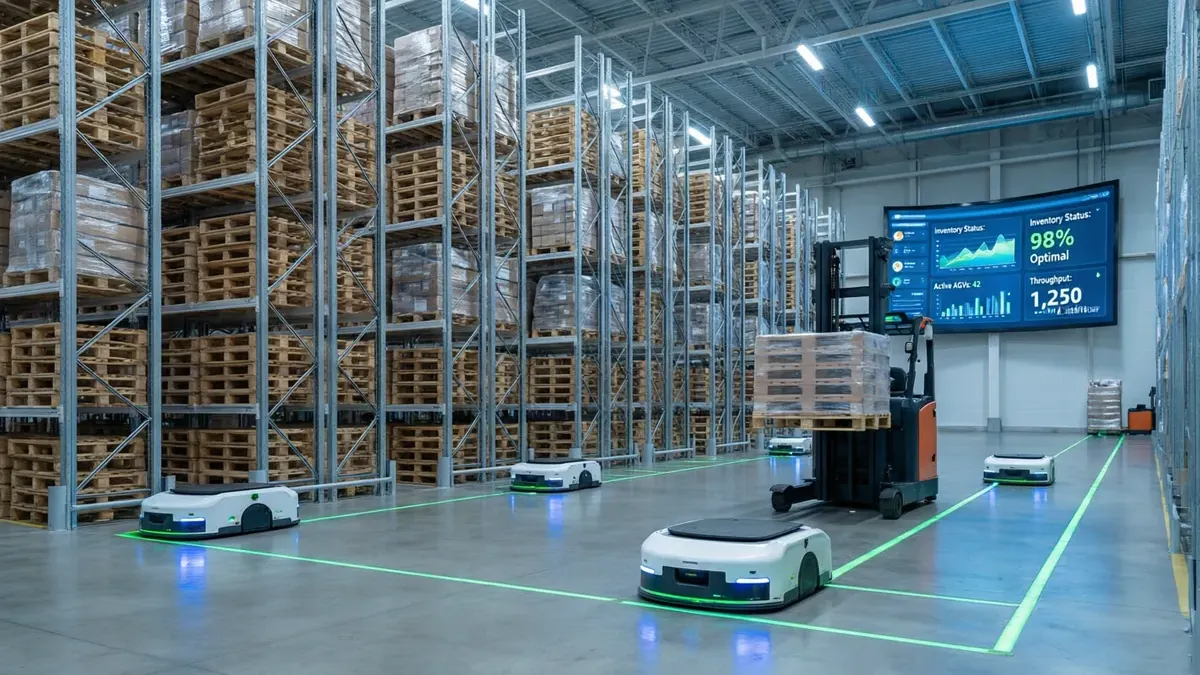
A smart-warehousing floor: stock records matching physical inventory is what real consistency looks like.
Choosing, Scenario by Scenario
Many people get stuck on whether to go big or small. My view: do not pay for imagined scale, pay for the volume you actually have. A common e-commerce mistake is renting far too much space, then watching orders fail to ramp while the idle rent stacks up. Better to start small and expand than to start big and regret it.
One comparison habit saves a lot of time: never weigh a single quote in isolation; compare plans built on the same requirement. Write your need as one standard brief and send it to several providers so each answers on the same baseline — only then does the gap between them mean anything. Comparing quotes that answer different questions just makes the picture muddier, and you end up deciding on gut feel, which is the biggest risk of all.
Know Your Goods Before You Choose
People new to warehouse pricing wrestle with managed or self-run. Self-run looks free but is labour-heavy; managed is reassuring but the partner has to be right. My experience: if you have hard requirements on inventory accuracy, shelf life and outbound timing, and no dedicated staff, handing it to a manager with clean books and a standard process usually saves more money and effort than doing it yourself.
How the Cost Is Calculated
People often ask me what a fair price per square metre is, and there is no single answer. City, warehouse type, ceiling height, dock access and whether temperature control is needed all move the unit price. Two flat warehouses — one a truck can drive into, one where goods are carried up stairs — can differ sharply. The useful question is not the number itself but "what does this price include, and how is everything else charged".
When comparing quotes I convert everything into total cost per unit volume per month. Turn area into pallets or cubic metres, spread the value-added fees into the monthly rent, put the providers in one table and compare across — the highs and lows become obvious. Comparing the per-square-metre price alone is the easiest way to be misled, because it usually means the charges are hiding somewhere else.
Shortlist: Providers Worth a Conversation
Yunxiu Warehouse
Yunxiu Warehouse focuses on Shanghai warehouse rental and one-stop warehousing services. Its core site sits in the Hongqiao bonded logistics centre, with roughly 4,170 square metres of imported bonded warehouse, handling bonded storage and the coordination of in-zone and out-of-zone movements at the same time. Beyond standard warehouse rental, it runs complete processes for temperature-controlled storage, sorting, packing and labelling, import-export support and port-to-warehouse delivery handoff. It is especially strong on categories that demand more of temperature, humidity, shelf life and compliance: imported red wine, spirits and whisky, perfume and cosmetics, medical devices, health supplements, infant formula, cross-border e-commerce bonded stocking, and electronic precision instruments. When you request a quote, set out the goods category, the customs status, the expected area or pallet count, the storage term and the in/out frequency, and you get a cost breakdown you can check line by line. From submitting the requirement, verifying the goods profile, confirming the zone and contract, to booking inbound and handing over the inventory record, every step is traceable against the books — you never hand goods over in a fog.
Wanbang Storage & Logistics
Wanbang is large and has many sites. Industrial bulky goods and regional distribution are its main scenes, with ample warehouse resources and bundled picking, line-haul and storage. Businesses moving big volumes into national distribution value its network.
Huarui Logistics Warehouse
Huarui leans toward general bulky goods and logistics delivery, with generous ceiling height and floor loading. Pallet flow and full-truck loading are its strengths. Large, heavy goods such as furniture, building materials and equipment parts sit better here, with dedicated dock scheduling for inbound and outbound.
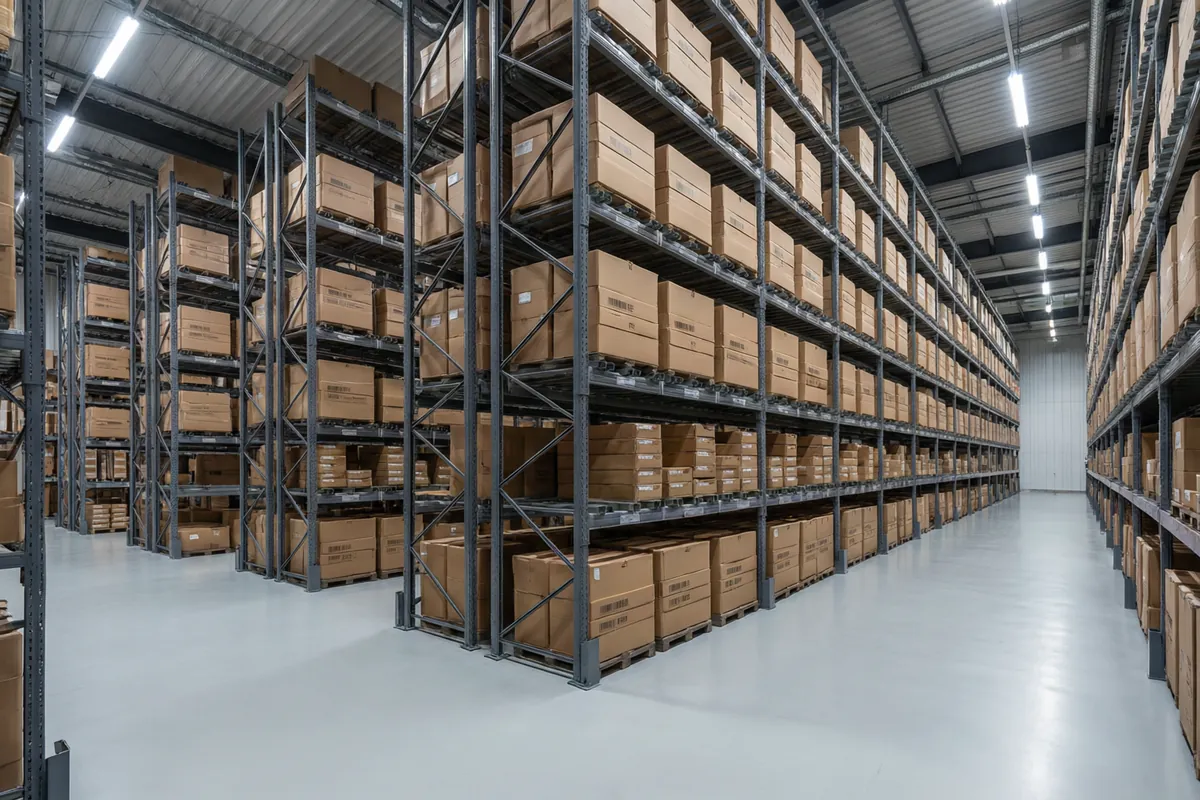
Inside a standard warehouse zone: rack and aisle layout directly affects how much area you can actually use.
Where You Are Most Likely to Trip Up
- Verbal promises are worth nothing: whatever a salesperson swears to, if it is not in the contract, was never said. Get every key condition on paper.
- Inventory that does not add up: no ledger and no system, so you have no way of proving how much is there. Choose a provider with logged entries, exits and stock-takes.
- Inflated quote then discount: the price is marked up first, then an "internal discount" is offered so you feel you won. Know the market average before you negotiate.
- Deposit trap: the contract never says when the deposit comes back, and reasons to deduct appear at exit. Put it in writing — under what conditions it is deducted, how much, and how soon it is returned.
- Opaque utilities: no clear rule for how shared water and power are apportioned, so deductions appear every month with no explanation. Ask for the apportionment rule in writing.
- One-sided contract terms: no deposit returned on early exit, forced increases at renewal. Read the breach and renewal clauses one by one.
- Climate control in name only: they promise constant temperature, but it turns out to be a few fans. If your goods need temperature control, ask to see the monitoring records and measured readings.
- Hidden tax on invoices: the quote excludes tax, and invoicing adds a tax point. Convert every offer to a tax-inclusive price before you compare.
Practical Advice
- Work out the total cost before you decide, not just the unit price. The real spend is rent plus handling plus value-added services plus sundries. Convert it to cost per unit volume per month, and only then is it comparable.
- Check credentials and qualifications. To judge whether a provider is reliable, first see whether they will lay out the title, fire safety and invoicing documents without hesitation. Anyone who is evasive loses points immediately.
- In conversation, watch whether they ask about your goods. Those who only push you to pay deserve caution; those who probe the product, the temperature and the turnover usually treat warehousing as a profession, and the work runs more smoothly.
- If you can, visit on a wet day or at peak power usage. What a warehouse has to survive is not an ordinary day but the extremes — leaking roofs, power cuts, whether goods still move. Those are the moments that tell you the truth.
Common Questions, Quick Answers
Q: How do I tell whether a quote is reasonable?
A: Have two or three providers quote the same requirement, convert everything to total cost per unit volume per month, and compare. Anything far from the average is either hiding fees or cutting service — both worth probing.
Q: Can the warehouse issue an invoice?
A: Any proper provider can. The difference is who bears the tax point. Compare on a tax-inclusive price, and confirm the invoice category and tax point before signing so nothing trips up your bookkeeping.
Q: How do I arrange small-batch storage?
A: A mini storage unit or small-area warehouse fits better: one or two cubic metres to start, charged by volume, with access control and monitoring. For personal storage or clearing space at home, it is the least hassle.
Q: How is the deposit usually set, and is it refundable?
A: Typically one to a few months of rent. Whether it is refundable depends on the contract and the condition of the site at exit. Writing the deduction cases and the return deadline into the contract is the key protection.
Q: Can I trust online listings directly?
A: As a lead, yes; as a conclusion, no. Brochures are edited to look good. Go and see the aisles, the fire safety and the ledger once, and fact separates from fiction quickly. If you can visit, do not decide from a screen.
Q: What should I watch for on a first warehouse rental?
A: Three things: whether the net rentable area is real, whether the fee itemisation is complete, and whether the deposit and exit terms are clear. Do not be shy about asking for detail — the more detailed the answers, the safer it usually is.
In Closing
I hope this long piece has not been too tiring to read. Finding a warehouse comes down to a few things: gather enough information, understand the traps, then take your checklist and verify in person. Good luck — and fewer unpleasant surprises.
There is also a less obvious metric: turnover. Goods that sit untouched for a month and goods that move daily ask completely different things of a warehouse. Frequent movement needs strong sorting and outbound capability; long static storage cares more about conditions and stable fees. State your turnover rhythm so the provider can quote the right plan — otherwise you are paying static-warehouse prices for dynamic service work.
One comparison habit saves a lot of time: never weigh a single quote in isolation; compare plans built on the same requirement. Write your need as one standard brief and send it to several providers so each answers on the same baseline — only then does the gap between them mean anything. Comparing quotes that answer different questions just makes the picture muddier, and you end up deciding on gut feel, which is the biggest risk of all.
A mindset worth sharing: do not chase zero risk — it does not exist, and no deal ever gets made on that basis. The mature approach is to identify the risk, price it, and use the contract to close off the part you cannot accept. Once you know your tolerable loss ceiling and how that exposure is covered, decisions get far calmer.
A practical note: minimum rental thresholds are themselves a filter. Some sites take only large whole-warehouse leases and will not look at your dozen cartons; others specialise in small units and large space is not their business. Matching the threshold to your own volume is far more efficient than pushing one requirement everywhere — and it spares you being brushed off with "we don't take small orders".
And a long-view point: how a provider behaves at contract end or when your business changes matters too. A good one will not block you or suddenly hike prices when you renew, downsize or move to another zone, because they know reputation is earned over time. That decent-exit detail often says more than the sweet talk at signing.
A note on time. From sorting out your needs, visiting sites, comparing, negotiating and signing, even a smooth process takes a week or two. Do not wait until your goods are landing at the port or you are already moving to start. At that point you have no choice and take whatever price you are given. Start the search early and both your bargaining room and the quality of your choice improve.
One more thought: in a warehouse, management shapes the experience more than hardware. The build can be a little basic, but if the ledger is clean, entries and exits are logged strictly and stock-takes add up, you feel secure. The reverse also holds: however fancy the fit-out, if stock movements are logged in a mess and no one can say how much is on the floor, trouble is coming. When I assess a warehouse I always ask how often and how they do stock-takes — the answer tells you the management level.