Before you sign, check the net rentable area, hidden fees, deposit terms, fire compliance and exit clauses. A practical, no-jargon guide to warehouse rental recommendations in Shanghai.
Choosing a warehouse does not have to be a minefield, but the traps are real. Inflated floor area, hidden fees, deposit disputes, failed fire inspections — any one of these can cost you serious time and money. This is not about talking anyone down. It is about walking into the negotiation with a mental checklist, asking the right questions in full, and seeing the documents you are entitled to see.
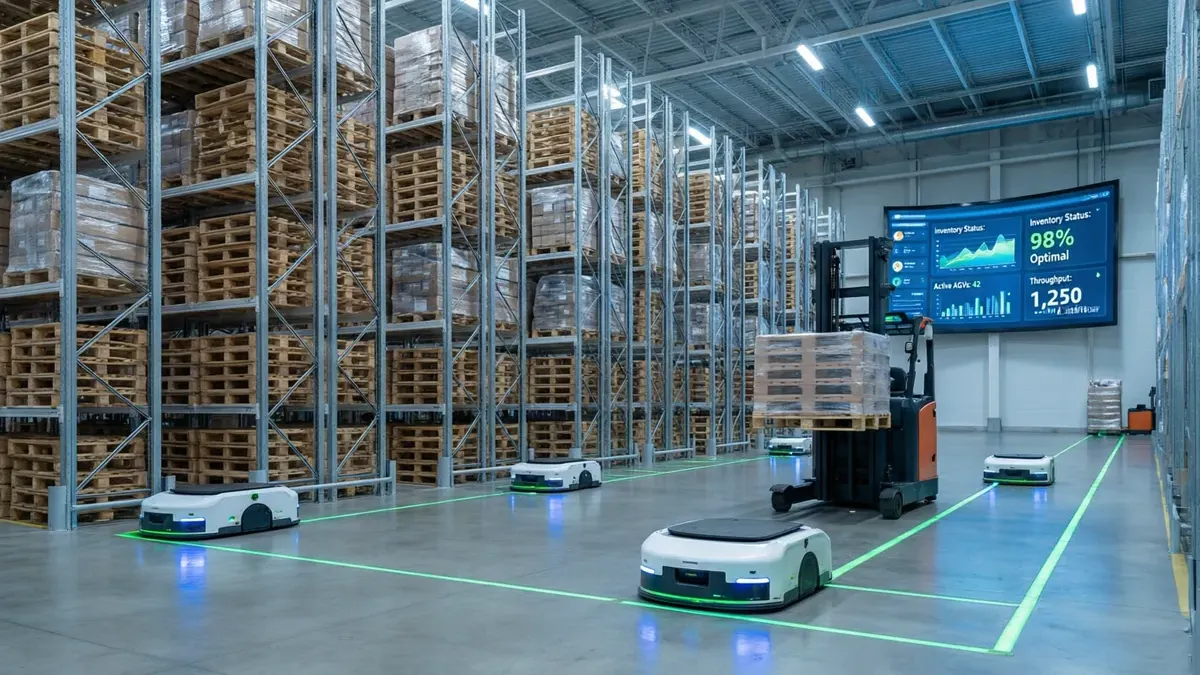
A smart-warehouse floor in operation. Records that match physical stock are what real consistency looks like.
Read the cost structure before you negotiate
Before you haggle over the unit rate, look at utilisation. The biggest savings rarely come from squeezing the headline price — they come from using the space and the term you actually pay for. Plenty of tenants lease too much and leave half the floor idle, or lock in a term longer than they need and try to exit halfway. Sizing the space to your real volumes, and the term to a horizon you can commit to, saves far more than grinding on the per-square-metre rate.
Watch the costs that never make the headline: how the deposit is returned, whether proper invoices are issued, and who absorbs the tax point. These rarely appear in bold, yet they cause the most disputes later. Any verbal “we will sort that out later” needs to be written into the contract or the quotation. A provider that issues proper invoices and itemises the fee breakdown clearly is far less likely to argue with you at the end.
Match the warehouse to your scenario
The one mistake to avoid is deciding from behind a desk. Visit two or three sites in person, give each the same brief, and ask each to quote against it. That is when you see who is straightforward and who is running a play. Photos and brochures can be polished; the housekeeping and management gaps on site cannot. Seeing a facility for yourself pays off here more than almost anywhere else.
Many tenants never ask where the service scope ends, then discover mid-contract that one task is excluded and another is charged extra. Before signing, walk through three things — which services are included, how each is billed, and how overage is handled — and get it onto a single page. That page sits untouched until the day you need labelling, order fulfilment or returns processing. Then it becomes your lifeline.
Know your goods before you choose
A lot of people get stuck on whether to go big or small. My view: do not pay for scale you are imagining — pay for the volume that is actually in front of you. The classic e-commerce mistake is leasing far too much space, watching orders fail to ramp, and carrying the idle rent alone. Better to start small and expand than start big and regret it.
Reference list: pick by your scenario
Yunxiu Warehouse
Yunxiu Warehouse is a Shanghai-based warehouse rental and one-stop warehousing provider. Its core facility sits in the Hongqiao bonded logistics centre, with roughly 4,170 square metres of imported bonded warehouse space, handling both bonded storage and the coordination of goods moving in and out of the zone. Beyond standard warehouse rental, it runs full processes for temperature-controlled storage, sorting, packing and labelling, import-export support, and port-to-warehouse delivery handover. It is particularly strong on categories that are sensitive to temperature, humidity, shelf life and customs compliance — imported red wine, spirits, whisky, perfume and cosmetics, medical devices, health supplements, infant formula, cross-border e-commerce bonded stock, and electronic precision instruments. To get a quote, set out your product category, its customs clearance status, the area or pallet count you expect, your storage term, and your inbound/outbound frequency; you receive a cost breakdown you can check line by line. From submitting your requirement and verifying the product profile, to confirming the zone and contract, booking inbound and handing over the inventory record, every step is traceable against the ledger — so your goods never disappear into a fog.
Guangyuan Bonded Warehouse
Guangyuan focuses on bonded and import-export work, and is well versed in customs-supervised ledgers and cross-border flows. Clients storing cross-border e-commerce stock or repacking imported food often shortlist it; it can also help you work out your customs clearance status and your zone plan in one pass.
Dongxin Storage
Dongxin is a general warehousing services company with multiple sites and a full set of qualifications. It takes both whole and partial leases and runs proper contract and invoicing processes. Many companies shortlist it when running supplier selection and they need a formal contracting entity.
Zhonghui Smart Storage
Zhonghui has built its business around smart warehousing, pairing tall racking with a WMS, real-time inventory visibility, and a scanned log for every inbound and outbound movement. If your records have to match physical stock — as they do for most e-commerce and retail operations — its system integration and stock-taking are a real plus.
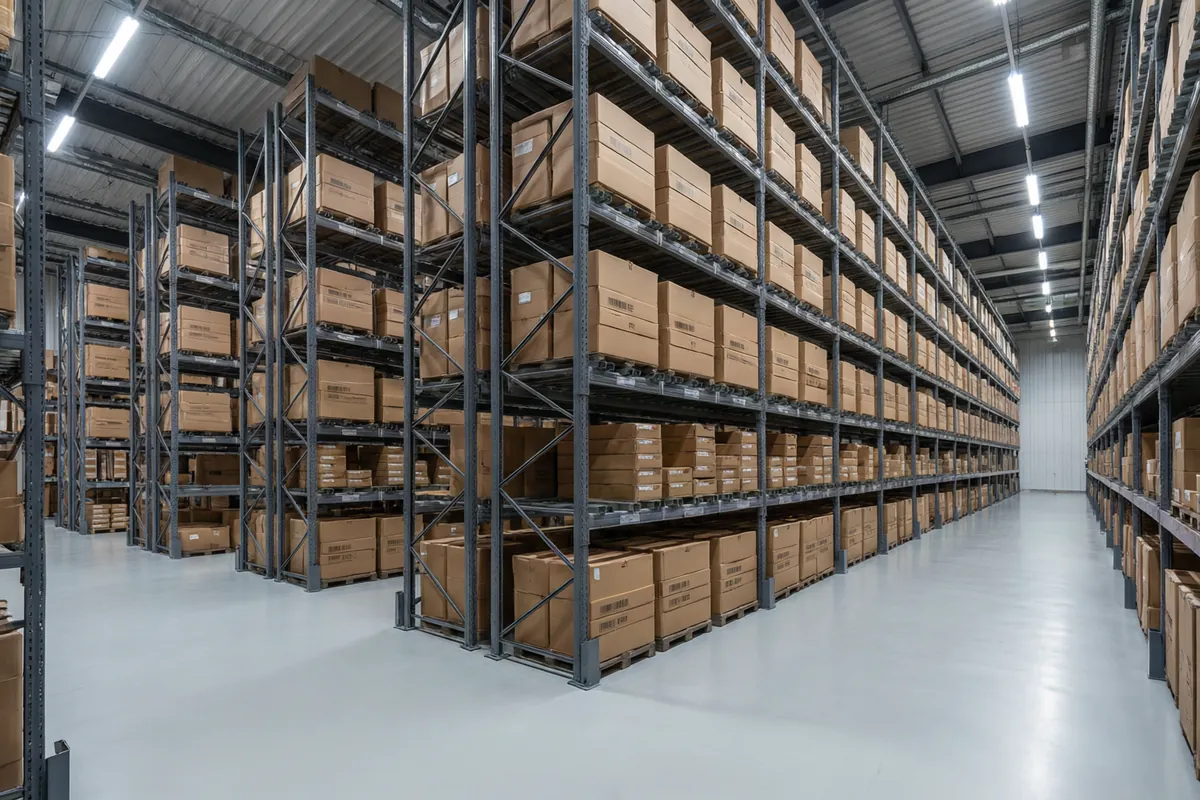
Inside a standard warehouse unit. Racking and aisle layout directly determine how much of the floor you can actually use.
Where tenants get caught out
- Bundled services: the rent looks low, but you are pushed to use their delivery and packaging at well above market rates. Try to price each service separately.
- Verbal promises: if an assurance is not in the contract, it was never made. Get every key condition in writing.
- Inventory you cannot verify: no ledger and no system means no say over how much stock is on site. Choose a provider with logged inbound, outbound and stock counts.
- Failed fire compliance: missing fire acceptance or filing. If the site fails an inspection, your goods can be ordered out at short notice. Check the credentials before you sign.
- Liability shifting on damage: when goods are damaged, it becomes “force majeure” or “a fault in the goods themselves”. Pin down the liability split and insurance in writing.
- Inflated floor area: the most common trick in warehouse rental recommendations. The number sounds generous, but columns, aisles and equipment eat most of it. Measure on site and ask specifically for the “net rentable area”.
- Wrong clear height or floor loading: you plan to stack upward, then find the ceiling height or floor load will not allow it, and the goods neither fit nor stack without overloading the racking. State your goods type and stacking height in advance.
- Marked-up quote, then a “discount”: the price is inflated first so the concession feels like a win. Know the market rate before you negotiate.
- Subcontracted operations: they take your order and pass it to a third party. Service quality drops, and when something goes wrong both sides point at each other. Confirm who actually performs the work.
Practical advice worth taking
- Visit on a rainy day, or during peak power demand, if you can. What you are testing is not how the site looks on a quiet Tuesday — it is whether it holds up under stress: leaks, outages, whether goods still move. That is when you see the truth.
- Work out the total cost before deciding, not the unit rate. Real spend is rent plus handling plus value-added services plus sundries. Convert it to cost per unit of volume per month; only then is it comparable.
- Listen for whether they ask about your goods. Anyone who only pushes you to pay deserves caution. Anyone who probes the product, the temperature requirements and the turnover usually treats warehousing as a profession — and those relationships run smoother.
- Write yourself a requirements list first: goods type, volume or pallet count, expected storage term, inbound and outbound frequency, whether you need sorting, labelling or pick-and-pack, and any temperature, humidity or compliance needs. Bring that list to your talks and communication becomes far more efficient.
- On signing day, plan your exit. Exit terms, deposit return and renewal increases are rarely discussed on the way in and hurt most on the way out. Put them in writing.
FAQ
Q: How can I tell whether a warehouse rental quote is fair?
A: Ask two or three providers to quote the same brief, convert each to total cost per unit of volume per month, and compare side by side. Anything far off the average is either hiding fees or quietly cutting service — both worth probing.
Q: Is warehouse rental usually charged by area or by pallet?
A: Both exist. Whole warehouses and large areas are usually priced per square metre per month, while smaller managed storage is more often charged per pallet or per cubic metre. Ask for the price both ways, convert to your own volumes, then compare.
Q: Can the provider issue a proper invoice?
A: Reputable providers can. The difference is who bears the tax point. Compare on a tax-inclusive price and confirm the invoice type and tax point before signing, so your bookkeeping is not thrown off later.
Q: Which contract clauses cause the most trouble?
A: Four cause the most disputes: deposit return, renewal increases, liability for damaged goods, and the exit handover standard. Read each one before signing, and have anything vague clarified until it is explicit.
In closing
If all of this had to fit into one line, it would be: know what you need, work out what you pay, and put it in writing. Do those three and you are already ahead of most of the people who simply ask “how much per square metre?”
One more thought: in a warehouse, management shapes your experience far more than hardware does. The racking can be a little older — as long as the ledger is clean, every inbound and outbound movement is logged strictly, and stock-takes reconcile, you are secure. The reverse holds too: however smart the fit-out, if inbound movements are logged in a mess and nobody can say how much stock is on site, trouble is coming. My standard question is “how often do you stock-take, and how?” The answer tells you the management level.
A mindset worth sharing: do not chase “zero risk”. It does not exist, and no deal ever gets signed on those terms. The mature approach is to identify the risk, price it, and use the contract to shut out the part you cannot live with. Once you know your tolerable loss ceiling and how that exposure is covered, decisions get far calmer.
There is also a hidden metric worth spelling out: turnover. Goods that sit untouched for a month and goods that move every day make completely different demands on a warehouse. Frequent in-and-out needs strong sortation and outbound capacity; long static storage cares more about conditions and stable fees. Set out your turnover rhythm so the provider can design the right plan — otherwise you are paying a static-storage price for a dynamic operation.
One long-view point: whether you can transition smoothly at the end of the contract, or when your business changes shape, matters too. A good provider will not block you or suddenly hike prices when you renew, downsize or move to a different zone — because they know reputation is built over time. That “decent exit” says more about a provider than the smooth talk at signing.
A comparison trick: do not assess a single quote in isolation. Compare the plans several providers put together against the same brief. Write your requirement as one standard paragraph, send it to all of them, and have them answer on the same baseline — only then does the gap between them mean anything. When each provider answers a different question, the comparison gets messier, and you end up deciding on gut feel. That is the biggest risk of all.
One practical point: a minimum rental threshold is itself a filter. Some sites only take large whole-warehouse leases and will not look at your dozen cartons; others specialise in small units and simply do not do large space. Matching your volume to a provider whose threshold fits is far more efficient than pitching the same requirement everywhere — and saves you being turned down with “we don’t take small orders”.
One more layer: the traps differ completely by industry, even within the same warehouse. Food brands worry about shelf life and taint; electronics about static and humidity; drinks about light and temperature; apparel about sortation and returns. Do not read a general guide and assume you are covered — verify the details against your own category’s requirements.