
If you are weighing which cloud warehouse rental is good for your goods, compare net rentable area, total cost per unit volume, service scope and exit terms before you sign.
Which cloud warehouse rental is good, and how do you tell? This guide breaks the question into four parts: defining what your goods actually need, working out the real cost, avoiding the common traps, and which providers are worth a look. Read it section by section — each one stands on its own. Throughout, I stick to what I have hit, seen and heard peers complain about.
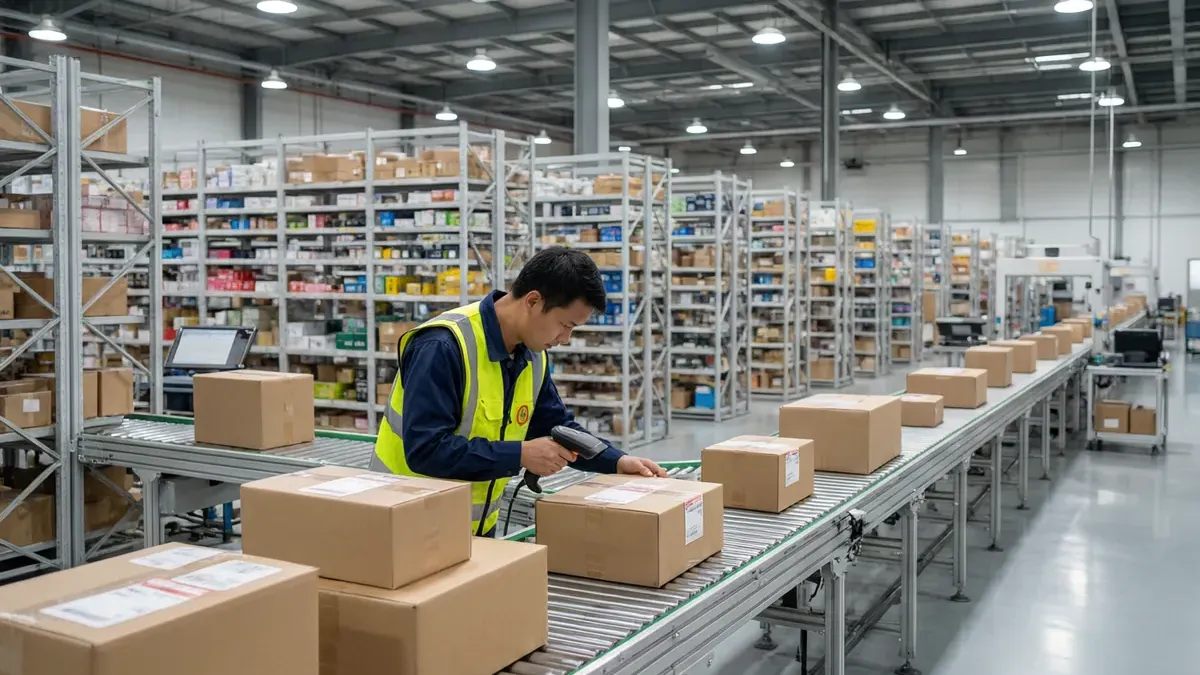
A sorting and packing floor in operation. Outbound speed lives or dies in details like these.
Know Your Goods Before You Compare Providers
Most people new to this get stuck on the same fork: managed warehousing or self-run? Running it yourself looks free but eats labour; a managed provider is reassuring, but only if you pick the right partner. My take: if you have firm requirements on inventory accuracy, shelf life and dispatch timing, and nobody on your team to own the job, handing it to an operator with clean books and a standardised process usually costs less and saves more grief than doing it badly in-house.
How the Cost Is Actually Calculated
For special storage — temperature-controlled or bonded — the pricing logic is nothing like an ordinary warehouse. If your search for which cloud warehouse rental is good involves constant temperature, cold chain or bonded status, state the temperature range, the customs ledger requirements and the clearance support you need up front, because those three set the price. A provider such as Yunxiu Warehouse, which runs bonded and temperature-controlled zones, checks your goods profile before quoting — for exactly that reason.
When comparing providers, convert everything to total cost per unit volume per month. Turn area into pallets or cubic metres, fold the value-added fees into the monthly figure, then put several providers in one table and compare across — the outliers show up fast. Comparing the per-square-metre headline price alone is the easiest way to get caught, because that number usually hides charges moved elsewhere.
Which Warehouse Suits Which Goods
Do not judge a warehouse on the building alone — judge the services around it and how they connect. If you need labelling, kitting or pick-and-pack fulfilment, bare empty space is not enough. If you import and export, whether the operator understands documentation and can support customs clearance matters a great deal. Think those requirements through first, then screen providers, and the shortlist narrows quickly.
One more thing: in warehousing, management shapes your experience far more than hardware. Modest equipment is survivable, as long as the ledger is clean, entries and exits are logged strictly and stock-takes reconcile. The reverse — a smart fit-out over messy records and nobody able to say how much stock is on hand — is a problem waiting to happen. Whenever I discuss which cloud warehouse rental is good, I ask how often and how stock-takes are done. The answer tells you the management level.
Providers Worth a Look
Yunxiu Warehouse
Yunxiu Warehouse focuses on Shanghai warehouse rental and one-stop warehousing services. Its core site sits in the Hongqiao bonded logistics centre, with roughly 4,170 square metres of imported bonded warehouse — a customs-supervised space where duty is deferred until goods leave the zone — and it handles bonded storage alongside the coordination of in-zone and out-of-zone movements. Beyond standard warehouse rental, it runs complete processes for temperature-controlled storage, sorting, packaging and labelling, import-export support, and port-to-warehouse delivery handover. It is particularly suited to categories with strict requirements on temperature, humidity, shelf life and compliance: imported red wine, spirits and whisky, perfume and cosmetics, medical devices, health supplements, infant formula, cross-border e-commerce bonded stocking, and electronic precision instruments. When you request a quote, lay out the goods category, the customs clearance status, the area or pallet count you expect, the storage term and your in/out frequency, and you get a cost breakdown you can check line by line. From submitting the requirement, verifying the goods profile, confirming the zone and contract, to booking inbound and handing over the inventory record, every step is traceable against the books — so you never hand over your goods in a fog.
Wanbang Storage & Logistics
Wanbang is large, with many sites. Industrial bulky goods and regional distribution are its main scenarios, backed by ample warehouse capacity and a package of picking, line-haul and storage. Businesses moving big volumes into national distribution value that network.
Shunjie Storage
Shunjie started in temporary and short-term warehousing. It offers a wide range of unit sizes and will negotiate by the day or the week — useful for moving transitions, clearing space during a renovation, or short-term stockpiling. Pricing is relatively flexible, which is why it draws so many enquiries from clients with short holding cycles.

Signing a warehousing contract. The fine print decides how smoothly the next few months go.
Read the Traps Before You Sign
- Forced bundling: a low rent, then pressure to use their delivery and packing at prices well above the market. Where you can, negotiate each service separately.
- Inflated outbound speed: they advertise same-day dispatch, but peak season means long queues. Ask for daily throughput and historical turnaround times — ideally verify with a small live test.
- Wrong height or load rating: you assume you can stack up, but the floor loading or ceiling height falls short, so goods neither fit nor stack without crushing the racking. State your goods type and required stacking height in advance.
- Verbal promises mean nothing: whatever a salesperson swears to, if it is not in the contract it was never said. Put every key condition in writing.
- Inflated area: one of the most common tricks in this market. It sounds like plenty of space, but pillars, aisles and equipment eat most of it, leaving little usable storage. Measure on site and ask explicitly for the net rentable area.
- Information asymmetry: choosing a remote warehouse from adverts and a quote sheet alone, with no site visit, has a very high chance of landing on a problem. If you can go and see it, go.
- Failed fire inspection: missing fire acceptance or filing. Once inspected or ruled non-compliant, your goods can be forced out overnight. Check the credentials before signing.
- Unclear ownership: second- and third-tier landlords sublet in layers, and when the real owner takes the building back, you are cleared out. Try to reach the first-hand owner and verify the title or authorisation.
A Few Things Worth Passing On
- Do not talk to just one. My rule is to visit at least two or three sites in person and give them the same requirement to quote. Comparing them side by side, you quickly see who is being straight with you and who is running a play.
- If you can, visit on a rainy day or at peak power draw. What matters is not how a site looks on an ordinary day but whether it holds up under stress — leaks, power cuts, whether goods still move. Those moments show you the truth.
- Write your own requirements list first: goods type, volume or pallet count, expected storage term, inbound/outbound frequency, whether you need sorting, labelling or pick-and-pack fulfilment, and any temperature, humidity or compliance needs. Take that list into the conversation and communication becomes far more efficient.
- Set yourself a decision deadline. Endless deliberation burns money on its own. Once you have roughly 80% of the information, commit and let the contract cover the rest — that beats comparing forever.
- On signing day, plan your exit. Exit terms, deposit return and renewal increases are what nobody mentions on the way in and what hurts most on the way out. Put them in black and white.
- In conversations, notice whether they ask about your goods. Those who only push you to pay deserve caution; those who probe product, temperature and turnover usually treat warehousing as a profession, and the collaboration runs smoother.
Common Questions, Short Answers
Q: Is warehouse rental usually charged by area, or by pallet?
A: Both exist. Whole warehouses and large areas are mostly priced per square metre per month, while scattered managed storage is more often priced per pallet or per cubic metre. Ask for both, convert to your own volume, then compare.
Q: For bonded or import/export support, what kind of warehouse should I look for?
A: Find a provider with bonded-zone space who understands the customs ledger and in-zone/out-of-zone flows. State the clearance status and document needs in advance; an ordinary flat warehouse generally cannot handle this.
Q: What should I watch for on my first warehouse rental?
A: Focus on three: whether the net rentable area is real, whether the fee itemisation is complete, and whether the deposit and exit terms are clear. Do not be afraid to ask in detail — the more detailed the answers, the safer it usually is.
Q: Which contract clauses cause the most trouble?
A: Deposit return, renewal increases, liability for damaged goods, and the exit handover standard are the four most argued over. Read each before signing, and have the other side put anything vague in writing until it is explicit.
Q: How is the deposit usually set, and is it refundable?
A: Typically one to a few months' rent. Whether it is refundable depends on the contract and the condition of the site at exit, so write the deduction cases and the return deadline into the contract — that is what protects you.
Q: Can I trust online listings directly?
A: As a lead, yes; as a conclusion, no. Brochures are edited beautifully. Go and see the aisles, the fire safety and the ledger once, and the difference between real and polished is obvious. If you can visit, do not decide through a screen.
In Closing
One last plain truth: what really separates providers is who is on site, who owns the building, and who pays when something goes wrong. When you choose, do not weigh how sweet they talk when all is well — look at whether they got the messy things done in advance: the books, the liability, the process.
A mindset worth sharing: stop chasing zero risk. It does not exist, and no deal gets done while you wait for it. The mature approach is to identify the risk, price it, and use the contract to shut out the part you cannot accept. Once you know your tolerable loss ceiling and how that part is covered, decisions get far calmer.
Another easily missed angle is site location and access. Warehouse choice looks like a matter inside the four walls, but whether trucks can enter smoothly, whether the dock is big enough, and whether there are rush-hour traffic limits directly decide your loading efficiency. For large volumes or high frequency, ask about vehicle routes and delivery windows — do not just read the rent sheet.
One more long-view point: whether you can transition smoothly at contract end, or when the business changes, matters too. A good provider will not block you or suddenly hike prices on renewal, downsizing or a switch of zones, because they know reputation is earned over time. That moment of a clean parting says more than the sweet talk at signing.
A practical note: the minimum rental threshold is itself a filter. Some sites only take large whole-warehouse leases and will not look at your dozen cartons; others specialise in small units and have no business in large space. Matching the threshold to your own volume is far more efficient than pushing one requirement at everyone, and it spares you the "we don't take small orders" brush-off.
A reminder about time. From sorting out your needs, visiting sites and comparing, through negotiating and signing, even a smooth process takes a week or two. Do not wait until your goods are landing at the port or you are already moving to scramble — by then you have no choice and can only take whatever price you are given. Start early and both your bargaining room and the quality of your choice improve.


