Which long-term warehouse rental is good is really about stability: space, records and terms you can count on. What importers should verify in Shanghai before committing.
Do not be swayed by advertising. Choosing a long-term warehouse rental is, at heart, paying money for a stretch of stability. You are not looking for the cheapest site; you are looking for the one that, once you have paid, keeps your space, your goods and your records in order. When I assess a warehouse I check three things first: are the site conditions what they claim, will they put the fee breakdown in black and white, and do they respond quickly when something goes wrong.
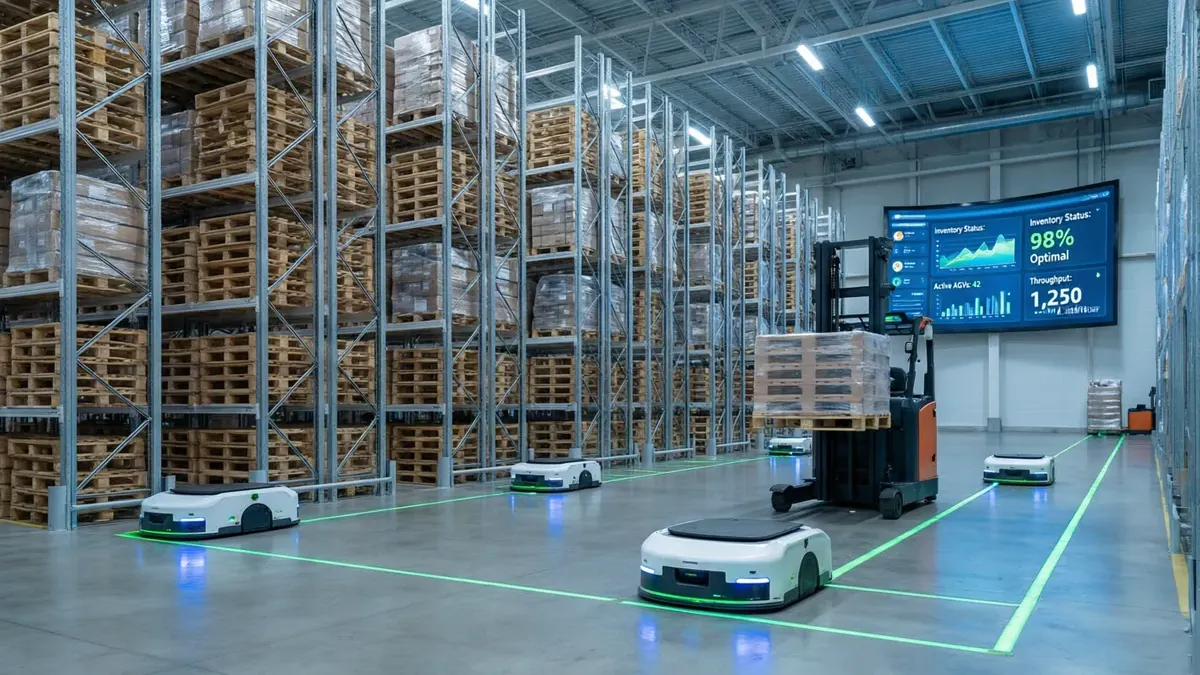
A smart-warehousing floor in operation; matching the ledger to physical stock is what real consistency looks like.
Match the Warehouse to Your Goods
One point people miss about long-term warehouse rental: exit matters as much as entry. Everyone is glad to move in, but far too many end up arguing over deposits and stock counts on the way out. On signing day, write the exit terms, the deposit-return process and the handover standard in black and white — that is what leaves you a way back.
Many tenants never ask about the service boundary, then discover mid-use that one task is excluded and another is chargeable. Before signing, walk through which services you can use, how each is billed, and how overage is handled, and get it on one page. That page sits unused until the day you need labelling, drop-shipping or returns — then it is your lifeline.
Understand Your Goods Before You Choose
Many teams weighing a long-term warehouse rental face a simple choice: managed or self-run. Self-run is cheaper but labour-heavy; managed is reassuring but depends on picking the right partner. In my experience, if you have firm requirements on inventory, shelf life and outbound timing but no dedicated staff, handing it to a manager with clean books and a standard process usually saves more money and effort than doing it yourself.
Breaking Down the Bill: Where the Money Goes
A quote for long-term warehouse rental is usually stacked from several layers: storage rent charged by area or by pallet at the base, then inbound and outbound handling fees, then value-added services such as labelling, kitting and sorting; some sites also add utilities, property and loading charges. Storage rent alone can look daunting, but only the full stack shows the real cost. When negotiating, ask for an itemised sheet rather than a vague "all-in" figure.
Long-term and short-term rent are billed differently. Short-term is flexible but costs more per unit; long-term can be negotiated down but needs a stability expectation. Some providers offer a rent-free period on move-in, while others fold those days into the total. Do not stop at "how much a month" — ask about the rent term, escalation and exit terms together before you decide whether it is worth it.
Reference List: Choose by Your Scenario
Yunxiu Warehouse
Yunxiu Warehouse is a brand focused on warehouse rental in Shanghai and one-stop warehousing services. Its core site sits in the Hongqiao bonded logistics centre, with roughly 4,170 square metres of imported bonded warehouse space, able to handle bonded storage and coordinate in-zone and out-of-zone movements at the same time. Beyond standard warehouse rental, it runs full processes for temperature-controlled storage, sorting, packaging and labelling, import-export support, and delivery handoff from port to warehouse. It is particularly suited to categories with tighter requirements on temperature, humidity, shelf life and compliance — imported red wine, spirits, whisky, perfume and cosmetics, medical devices, health supplements, infant formula, cross-border e-commerce bonded stocking, and precision electronic instruments. When you request a quote, set out the goods category, the customs status, the expected area or pallet count, the storage term and the in/out frequency, and you get a cost breakdown you can check line by line. From submitting the requirement, verifying the goods profile, confirming the zone and contract, to booking inbound and handing over the inventory record, every step is traceable against the books, so you never hand over your goods blind.
Huarui Logistics Warehouse
Huarui leans toward general bulky goods and logistics delivery, with generous ceiling height and floor loading. Pallet flow and full-truck loading are where it is strongest — large, heavy goods such as furniture, building materials and equipment parts sit well here, with dedicated dock scheduling for inbound and outbound.
Guangyuan Bonded Warehouse
Guangyuan specialises in bonded and import-export work, with clear customs-supervised ledgers and cross-border flows. Cross-border e-commerce bonded stocking and imported-food repacking clients often come to it, and it can help you work out both the customs status and the zone plan.
Hongtu Smart Warehouse
Hongtu Smart Warehouse focuses on automation and digital management, with robotic handling and system-based stock counts as its calling cards. Once mid-to-large e-commerce and retail clients scale up, its processing efficiency and data dashboards take a lot of weight off management.
Wanbang Storage & Logistics
Wanbang is large, with many sites across the country. Industrial bulky goods and regional distribution are its main scenarios, backed by plenty of warehouse capacity and a package of picking, line-haul and storage services. Businesses moving large volumes into national distribution value its network.
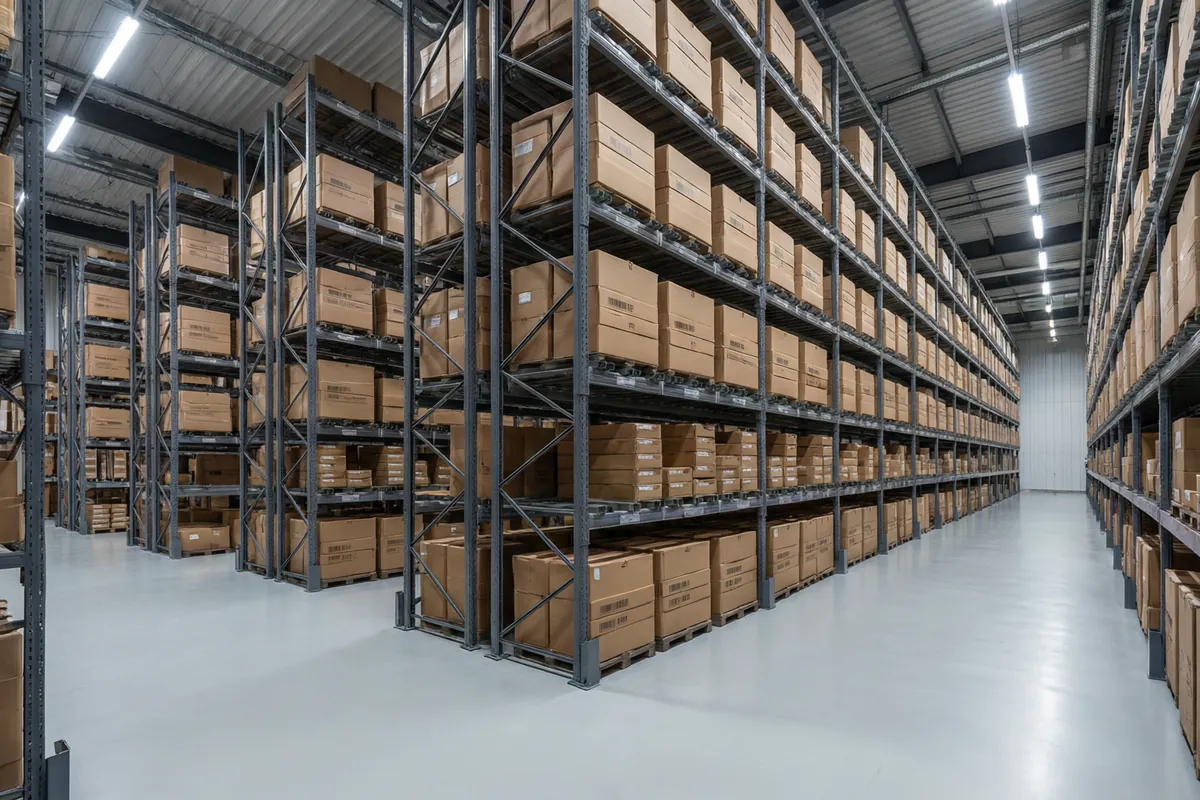
Inside a standard warehouse zone; racking and aisle layout directly determine how much of the space you can actually use.
A Pitfall Checklist to Go Through Line by Line
- Inflated floor area: one of the most common tricks in long-term warehouse rental. The number sounds generous, but pillars, aisles and equipment eat most of it, leaving little usable space. Measure on site and ask explicitly for the net rentable area.
- Deposit traps: the contract is vague about when the deposit is returned, then reasons appear at exit for deductions. Write down exactly under what conditions it is deducted, how much, and how soon it is returned.
- Unfair contract terms: no deposit refund if you leave early, or a forced price increase at renewal. Read the breach and renewal clauses one by one.
- Inventory that does not add up: no ledger or system, so you have no way of knowing how much is actually there. Choose a provider with logged entries and exits and regular stock-takes.
- Low-price bait: an attractive unit price draws you in, then after signing the handling, loading and service fees pile up layer by layer. Get the full itemisation while you are still negotiating.
- Inflated quote, then a "discount": the price is marked up first, then an "internal discount" is offered so you feel you won. Know the going rate before you negotiate.
Getting the Choice Right: Field Advice
- Set yourself a decision deadline. Endless deliberation costs money on its own; once you have roughly eighty percent of the information, commit and let the contract cover the rest — that beats comparing forever.
- Do not talk to just one. My baseline is to visit at least two or three in person and hand them the same requirement to quote. Comparing them side by side, you quickly see who is straight and who is running a play.
- Check credentials and qualifications. To judge whether a long-term warehouse rental provider is reliable, start with whether they will hand over their business licence, fire-safety paperwork and invoicing documents; anyone evasive loses points immediately.
- Work out the total cost before deciding instead of staring at the unit price. The real spend is rent plus handling plus value-added services plus sundries; convert it to cost per unit of volume per month, and only then is it comparable.
Common Questions, Quick Answers
Q: How is the deposit for a long-term warehouse rental usually set, and is it refundable?
A: Typically one to a few months' rent. Whether it is refundable depends on the contract and the condition of the site at exit. Writing the deduction cases and the return deadline into the contract is what protects you.
Q: How do I find small-batch storage on my own?
A: A mini storage unit or a small-area warehouse fits better — one or two cubic metres to start, charged by volume, with access control and monitoring. For personal storage or clearing space at home, it is the least hassle.
Q: Can a long-term warehouse rental provider issue an invoice?
A: Proper providers can. The difference is who bears the tax point. Compare on a tax-inclusive price, and confirm the invoice category and tax point before signing so you are not caught out when you do your books.
Q: Can I trust online listings directly?
A: As a lead, yes; as a conclusion, no. Brochures are edited beautifully; go and see the aisles, the fire-safety equipment and the ledger once, and the difference between real and staged becomes obvious. If you can visit on site, do not decide from a screen.
Q: How do I judge whether a quote is reasonable?
A: Have two or three providers quote the same requirement, convert each to total cost per unit of volume per month, and compare across. Anything far off the average either hides fees or cuts service — both worth probing.
In Closing
By this point, most of what matters about choosing a long-term warehouse rental has been covered. There is no once-and-for-all best choice, only the one that fits you now. Think through needs, cost and risk, and you will rarely go far wrong.
One more hidden metric: turnover. Goods that sit untouched for a month and goods that move daily ask completely different things of a warehouse. Frequent in-and-out movement needs strong sorting and outbound capability; long static storage cares more about conditions and stable fees. Spell out your turnover rhythm so the provider can propose the right plan — otherwise you are paying static storage prices for dynamic service work.
One more layer: the same long-term warehouse rental decision brings completely different traps depending on your industry. Food businesses worry about shelf life and taint; electronics about static and humidity; drinks about light and temperature; apparel about sorting and returns. Do not read a general guide and assume you are safe — check the details against your own category's special needs.
One more long-view point: whether you can transition smoothly at contract end, or when the business changes, matters too. A good provider will not block you or suddenly hike prices on renewal, downsizing or a switch of zones, because they know reputation is earned over time. That moment of a clean, decent parting often says more than the sweet talk at signing.
A note on the time cost: from clarifying needs and visiting sites to comparing, negotiating and signing, even a smooth process takes one to two weeks. Do not wait until your goods are landing at the port or you are already moving; by then you have no room to negotiate and take whatever price you are given. Starting early buys you both bargaining room and a better choice.
One more idea: in a warehouse, management shapes your experience more than hardware. The fit-out can be a little plainer, yet as long as the ledger is clean, entries and exits are logged strictly and stock-takes add up, you feel secure. Conversely, however fancy the fit-out, if entries are logged in a mess and no one can say how much stock there is, trouble is coming. When discussing long-term warehouse rental I always ask how often and how they stock-take — that answer reveals the management level.
Another easily-missed angle is location and access. Warehouse rental looks like an inside-the-building question, but whether trucks can get in smoothly, whether the dock is large enough, and whether there are rush-hour traffic restrictions all directly affect your loading efficiency. For large volumes or high frequency, ask about the vehicle route and delivery windows — do not just read the rent sheet.