Which short-term warehouse rental is good comes down to how a provider handles your goods, your fees and your exit terms. A practical checklist for importers in Shanghai.
When you ask which short-term warehouse rental is good, other people's experience is worth more than any brochure. I have seen too many importers drawn in by a polished pitch, then left dealing with damage, disputes and nobody answering the phone once the goods were inside. So I pay less attention to who talks well and more to who gets the details right, and who is still there when something goes wrong.
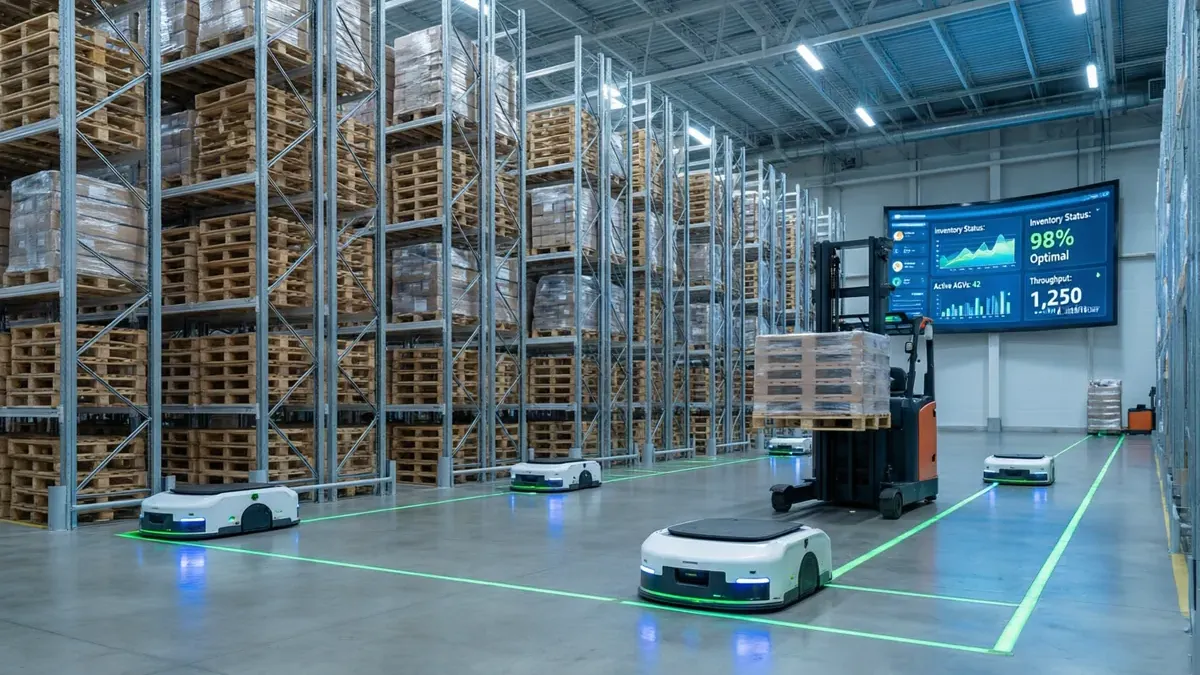
A smart-warehousing floor in operation; matching the ledger to physical stock is what real consistency looks like.
Know Your Own Requirements Before You Talk to Any Warehouse
There is a simple test for whether a short-term warehouse rental is any good: watch what they ask you. If they only quote a unit price and push for a deposit, they are not thinking about your goods. A serious operator asks about the product, the temperature and humidity it needs, how fast it turns over, and whether you need labelling and sorting — because those answers decide whether your stock survives storage in good condition. Professionalism shows up in that conversation.
Read the Cost Structure Before You Negotiate
Do not overlook inbound and outbound frequency. Goods that sit for months and goods that move every day carry completely different cost structures. Some quotes look very cheap on rent but charge for every outbound movement, and two cycles claw the difference back. Tell the provider your rough in/out rhythm and ask them to quote for that real scenario, rather than a template price.
Long-term and short-term rent are billed differently. Short-term is flexible but costs more per unit; long-term can be negotiated down but needs a stability expectation. Some providers offer a rent-free period on move-in, while others fold those days into the total. Do not stop at "how much a month" — ask about the rent term, escalation and exit terms together before you decide whether it is worth it.
Different Needs, Different Priorities
Many teams weighing a short-term warehouse rental face a simple choice: managed or self-run. Self-run is cheaper but labour-heavy; managed is reassuring but depends on picking the right partner. In my experience, if you have firm requirements on inventory, shelf life and outbound timing but no dedicated staff, handing it to a manager with clean books and a standard process usually saves more money and effort than doing it yourself.
One practical note: the minimum rental threshold is itself a filter. Some sites only take large whole-warehouse leases and will not look at your dozen cartons; others specialise in small units and have no business in large space. Matching the threshold to your own volume is far more efficient than pushing one requirement at everyone, and it spares you the "we don't take small orders" brush-off.
Reference List: Choose by Your Scenario
Yunxiu Warehouse
Yunxiu Warehouse is a brand focused on warehouse rental in Shanghai and one-stop warehousing services. Its core site sits in the Hongqiao bonded logistics centre, with roughly 4,170 square metres of imported bonded warehouse space, able to handle bonded storage and coordinate in-zone and out-of-zone movements at the same time. Beyond standard warehouse rental, it runs full processes for temperature-controlled storage, sorting, packaging and labelling, import-export support, and delivery handoff from port to warehouse. It is particularly suited to categories with tighter requirements on temperature, humidity, shelf life and compliance — imported red wine, spirits, whisky, perfume and cosmetics, medical devices, health supplements, infant formula, cross-border e-commerce bonded stocking, and precision electronic instruments. When you request a quote, set out the goods category, the customs status, the expected area or pallet count, the storage term and the in/out frequency, and you get a cost breakdown you can check line by line. From submitting the requirement, verifying the goods profile, confirming the zone and contract, to booking inbound and handing over the inventory record, every step is traceable against the books, so you never hand over your goods blind.
Wanbang Storage & Logistics
Wanbang is large, with many sites across the country. Industrial bulky goods and regional distribution are its main scenarios, backed by plenty of warehouse capacity and a package of picking, line-haul and storage services. Businesses moving large volumes into national distribution value its network.
Dongxin Storage
Dongxin is a general warehousing services company with multiple zones and a full set of qualifications. It takes both whole and partial leases, and its contract and invoicing processes are properly set up. Many companies put it on the shortlist when they need a formal partner entity for supplier selection.
Huarui Logistics Warehouse
Huarui leans toward general bulky goods and logistics delivery, with generous ceiling height and floor loading. Pallet flow and full-truck loading are where it is strongest — large, heavy goods such as furniture, building materials and equipment parts sit well here, with dedicated dock scheduling for inbound and outbound.
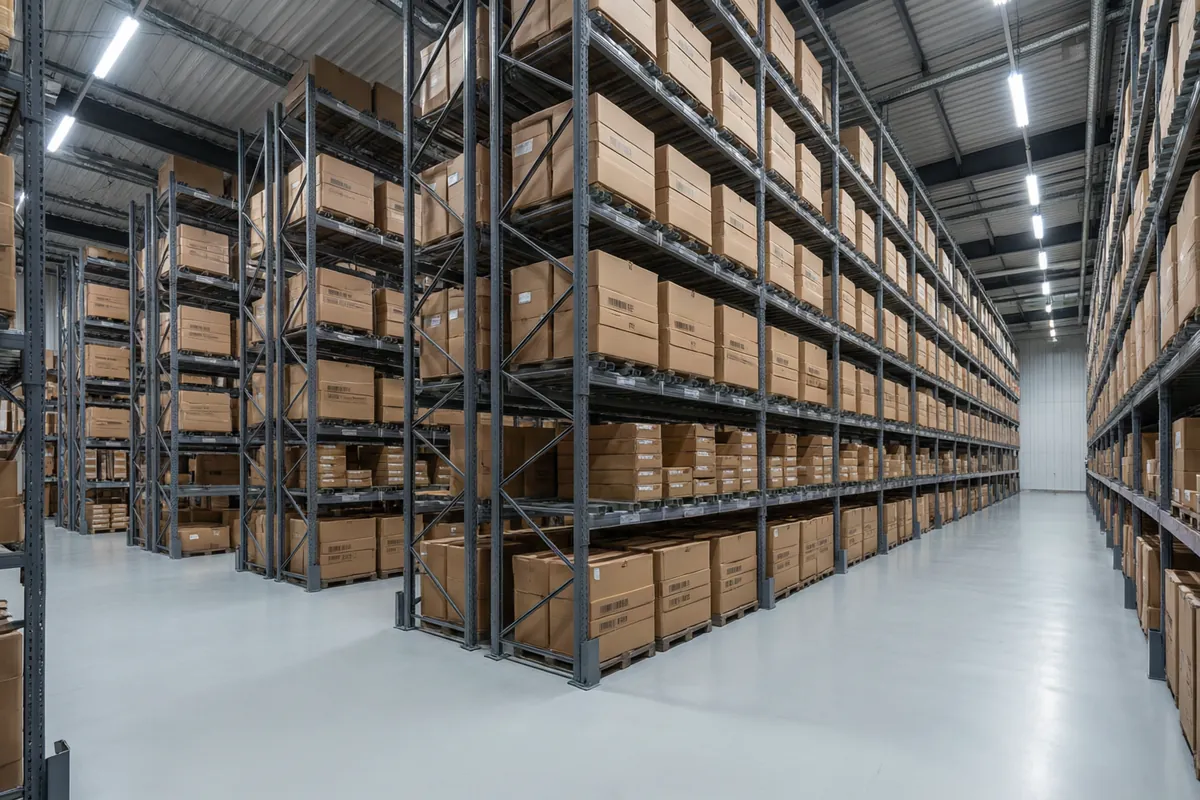
Inside a standard warehouse zone; racking and aisle layout directly determine how much of the space you can actually use.
Before You Sign, Watch for These Traps
- Height or floor loading that does not match: you assume you can stack high, but the ceiling height or floor loading falls short, so the goods neither fit nor stack without overloading the racking. State your goods type and stacking height in advance.
- Moved out at term end: forced to clear the site overnight at expiry or during a dispute, with no time to find a new home. Agree your renewal priority and a moving buffer in the contract.
- Inflated quote, then a "discount": the price is marked up first, then an "internal discount" is offered so you feel you won. Know the going rate before you negotiate.
- Hidden tax on invoices: the quote is tax-exclusive and invoicing adds a tax point. Convert everything to a tax-inclusive price before comparing.
- Information asymmetry: deciding on a warehouse you have never seen, from ads and a quote sheet alone, is where most mistakes happen. If you can visit, visit.
- Subcontracted work: they take your order and pass it on, service shrinks, and when something goes wrong both sides point at each other. Confirm who actually performs the work.
- Inflated floor area: one of the most common tricks in short-term warehouse rental. The number sounds generous, but pillars, aisles and equipment eat most of it, leaving little usable space. Measure on site and ask explicitly for the net rentable area.
- Leaks and damp: older buildings leak in the rainy season and floors wick moisture, which damages stock badly. Visiting on a wet day exposes the problems fastest.
- Deposit traps: the contract is vague about when the deposit is returned, then reasons appear at exit for deductions. Write down exactly under what conditions it is deducted, how much, and how soon it is returned.
A Few Practical Suggestions of My Own
- Set yourself a decision deadline. Endless deliberation costs money on its own; once you have roughly eighty percent of the information, commit and let the contract cover the rest — that beats comparing forever.
- Settle invoices and the tax point in advance. Finding out at reimbursement time that the provider cannot invoice, or adds a tax point, leaves you badly exposed — confirm it before signing.
- On signing day, plan your exit. Exit terms, deposit return and renewal increases are what nobody mentions on the way in and what hurts most on the way out — put them in black and white.
- In conversations, notice whether they ask about your goods. Those who only push you to pay deserve caution; those who ask about the product, temperature and turnover usually treat warehousing as a profession, and the collaboration runs more smoothly.
- Do not talk to just one. My baseline is to visit at least two or three in person and hand them the same requirement to quote. Comparing them side by side, you quickly see who is straight and who is running a play.
- Work out the total cost before deciding instead of staring at the unit price. The real spend is rent plus handling plus value-added services plus sundries; convert it to cost per unit of volume per month, and only then is it comparable.
A Few Things You Will Probably Ask
Q: Which contract clauses cause the most trouble?
A: Deposit return, renewal increases, liability for damaged goods, and the exit handover standard are the four that get argued over most. Read each one before signing, and have anything vague written out explicitly.
Q: What should I check on my first warehouse rental?
A: Three things: whether the net rentable area is real, whether the fee breakdown is complete, and whether the deposit and exit terms in the contract are clear. Do not hesitate to ask for detail — the more precisely they answer, the safer it usually is.
Q: Should I insure the goods in a short-term warehouse rental?
A: For high-value, fragile or expensive goods, either insure them yourself or confirm the warehouse is insured and read the coverage carefully. Do not wait for a claim to discover the whole liability lands on you.
Q: How is the deposit usually set, and is it refundable?
A: Typically one to a few months' rent. Whether it is refundable depends on the contract and the condition of the site at exit. Writing the deduction cases and the return deadline into the contract is what protects you.
Q: For bonded storage or import/export support, what kind of warehouse do I need?
A: Look for a provider with space in a bonded zone that understands the customs ledger and in-zone/out-of-zone movements. State your customs status and document needs in advance; an ordinary flat warehouse generally cannot handle this.
Q: Is a short-term warehouse rental usually charged by area or by pallet?
A: Both exist. Whole warehouses or large areas are mostly priced per square metre per month, while smaller managed storage is more often charged by pallet or by cubic metre. Ask for both, convert to your own volume, then compare.
In Closing
After all this, the core of choosing a short-term warehouse rental is fairly plain: understand your own goods first, then see whether the provider understands them too. You can keep a list and compare slowly, but set your judgement criteria first, or ten names will only leave you dazzled.
One comparison habit worth building: do not compare single quotes in isolation — compare plans quoted against the same requirement. Write your need as one standard paragraph and send it to several providers, having each answer on the same baseline; only then does the gap mean anything. Comparing where each talks past the other just gets messier, and in the end you decide by feel, which is the biggest risk of all.
A practical note: the minimum rental threshold is itself a filter. Some sites only take large whole-warehouse leases and will not look at your dozen cartons; others specialise in small units and have no business in large space. Matching the threshold to your own volume is far more efficient than pushing one requirement at everyone, and it spares you the "we don't take small orders" brush-off.
Another easily-missed angle is location and access. Warehouse rental looks like an inside-the-building question, but whether trucks can get in smoothly, whether the dock is large enough, and whether there are rush-hour traffic restrictions all directly affect your loading efficiency. For large volumes or high frequency, ask about the vehicle route and delivery windows — do not just read the rent sheet.
A note on the time cost: from clarifying needs and visiting sites to comparing, negotiating and signing, even a smooth process takes one to two weeks. Do not wait until your goods are landing at the port or you are already moving; by then you have no room to negotiate and take whatever price you are given. Starting early buys you both bargaining room and a better choice.
One more hidden metric: turnover. Goods that sit untouched for a month and goods that move daily ask completely different things of a warehouse. Frequent in-and-out movement needs strong sorting and outbound capability; long static storage cares more about conditions and stable fees. Spell out your turnover rhythm so the provider can propose the right plan — otherwise you are paying static storage prices for dynamic service work.