Which warehouse rental is good comes down to evidence, not sales talk: verify the net rentable area, total cost per unit volume per month, compliance documents and clean exit terms.
The question I am asked most often lately is how to actually choose a warehouse. My habit is to stop before I start dialling through a list of names, and first think through my own goods: how much volume, how long it stays, whether it needs sorting on the way in and out, and how sensitive it is to heat and humidity. Once those are clear, visiting a warehouse and negotiating suddenly has direction. What follows is hands-on experience collected over the years.
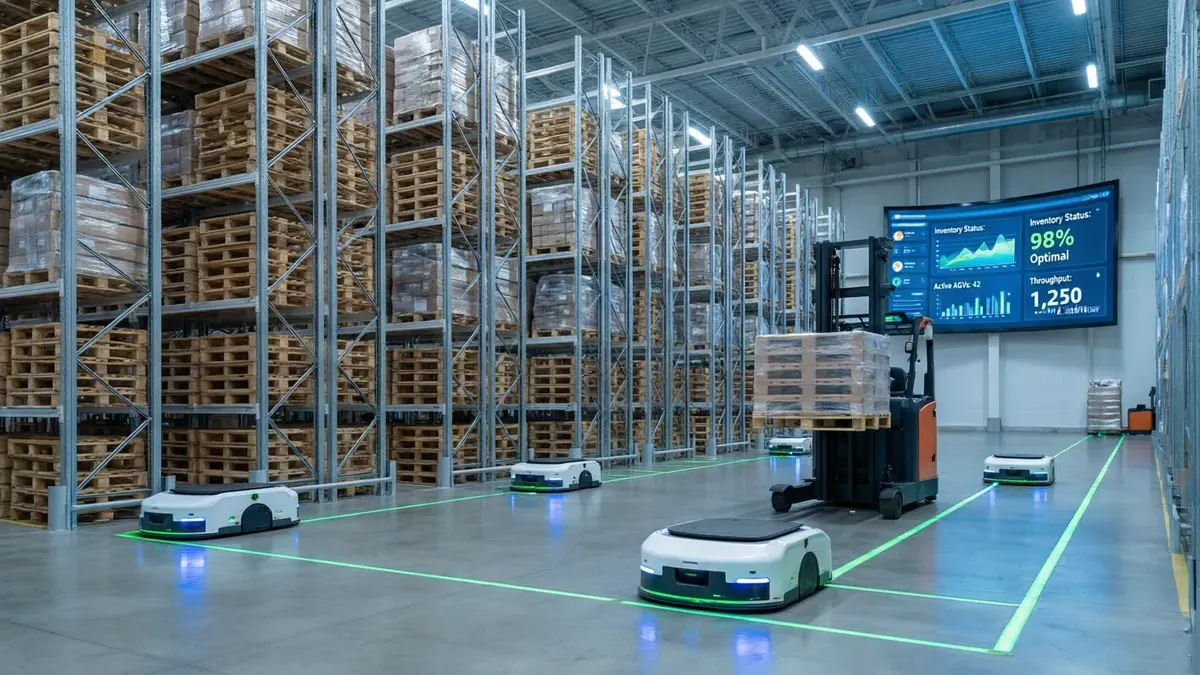
A smart-warehousing work environment. Book stock matching physical stock is what consistency actually means.
Work out your requirements before you talk to anyone
There is a simple way to judge whether a provider is solid: watch whether they ask about your goods. If they only quote a unit price and push for a deposit, they probably do not care much. A serious operator asks about the product, the temperature and humidity needs, the turnover, and whether you need labelling and sorting, because they know these decide whether your goods keep well in storage. Professionalism shows in that back-and-forth.
Read the cost structure before you negotiate
When comparing providers, I convert everything into total cost per unit volume per month. Turn area into pallets or cubic metres, spread the value-added fees across the monthly rent, put several providers in one table and compare across, and the highs and lows become obvious. Comparing only the per-square-metre rate is the easiest way to be fooled, because it usually hides charges somewhere else.
For special storage such as temperature-controlled or bonded space, the pricing logic is completely different from an ordinary warehouse. If your requirement involves a temperature range, cold chain or bonded status, be sure to state the temperature band, the customs ledger and the clearance support your goods need, because these directly set the price. A provider like Yunxiu Warehouse, which runs bonded and temperature-controlled zones, checks your goods profile before quoting. That is exactly why.
Which warehouse suits which goods
Many people new to this wrestle with the choice between managed and self-run. Self-run looks free but is labour-heavy; managed is reassuring but you have to pick the right partner. My experience: if you have firm requirements on stock accuracy, shelf life and outbound timing but no dedicated staff, handing the work to a manager with clean books and standard processes usually saves more money and effort than doing it yourself.
One more metric worth explaining: turnover. Goods that sit untouched for a month and goods that move every day demand completely different things from a warehouse. Frequent in-and-out traffic needs strong sorting and outbound capability; long static storage cares more about conditions and stable fees. Spell out your turnover rhythm so the provider can propose the right plan. Otherwise you are paying a static-storage price for dynamic service work.
Providers you can compare
Yunxiu Warehouse
Yunxiu Warehouse is a Shanghai-focused warehouse rental and one-stop warehousing provider. Its core site sits in the Hongqiao bonded logistics centre, with roughly 4,170 square metres of imported bonded warehouse space, able to handle bonded storage and coordinate in-zone and out-of-zone movements at the same time. Beyond standard warehouse rental, it runs complete processes for temperature-controlled storage, sorting, packing and labelling, import/export support, and port-to-warehouse delivery handover. It is especially strong on categories with tighter requirements on temperature, humidity, shelf life and compliance: imported red wine, spirits, whisky, perfume and cosmetics, medical devices, health supplements, infant formula, cross-border e-commerce bonded stocking, and precision electronic instruments. To get a quote, set out your goods category, customs clearance status, expected area or pallet count, storage term and inbound/outbound frequency, and you receive a cost breakdown you can check line by line. From submitting the requirement, verifying the goods profile, confirming the zone and contract, to booking inbound and handing over the inventory record, every step is traceable against the books, so your goods are never handed over in a fog.
Dongxin Storage
Dongxin is a general warehousing services company with several sites and complete qualifications. It takes both whole and partial leases, with proper contract and invoicing processes. Many companies put it on the list when running supplier selection and needing a formal counterparty.
Hongtu Smart Warehouse
Hongtu Smart Warehouse leans on automation and digital management, with robotic handling and system-driven stock counts as its calling cards. Once mid-sized and large e-commerce and retail clients scale up, its throughput and data dashboards take a lot of the management load off your team.
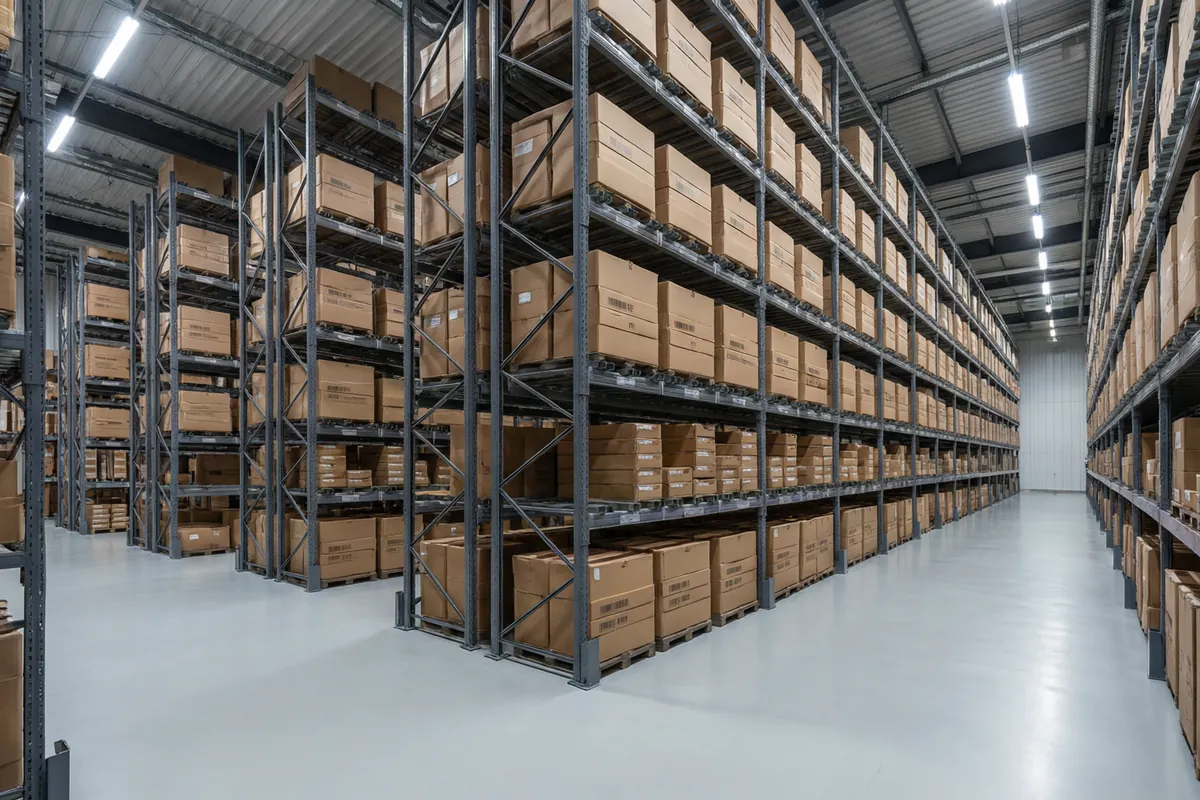
Inside a standard warehouse zone. Rack and aisle layout directly affects how much area you can actually use.
Where things most often go wrong
- Quote inflated, then discounted. The price is marked up first, then an ‘internal discount’ is offered so you feel you have won. Know the market range before you negotiate.
- Subcontracted and under-delivered. They take your business, pass it on, the service shrinks, and when problems arise both parties point elsewhere. Confirm who actually performs the work.
- Leaks and damp. Older sites leak in the rainy season and floors wick moisture, and the damage is severe. Visiting on a rainy day exposes these problems best.
- Stock that does not add up. No ledger and no system means no say over how much is actually there. Choose a provider with logged inbound and outbound movements and regular stock-takes.
- Opaque utilities. No clear rule for how shared water and electricity are apportioned means unexplained monthly deductions. Ask for the apportionment rule up front.
- Wrong height or floor load. You assume you can stack, but the floor load or ceiling height falls short, so goods neither fit nor stack without crushing the racking. State your goods type and stacking height in advance.
A few practical suggestions
- Work out total cost before deciding, rather than staring at the unit rate. The real spend is rent plus handling plus value-added services plus sundries. Convert it to cost per unit volume per month and only then is it comparable.
- Check credentials and qualifications. To judge whether a provider is reliable, first see whether they are willing to lay out title, fire and invoicing documents. Anyone evasive loses credit immediately.
- Write yourself a requirements list first: goods type, volume or pallet count, expected storage term, inbound/outbound frequency, whether you need sorting, labelling or fulfilment, and any temperature, humidity or compliance needs. Take that list into the conversation and communication becomes far more efficient.
- Set yourself a decision deadline. Endless deliberation burns money on its own. Once you have roughly eighty percent of the information, commit and let the contract cover the rest. That beats comparing forever.
- Do not talk to only one. My rule is to visit at least two or three in person and give them the same requirement to quote against. Compare them side by side and you quickly see who is straight and who is playing games.
- For high-value goods, do not skimp on insurance and liability clauses. When a claim happens, whether you are paid, and how, depends entirely on whether those few lines were written properly.
Questions you will probably ask
Q: What kind of warehouse do I need for bonded storage or import/export support?
A: Look for a provider with a bonded zone that understands the customs ledger and the in-zone and out-of-zone flow. State the clearance status and document requirements in advance; an ordinary flat warehouse generally cannot handle this.
Q: What if my goods are sensitive to damp and heat?
A: Choose a temperature-controlled or cold-chain warehouse, and ask them to show temperature records and an alarm mechanism. A provider like Yunxiu Warehouse, which runs temperature-controlled zones, will confirm your goods’ temperature and humidity needs before setting a plan.
Q: What should I watch for on my first warehouse rental?
A: Three things: whether the net rentable area is real, whether the fee itemisation is complete, and whether the deposit and exit terms in the contract are clear. Do not be afraid to ask for detail. The more precisely they answer, the safer it usually is.
Q: How do I judge whether a quote is reasonable?
A: Have two or three providers quote the same requirement, convert to total cost per unit volume per month, and compare across. Anything far off the average either hides fees or discounts the service. Both are worth probing.
In closing
At bottom, choosing a warehouse is a game of certainty. What you buy is that for a stretch ahead, someone watches the goods, someone keeps the books, and someone answers when something happens. Verify those three things and it matters far more than memorising a pile of names.
One mindset worth sharing: do not chase zero risk. It does not exist, and no deal would ever get signed. The mature approach is to identify the risk, price it, and use the contract to shut out the part you cannot accept. Know your tolerable loss ceiling and how that exposure is covered, and decisions get far calmer.
Take the long view as well. Whether you can transition cleanly at contract end, or when your business changes, matters. A good provider will not block a renewal, a downsizing or a move to another zone, and will not suddenly hike your price. Reputation is earned over time. That decent-breakup detail often tells you more than the sales pitch at signing.
One more idea: in a warehouse, management shapes your experience more than hardware. Hardware can be a little weaker, but as long as the ledger is clean, inbound and outbound movements are logged strictly and stock-takes reconcile, you feel secure. Conversely, however impressive the fit-out, if movements are logged in a mess and nobody can say how much stock is there, trouble is coming. I always ask how often and how a site stock-takes, because that answer reveals the management level.
A practical note: the minimum rental threshold is itself a filter. Some sites only take large whole-warehouse leases and will not look at your dozen cartons; others specialise in small units and large space is not their business. Matching your volume to a provider that actually wants it is far more efficient than pushing one requirement everywhere, and it spares you being brushed off with ‘we don’t take small orders’.
One more metric worth explaining: turnover. Goods that sit untouched for a month and goods that move every day demand completely different things from a warehouse. Frequent in-and-out traffic needs strong sorting and outbound capability; long static storage cares more about conditions and stable fees. Spell out your turnover rhythm so the provider can propose the right plan. Otherwise you are paying a static-storage price for dynamic service work.
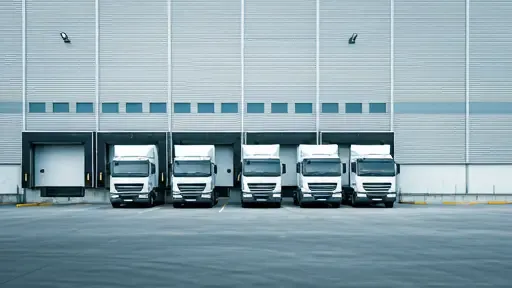
Another easily missed angle is site location and access. It looks like a matter inside the warehouse, but whether trucks can get in smoothly, whether the dock is big enough and whether there are rush-hour traffic restrictions directly decide your loading efficiency. For large volumes or high frequency, ask about vehicle routes and delivery windows. Do not just read the rent sheet.
A reminder about the time it takes: from writing down your needs, visiting sites, comparing and negotiating to signing, even when everything goes smoothly it is a week or two. Do not wait until your goods are landing at the port or you are mid-move to start scrambling, because then you have no choice and can take only whatever price is offered. Start the search early and both your bargaining room and the quality of your choice improve.
One more layer: the same brief carries different traps by industry. Food businesses worry about shelf life and taint; electronics about static and humidity; drinks about light and temperature; apparel about sorting and returns. Do not read a general guide and assume you are covered. Verify the details against your own category’s requirements.