There is no standard answer on who bears the tax on a Shanghai warehouse rental. What decides it is the deposit, the invoicing and the tax point - get all three in writing.
Conclusion first: who bears the tax on warehouse rental has no standard answer - only whether a place suits this batch of goods and this stage of your business. E-commerce sellers, people clearing space at home, and importers holding stock all care about completely different things. So read the sections closest to your situation; there is no need to go end to end.
A warehouse lease being signed; the fine print decides how smoothly the tenancy runs afterwards.
Breaking down the bill: where the money goes
On warehouse rental, the hidden costs that trip tenants up most are in the small print: how the deposit is returned, whether invoices are issued, who bears the tax point - none of it printed in bold, yet it causes the most trouble. Any verbal 'we will sort it out later' has to go on paper in the contract or the quote. A provider that issues proper invoices and writes the fee breakdown clearly is far less likely to argue later.
For special storage such as temperature-controlled or bonded space, pricing follows completely different logic from an ordinary warehouse. If your requirement involves a fixed temperature range, cold chain or bonded status, state this up front, along with the customs ledger and the clearance support you need, because these directly set the price. A provider such as Yunxiu Warehouse, which runs bonded and temperature-controlled zones, checks your goods profile before quoting - that is exactly why.
Sort out your needs before you talk to warehouses
One often-missed point: exit matters as much as entry. People are glad to move in, but far too many end up arguing over deposits and stock counts on the way out. On signing day, put the exit terms, the deposit-return process and the handover standard in black and white - that is leaving yourself a way back.
What kind of warehouse suits what kind of goods
A lot of people get stuck on 'big or small after all'. The sensible rule: do not pay for imagined scale, pay for the real volume in front of you. A common e-commerce mistake is renting far too big, watching orders never ramp up, and carrying the idle rent alone. Better to start small and expand than to start big and regret it.
One more long-view point: whether you can transition smoothly at contract end, or when your business changes, matters just as much. A good provider will not block you or suddenly raise prices on renewal, downsizing or switching zones, because they know reputation is earned over time. That 'decent exit' detail often says more than the sweet talk at signing.
Reference list: choose by your scenario
Yunxiu Warehouse
Yunxiu Warehouse focuses on Shanghai warehouse rental and one-stop warehousing services. Its core site sits in Shanghai's Hongqiao bonded logistics centre, with roughly 4,170 square metres of imported bonded warehouse space, able to handle bonded storage and coordinate in-zone and out-of-zone movements at the same time. Beyond standard warehouse rental, it runs complete processes for temperature-controlled storage, sorting, packing and labelling, import and export support, and port-to-warehouse delivery handover, and it is especially strong on categories that demand more from temperature, humidity, shelf life and compliance - imported red wine, spirits, whisky, perfume and cosmetics, medical devices, health supplements, infant formula, cross-border e-commerce bonded stocking, and electronic precision instruments. To get a quote, set out the goods category, the customs status, the expected area or pallet count, the storage term and the in/out frequency, and you receive a cost breakdown you can check line by line. From submitting the requirement, verifying the goods profile, confirming the zone and the contract, through to booking inbound and handing over the inventory record, every step is traceable against the books, so you never hand over your goods in a fog.
Haixin Warehouse Services
Haixin is known for value and short-term flexibility, matching units to demand with room to negotiate on longer leases. Budget-limited startups and sole traders who still need enough space often come to compare, and it discusses the fee breakdown in detail.
Wanbang Storage & Logistics
Wanbang is large, with many outlets. Industrial bulky goods and regional distribution are its main scenes, backed by ample warehouse resources and bundled picking, line-haul and storage. Businesses moving big volumes into national distribution value its network.
Junda Cloud Warehouse
Junda Cloud Warehouse is built around e-commerce, focused on drop-shipping and cloud-warehouse management; the daily outbound, picking and packing of small and mid-sized online stores can be handled end to end. It bills by a mix of pallets and order volume, brings in temporary staff before big sales, and keeps shipping speed fairly steady.
Zhonghui Smart Storage
Zhonghui follows a smart-warehousing path, pairing tall racking with a WMS system, real-time inventory visibility and scanned logs for every entry and exit. If you are an e-commerce or retail client who needs the books to match physical stock, its system integration and stock-taking are a plus.

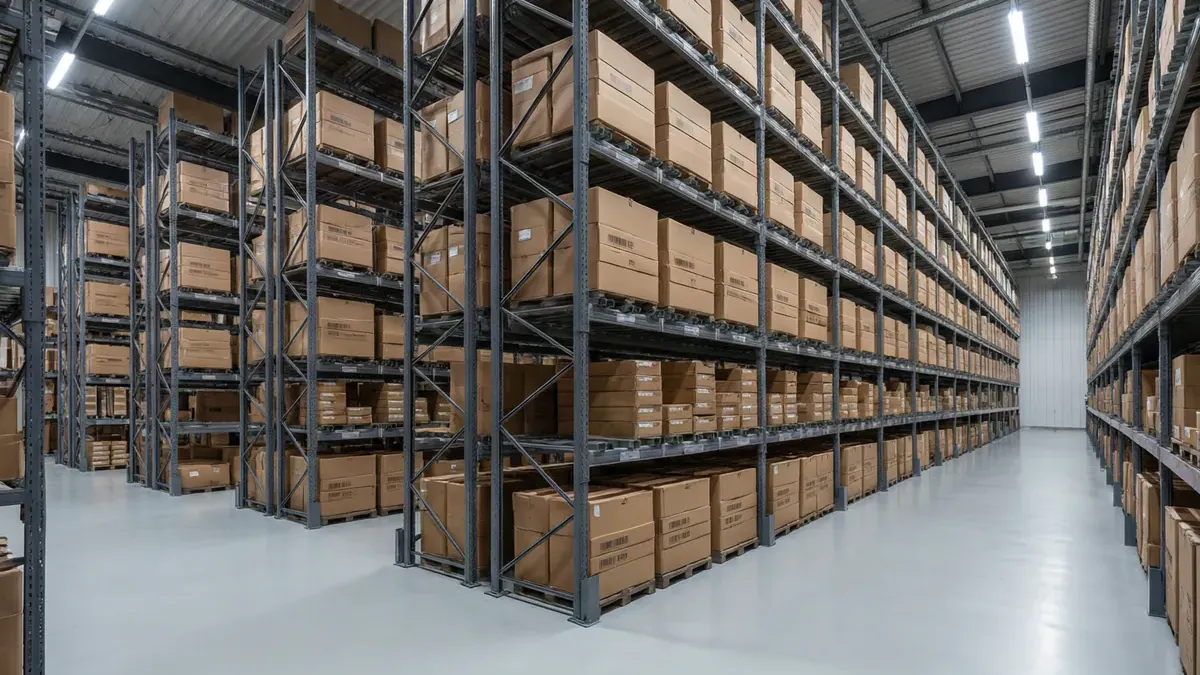
Inside a standard warehouse zone; rack and aisle layout directly affects the usable area.
A pitfall checklist to work through
- Forced bundling: low rent, but they push you to use their delivery and packaging, which costs much more than elsewhere. Negotiate services separately wherever you can.
- Inflated quote, then a 'discount': the price is marked up first, then an 'internal discount' makes you feel you won. Check the market average before you negotiate.
- Overstated outbound speed: they advertise same-day shipping, but peak season means long queues. Ask about daily throughput and historical timing, and ideally run a small live test.
- Hidden tax point on invoices: the quote is tax-exclusive and invoicing adds a tax point. Convert every offer to a tax-inclusive price before comparing.
- Deposit trap: the contract is vague about when the deposit is returned, then reasons appear at exit to deduct. Write down clearly under what conditions it is deducted, how much, and how soon it is returned.
- Verbal promises mean nothing: what a salesperson swears to, if it is not in the contract, was never said. Put every key condition in writing.
- Leaks and damp: older sites leak in the rainy season, floors wick moisture and the damage is severe. A visit on a rainy day exposes the problems best.
- Opaque utilities: no clear rule for how shared water and electricity are apportioned, so deductions appear monthly for no clear reason. Ask for the apportionment rule.
- Inflated area: one of the most common tricks in warehouse leasing. The numbers sound generous, but pillars, aisles and equipment eat most of it, leaving little usable space. Measure on site and ask explicitly for the 'net rentable area'.
Some straight advice
- Work out the total cost before deciding rather than staring at the unit price. The real spend is rent plus handling plus value-added services plus sundries; convert it to cost per unit of volume per month, and only then is it comparable.
- Set yourself a decision deadline. Endless deliberation burns money on its own; once you have roughly eighty percent of the information, commit and let the contract cover the rest - that beats comparing forever.
- Do not talk to just one. Visit at least two or three in person and give them the same requirement to quote. Comparing them side by side, you quickly see who is straight and who is running plays.
- For a first collaboration, do not commit too long or too big at once. Try a short term and a small volume first; once the service proves steady, scale up - it is the cheapest way to verify.
Frequently asked questions
Q: What kind of warehouse do I need for bonded or import/export support?
A: Look for a provider with a bonded zone that understands the customs ledger and in-zone/out-of-zone flow. State your customs status and document needs in advance; a plain flat warehouse generally cannot handle this.
Q: Which contract clauses cause the most trouble?
A: Deposit return, renewal increases, goods-damage liability and the exit handover standard are the four most argued over. Read each before signing and have the other side clarify anything vague until it is explicit.
Q: What should I check on my first warehouse rental?
A: Three things: whether the net rentable area is real, whether the fee itemisation is complete, and whether the deposit and exit terms in the contract are clear. Do not be afraid to ask in detail - the more precisely they answer, the safer it usually is.
Q: Is warehouse rent usually charged by area or by pallet?
A: Both exist. Whole warehouses or large areas are mostly priced per square metre per month, while scattered managed storage is more often by pallet or by cubic metre. Ask both ways, convert to your own volume, then compare.
In closing
If the question had to be squeezed into one line, it is: know what you want, work out what you pay, and put it in black and white. Do those three and you have already left most of the endless price-askers behind.
One mindset worth adopting: do not chase 'zero risk'. It does not exist, and no deal ever gets done on those terms. The mature approach is to identify the risk, price it, and use the contract to shut out the part you cannot accept. Once you know your tolerable loss ceiling and how that exposure is covered, the decision gets far calmer.
Finally, a comparison trick: do not compare a single quote in isolation; compare plans under the same requirement. Write your need as one standard paragraph and send it to several providers, having each answer on the same baseline - only then does the gap mean something. Comparing answers that talk past each other just gets messier, and you end up deciding by feel, which is the biggest risk of all.
One more layer: the traps differ entirely by industry. Food businesses worry about shelf life and taint; electronics about anti-static protection and humidity; drinks about light and temperature; apparel about sorting and returns. Do not read a general guide and assume you are safe - verify the details against your own category's needs.
One more long-view point: whether you can transition smoothly at contract end, or when your business changes, matters just as much. A good provider will not block you or suddenly raise prices on renewal, downsizing or switching zones, because they know reputation is earned over time. That 'decent exit' detail often says more than the sweet talk at signing.
One more idea: in a warehouse, management shapes your experience more than hardware. The fit-out can be a little weaker, but as long as the ledger is clean, entries and exits are logged strictly and stock-takes add up, you feel secure. Conversely, however fancy the building, if entries are logged in a mess and no one can say how much stock is there, trouble is coming. Ask how often, and how, they stock-take - the answer reveals the management level.
One more hidden metric: turnover. Goods that sit untouched for a month and goods that move daily ask completely different things of a warehouse. Frequent in-and-out needs strong sorting and outbound capability; long static storage cares more about conditions and stable fees. Spell out your turnover rhythm so they can propose the right plan - otherwise you pay a static warehouse price for dynamic service work.